

Gloucester Cathedral began life as the Benedictine Abbey of St Peter, founded in 1089 and re-designated a cathedral when the Diocese of Gloucester was created in 1541. The building contains the tomb of King Edward II, buried here in 1327, whose cult of pilgrimage financed much of the 14th‑century expansion. Find out more at GloucesterCathedral.org.uk

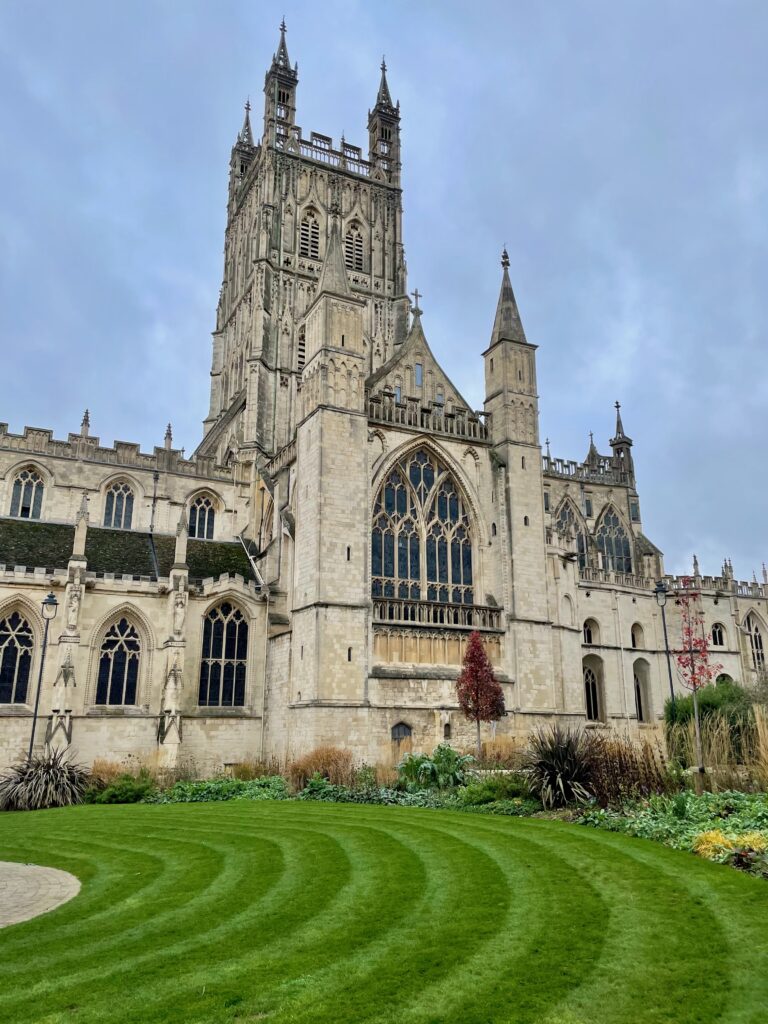
I visited in the winter and it was pretty chilly in the cathedral! Well worth the visit.

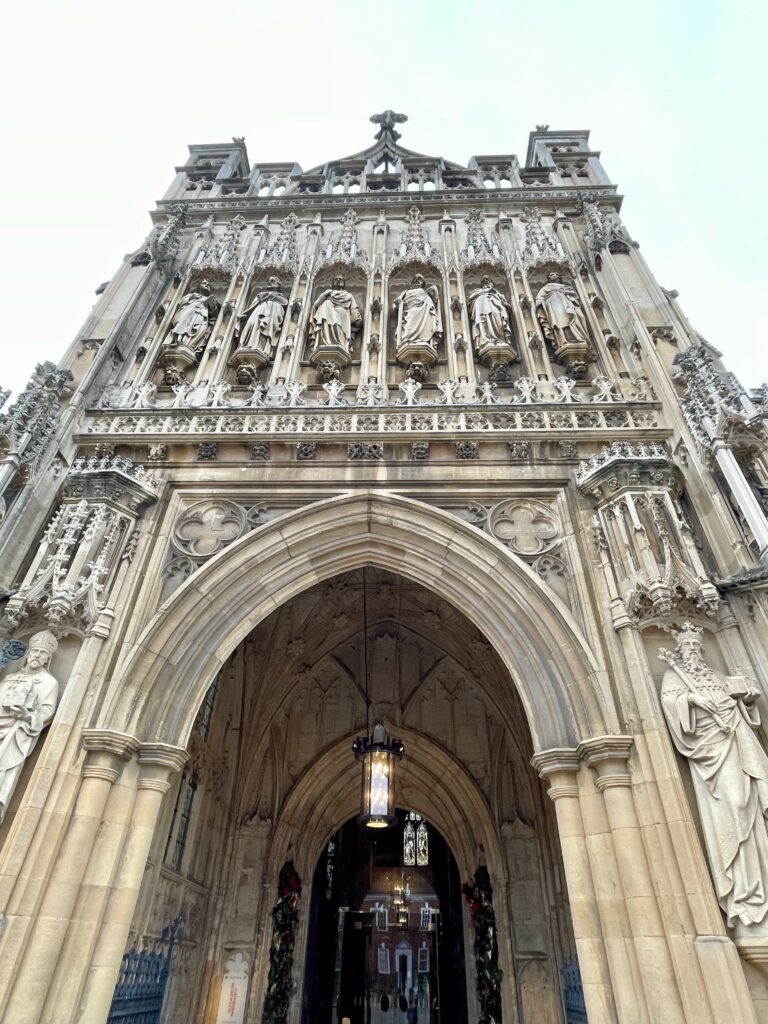
The cathedral’s ceremonial entrance on the south flank of the nave, begun soon after the abbey became the burial place of King Edward II (1327–30). It is one of England’s earliest fully developed Perpendicular Gothic façades. In the tall niches sit fifteen larger‑than‑life kings of England, from William I to Henry VI. The original 14th‑century figures weathered away; the present limestone replacements were installed in 1877, faithfully copying what medieval fragments survived.
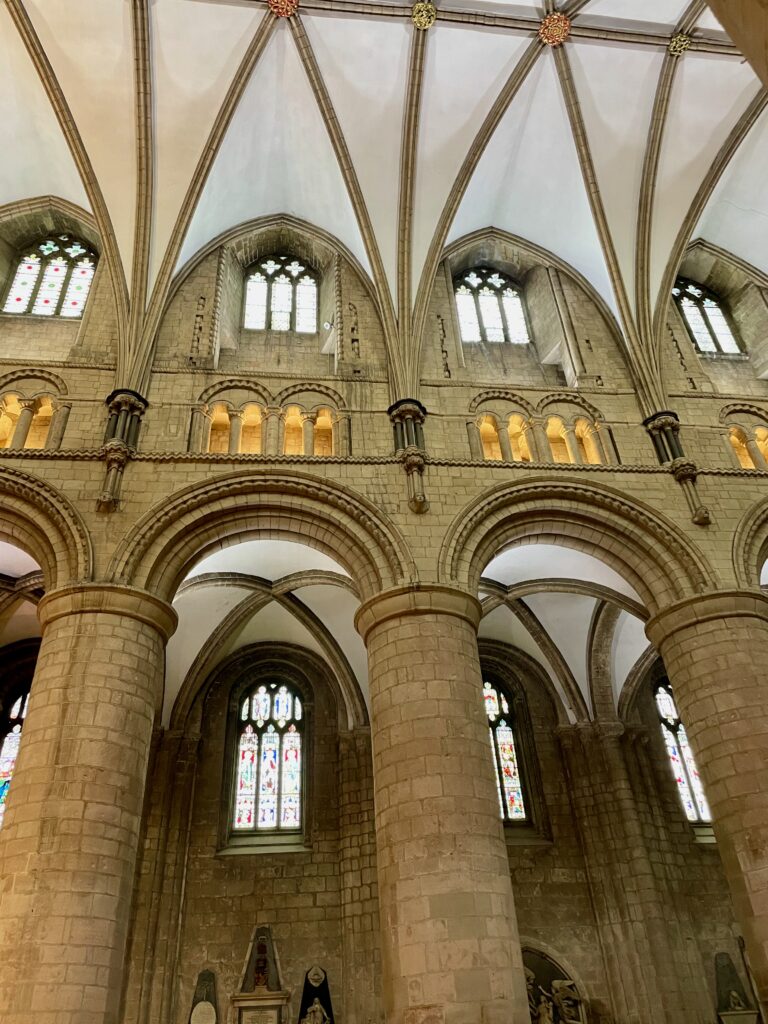
The Norman nave of Gloucester Cathedral, begun soon after the abbey’s foundation in 1089 and structurally complete by about 1130. Its great cylindrical piers, faced in pale Cotswold limestone, carry broad round‑headed arcade arches edged with classic 12th‑century zig‑zag moulding, hallmarks of the Romanesque style. Originally the nave had a timber roof that was destroyed in a fire in 1222. The present stone rib vault gave the Norman walls a new Gothic ceiling without altering the plan below.
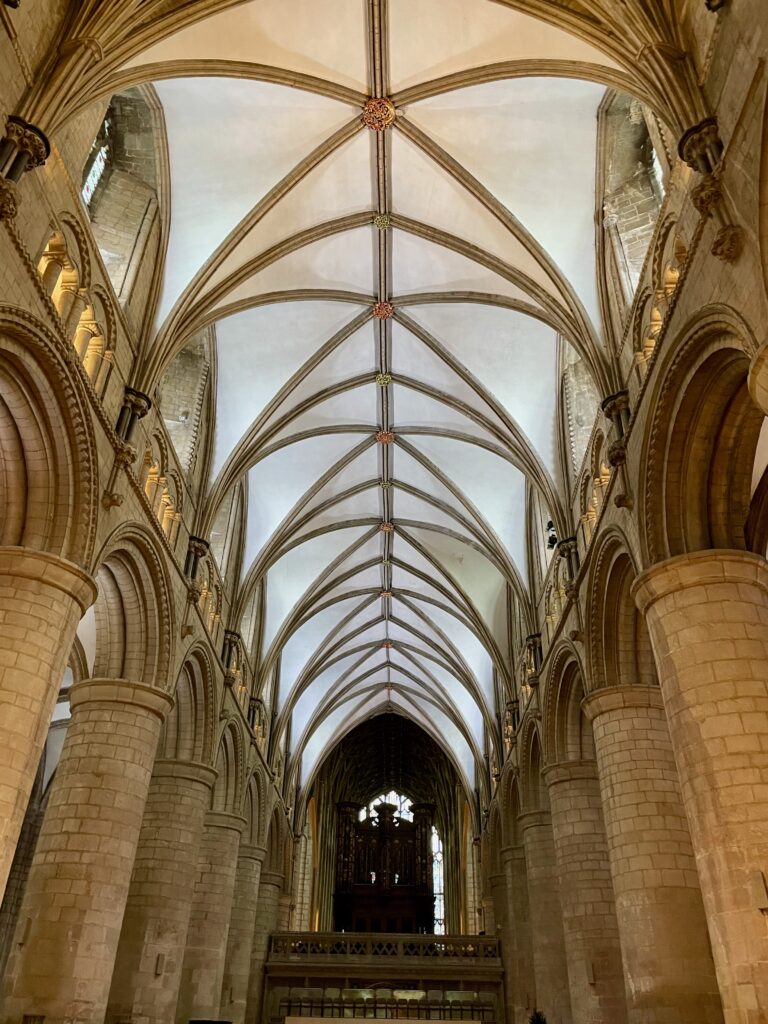
Norman columns from the nave. Norman arches are round. Gothic arches are pointed.
The quire, facing the 14th‑century pulpitum (rood‑screen) that marks the boundary with the nave. Sitting on top is the celebrated Harris organ case (1666), among the oldest working organ façades in any English cathedral. The pipes have been renewed many times; the wooden case is original.
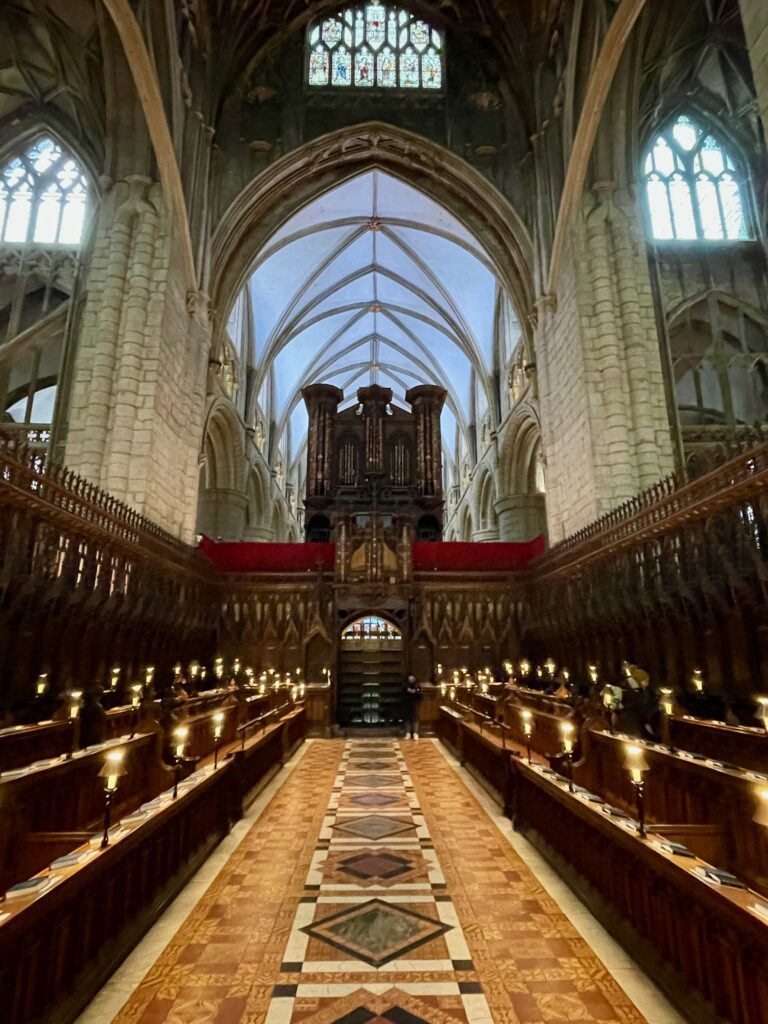
The ceiling above the Quire.
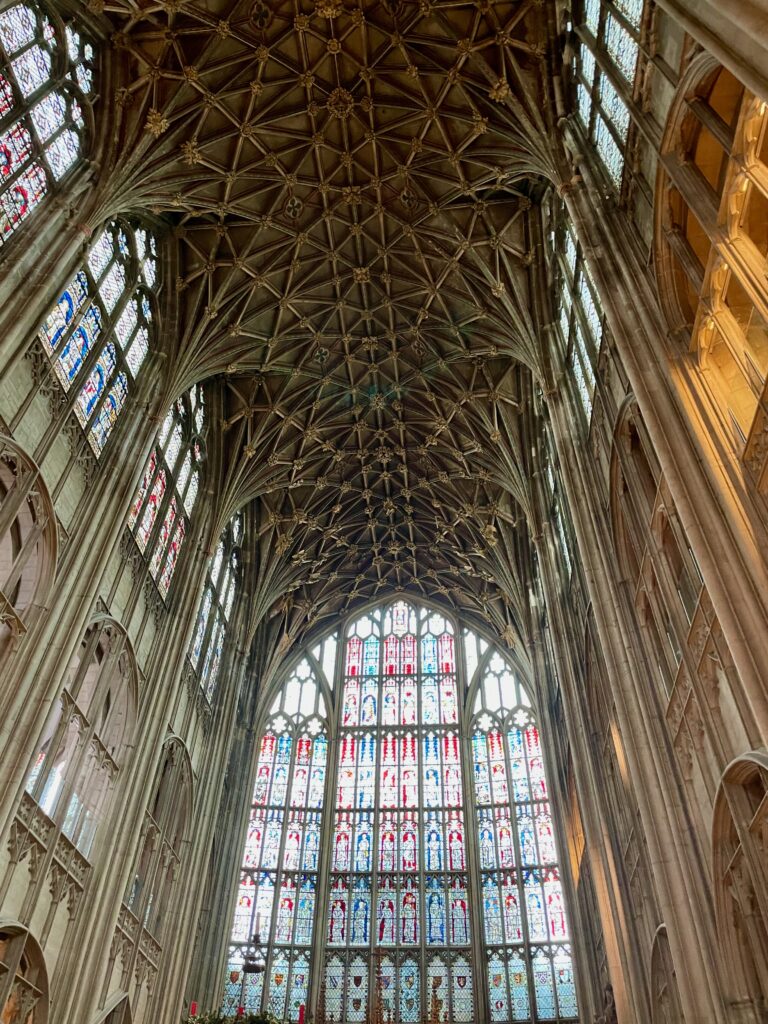
I love the lines of a Gothic vaulted ceiling! This looks towards the ceiling above the Quire.
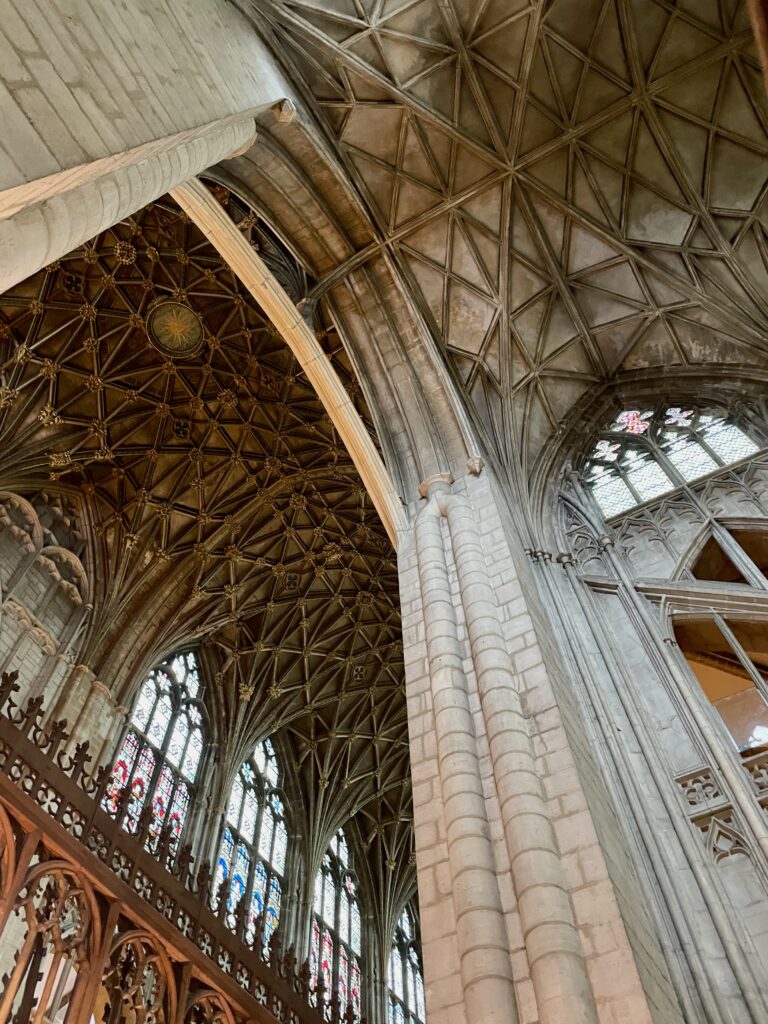
The 15th‑century Lady Chapel was the last major addition to the medieval abbey complex, constructed between about 1457 and 1483, during the high tide of the Perpendicular Gothic style.

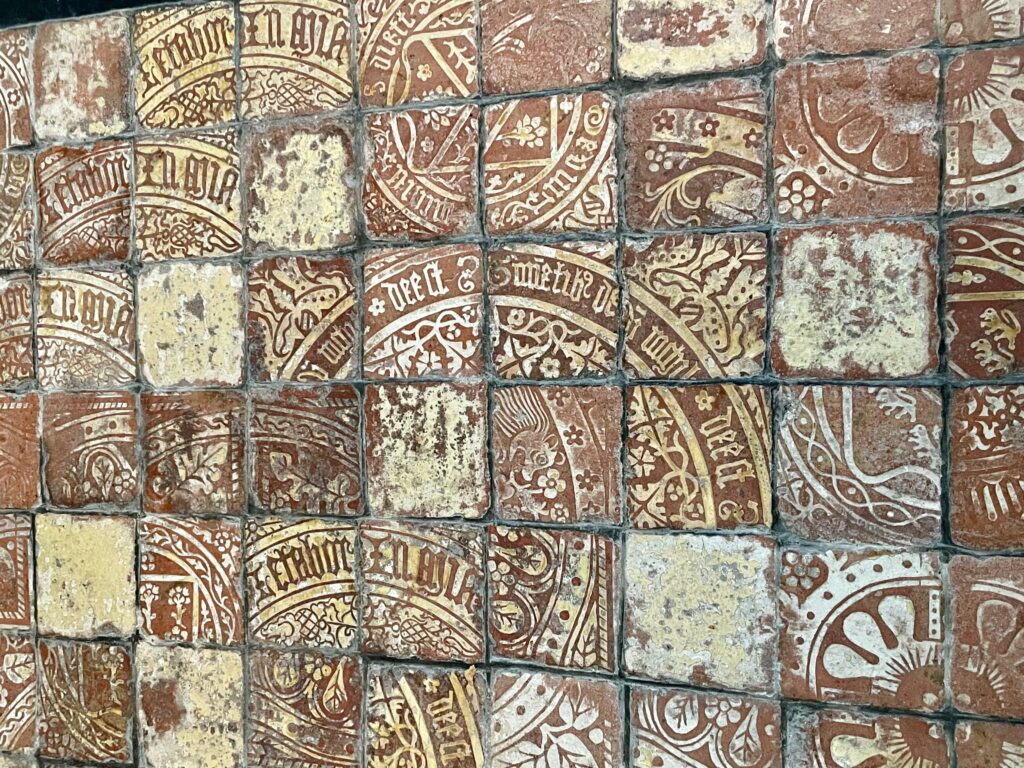
Gloucester owns one of England’s largest in‑situ collections of medieval floor tiles. Their mottos, heraldry and plant scrolls give a rare window onto the visual world that medieval worshippers literally walked over. The quarter‑circle fragments once formed large roundels that read Te Deum laudamus (“We praise thee, O God”), the opening of an ancient Latin hymn. They were lifted, catalogued and re‑laid during Project Pilgrim (2017‑18).
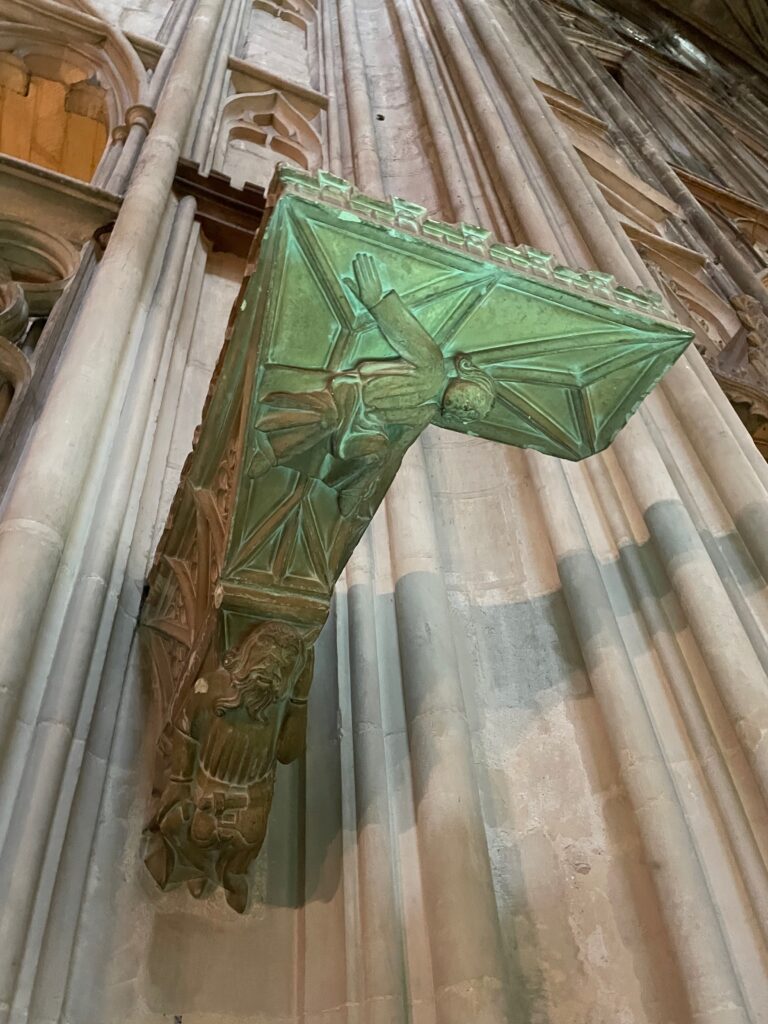
This is the 14th century Prentice’s (or Mason’s) Bracket, set high on the east wall of the south transept. Its plan copies a mason’s set‑square, and it might be a memorial to an apprentice who really fell to his death during construction, or it might be a religious allegory.
The shrine of Edward II is at the cathedral but it was blocked off when we visited. The picture below is Wikimedia Commons Credited to Jule955, CC BY-SA 3.0.

While I am not usually a fan of stained glass, I appreciate the aspects of modern art in the cathedral setting.
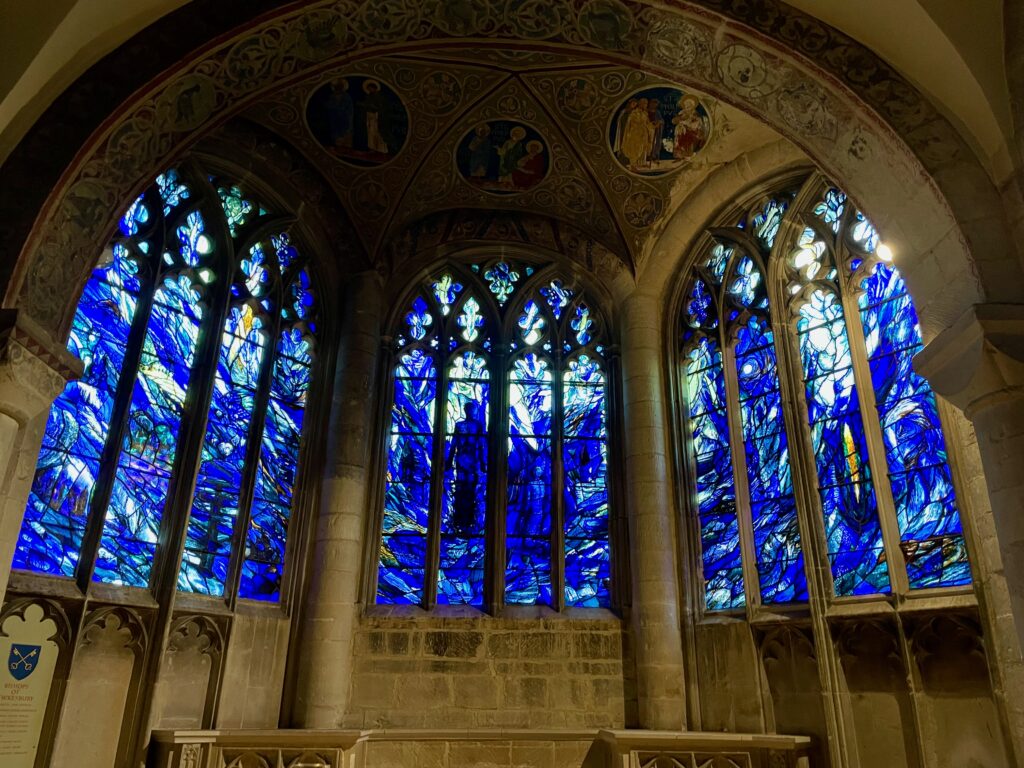
The blue glass window below occupies the tiny 14th‑century Chapel of St Thomas off the south ambulatory. In 1992 the medieval stone tracery was refilled with a three‑window triptych by contemporary artist Thomas Denny, commissioned for the 900th anniversary of the abbey’s foundation. It shows Doubting Thomas meeting the risen Christ, and elements from Psalm 148, where all the creatures of the earth praise the Lord.
The modern Ivor Gurney Window (installed 2013), honouring the Gloucester‑born poet–composer. It’s one of the two contemporary memorial windows that stained‑glass artist Thomas Denny set into the north chantry of the Lady Chapel in 2013–16. The window sits in a 15th‑century Perpendicular Gothic opening.
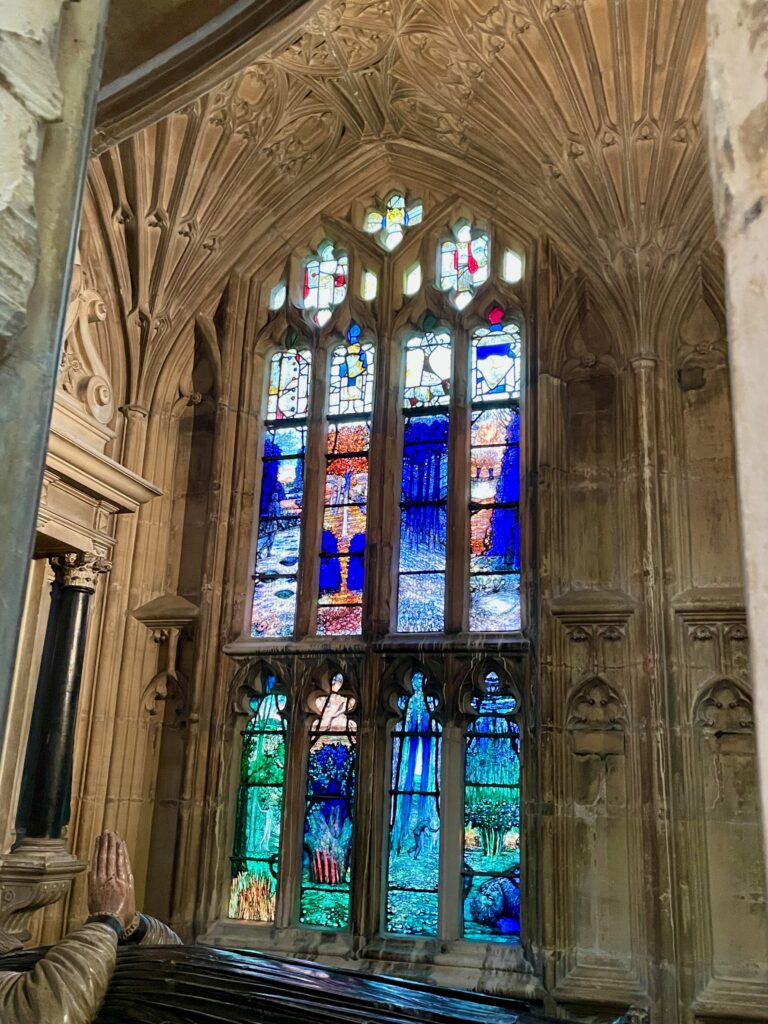
Beneath the window (just visible at lower left) lies the alabaster effigy of Bishop Godfrey Goldsborough (1604), a reminder that this small chapel layers 15th‑century masonry, a 17th‑century tomb and 21st‑century glass in the space of a few square metres. Very cool!
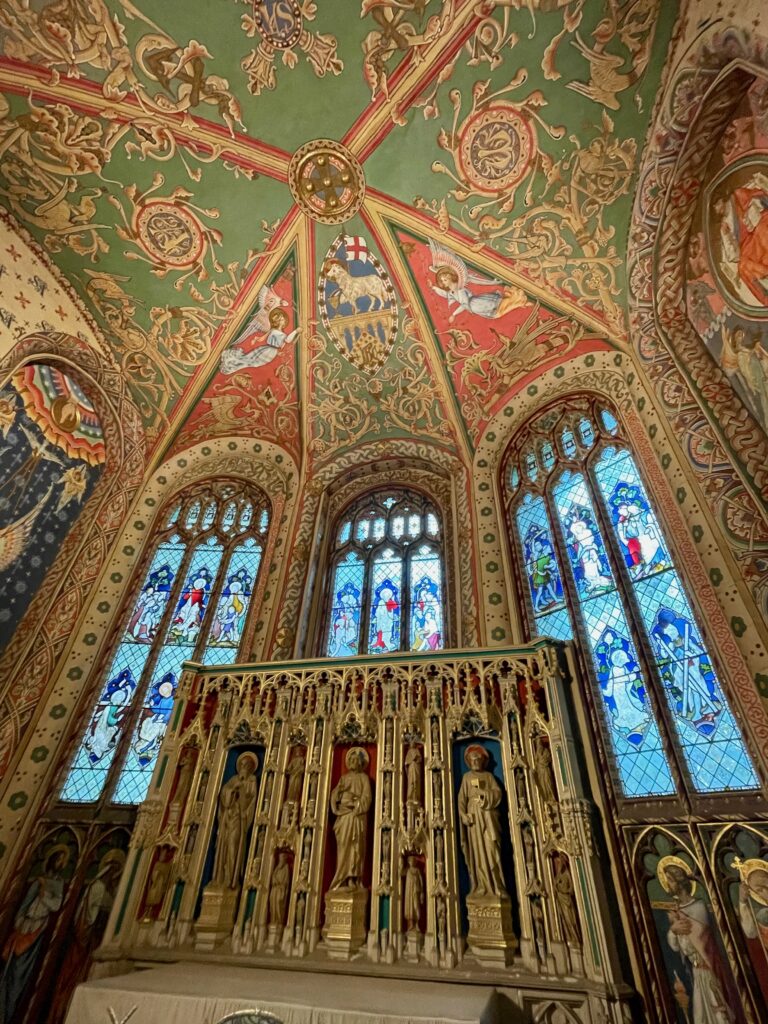
There’s more colour in St Andrew’s Chapel, tucked against the east wall of the south transept. It was completely refitted in the Victorian period and is now one of the most colourful spaces in the building. Every inch of the vault and wall‑panelling was covered in 1866‑67 by the Gloucestershire artist‑inventor Thomas Gambier Parry, using his resin‑based “spirit‑fresco” technique.
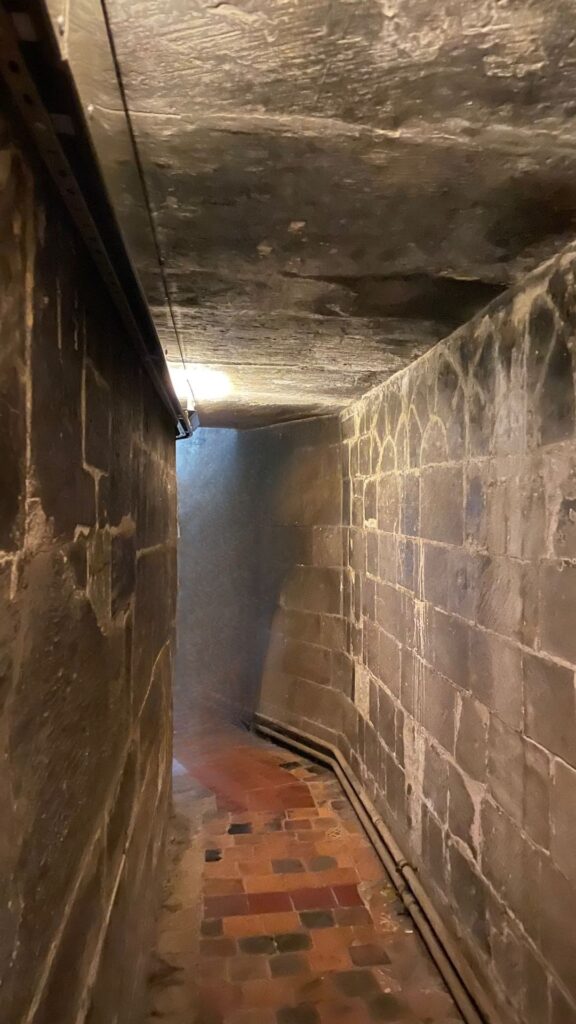
The Whispering Gallery is a narrow passage that lets two people around 25 metres apart converse in hushed tones thanks to quirky acoustics.

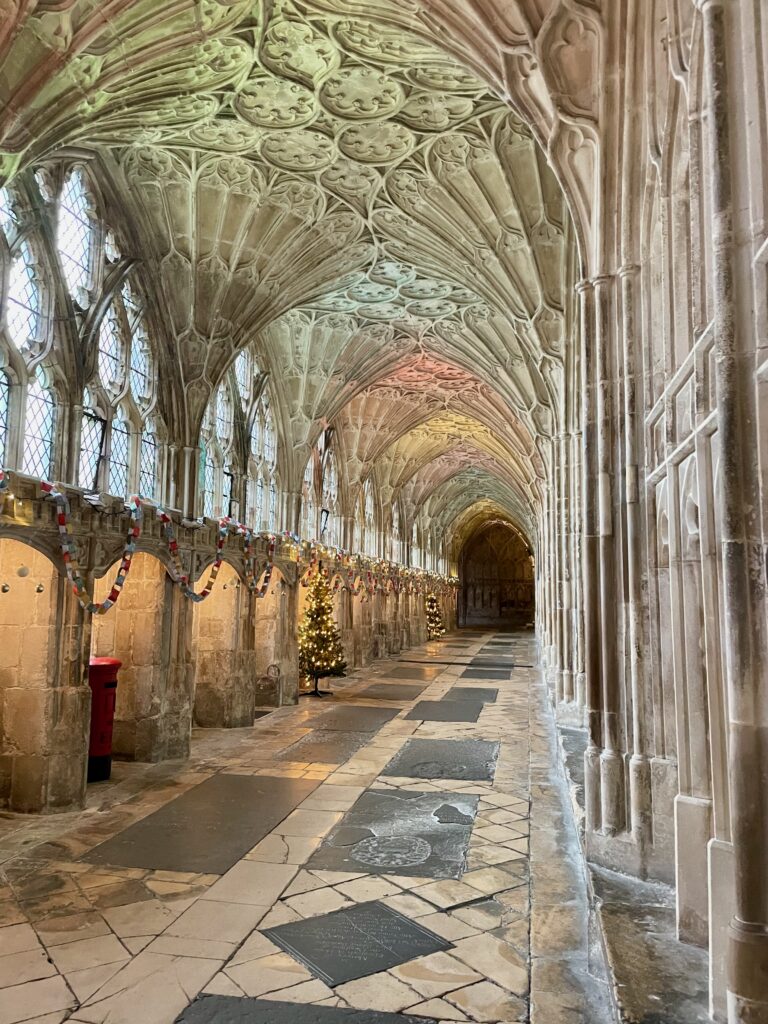
The cloisters, built 1351‑1412, feature the world’s earliest surviving fan‑vaulted ceilings.

We visited in December so it was quite festive. The cloisters have featured in Harry Potter as well as other films.
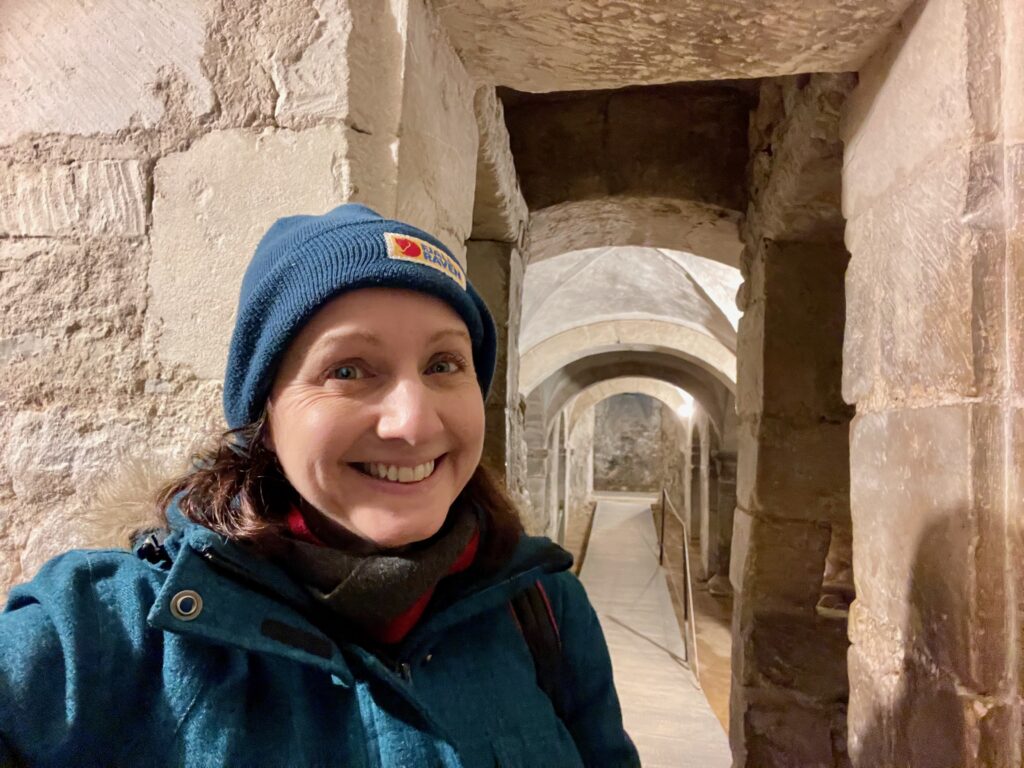
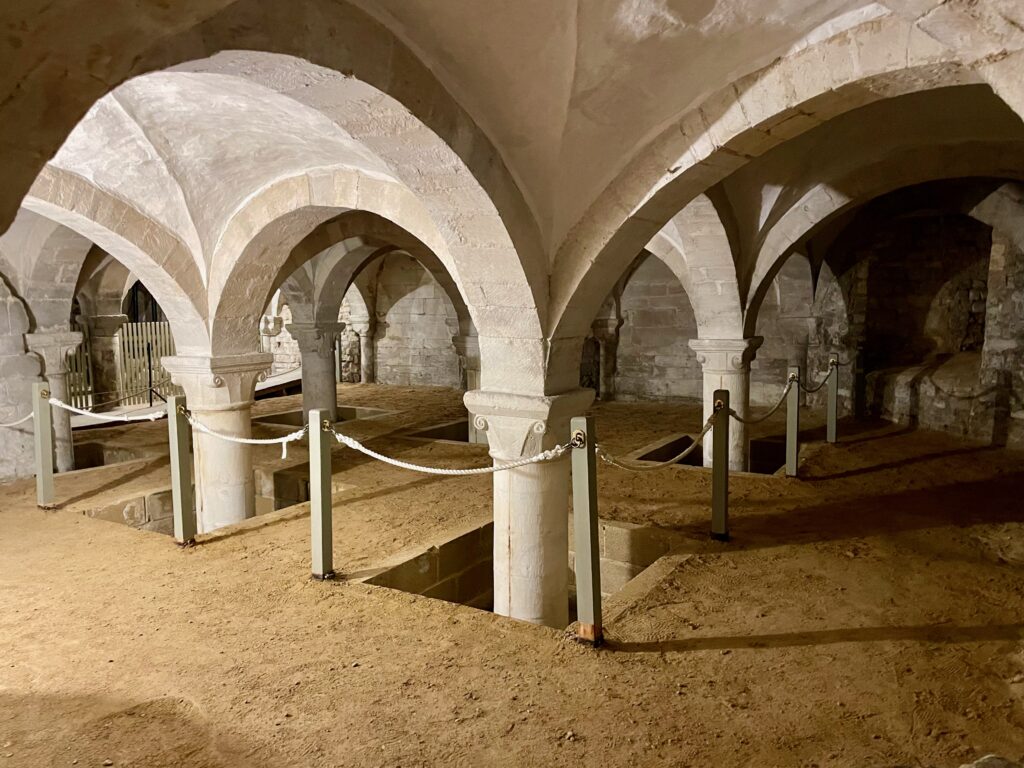
You need to book a tour to see the Norman crypt dating from 1089–1100.
Beatrix Potter’s Tailor of Gloucester ‘lived’ in a shop next to St Michael’s Gate, the entrance to the lay cemetery of the abbey and also used by pilgrims visiting the shrine of Edward II.
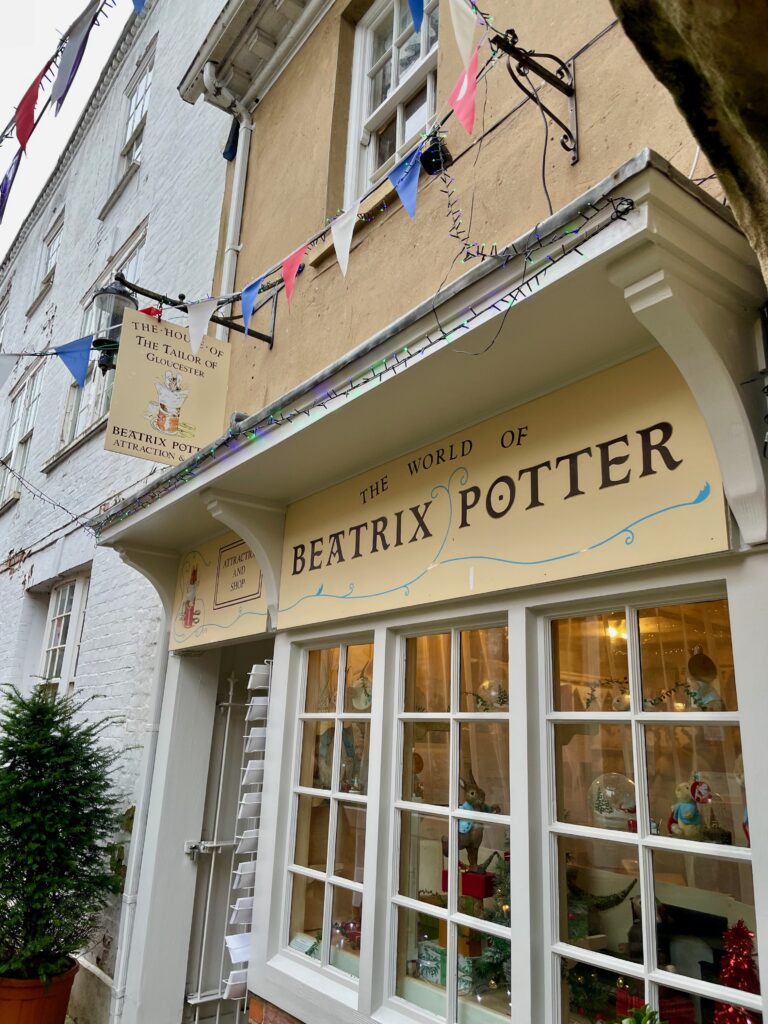
There is a lovely gift shop there where you can buy all things Beatrix Potter.
Books about or set in Gloucester or nearby in the Cotswolds


- The Tailor of Gloucester — Beatrix Potter. A poor tailor tries to survive the winter, struggling to complete a commission for the King, helped by some little mice. Children’s classic.
- Secret Gloucester. Guidebook — Christine Jordan. From fragments of the past that still line Gloucester’s streets to lesser-known facts there is something here to suit anyone’s tastes, such as the sale of wives in the eighteenth century, to hidden Roman ruins. Varying from the momentous to the outlandish, this little book brings together past and present to offer a taste of Gloucester.
- A Cotswold Killing — Rebecca Tope. Nestled in the fertile hills of the Cotswolds, the village of Duntisbourne Abbots is a well-kept secret: beautiful, timeless and quintessentially English. When recently widowed Thea Osborne arrives to house-sit for a local couple, her only fear is that three weeks there might prove a little dull. Her first night’s sleep at Brook View is broken by a piercing scream outside …
- Agatha Raisin and the Quiche of Death — MC Beaton. Agatha Raisin gives up her successful PR firm, sells her London flat, and settles in for an early retirement in the quiet village of Carsely. But she soon finds her life of leisure isn’t all it’s cracked up to be.
- A Country Escape — Katie Fforde. Fran has always wanted to be a farmer. And now it looks as if her childhood dream is about to come true. She has just moved to her aunt’s beautiful but very run-down farm in the Cotswolds. If she can turn the place around in a year, the farm will be hers. But Fran knows nothing about farming. She might even be afraid of cows …