

“…a vast symphony in stone, so to speak; the colossal work of one man and one people…” — Victor Hugo, Notre-Dame de Paris (1831)
In March 2026, we visited the cathedral of Notre-Dame de Paris. I had wanted to see the cathedral since it reopened after the terrible fire of 2019, and we went specifically so I could research my next ARKANE thriller, Crown of Thorns, which centres on the relic kept here.
The weather was wonderful, spring sunshine on pale stone, and in this article, I’ll share some of my photos from the trip so you can virtually join me in this beautiful place.
Notre-Dame stands on the Île de la Cité, the historic heart of Paris, and a bronze star in the square outside marks Point Zéro, the reference point from which road distances from Paris are measured. Entry is free, but it is very busy. You can book a free timed slot on the cathedral’s official website close to the time of your visit and skip the worst of the queuing.

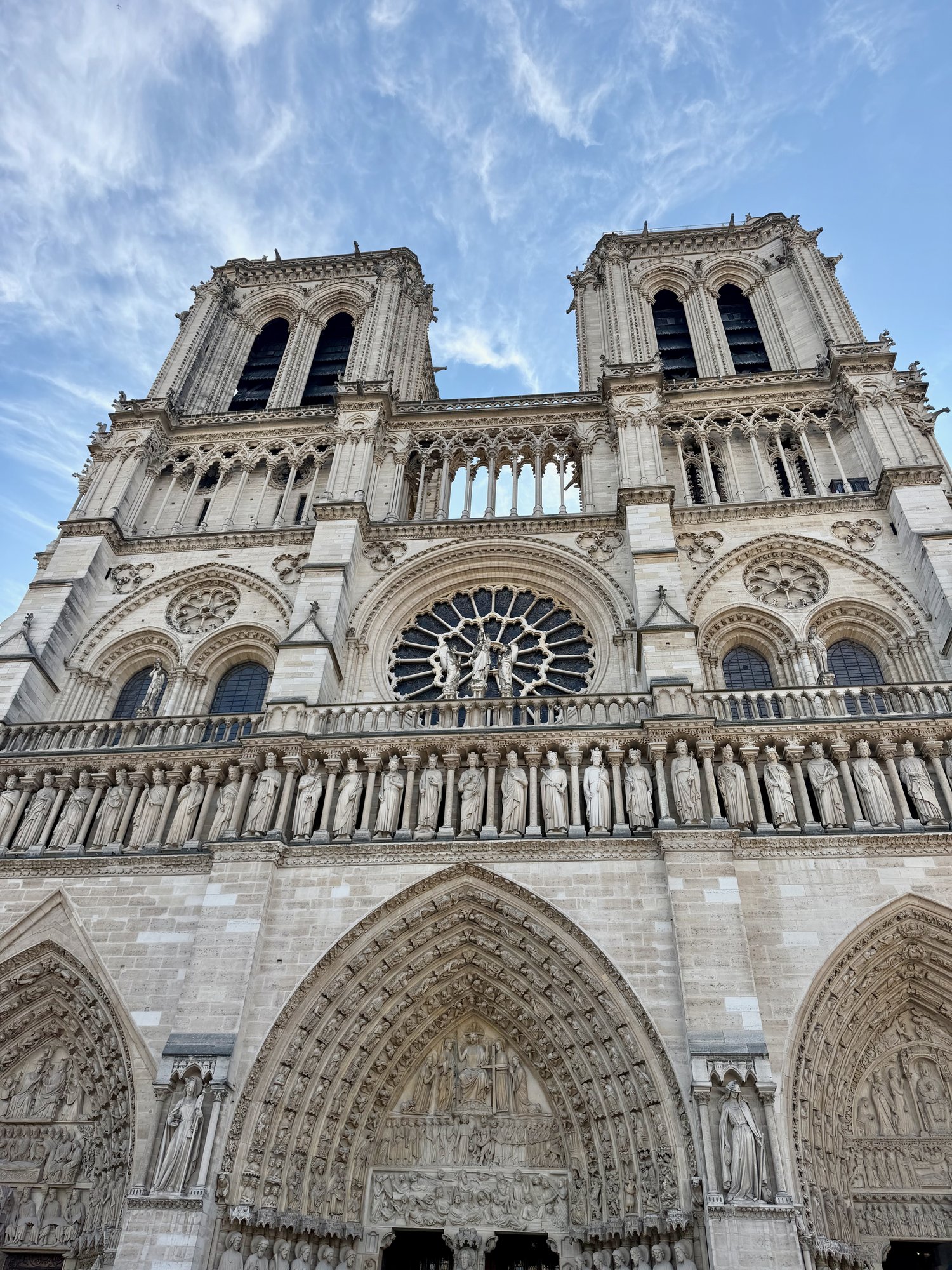
The first stone was laid in 1163 under Bishop Maurice de Sully, and until the mid-13th century this was one of the largest religious monuments in the Western world. Its builders’ contemporaries called the new style “Opus Francigenum,” French work. The word “Gothic” came later, coined in Renaissance Italy as an insult for a style its critics considered as barbaric as the Goths.
The west front went up between 1200 and 1250. Above the portals runs the Gallery of Kings, twenty-eight statues of the kings of Judah, the generations before Christ. In 1793, revolutionaries mistook them for kings of France and beheaded them one by one. The cathedral itself was pillaged, turned into a Temple of Reason, and for a time “served as a wine warehouse,” as its own history admits.
Twenty-one of the kings’ heads resurfaced in 1977, buried in a courtyard in the 9th arrondissement, and are now displayed in the Musée de Cluny, still carrying traces of their medieval paint. We also visited the Cluny the same weekend and it is an excellent and tastefully displayed museum, and not far from Notre-Dame.
By the 1830s the building was so derelict that Parisian authorities considered demolition. Victor Hugo’s The Hunchback of Notre-Dame (1831) changed that, sparking the national movement that led to the great restoration under Eugène Viollet-le-Duc. His sculptors slipped the architect into the replacement Gallery of Kings, giving King Ela his features.
The towers reopened for climbing in September 2025, but I don’t like heights, so I stayed happily at ground level.
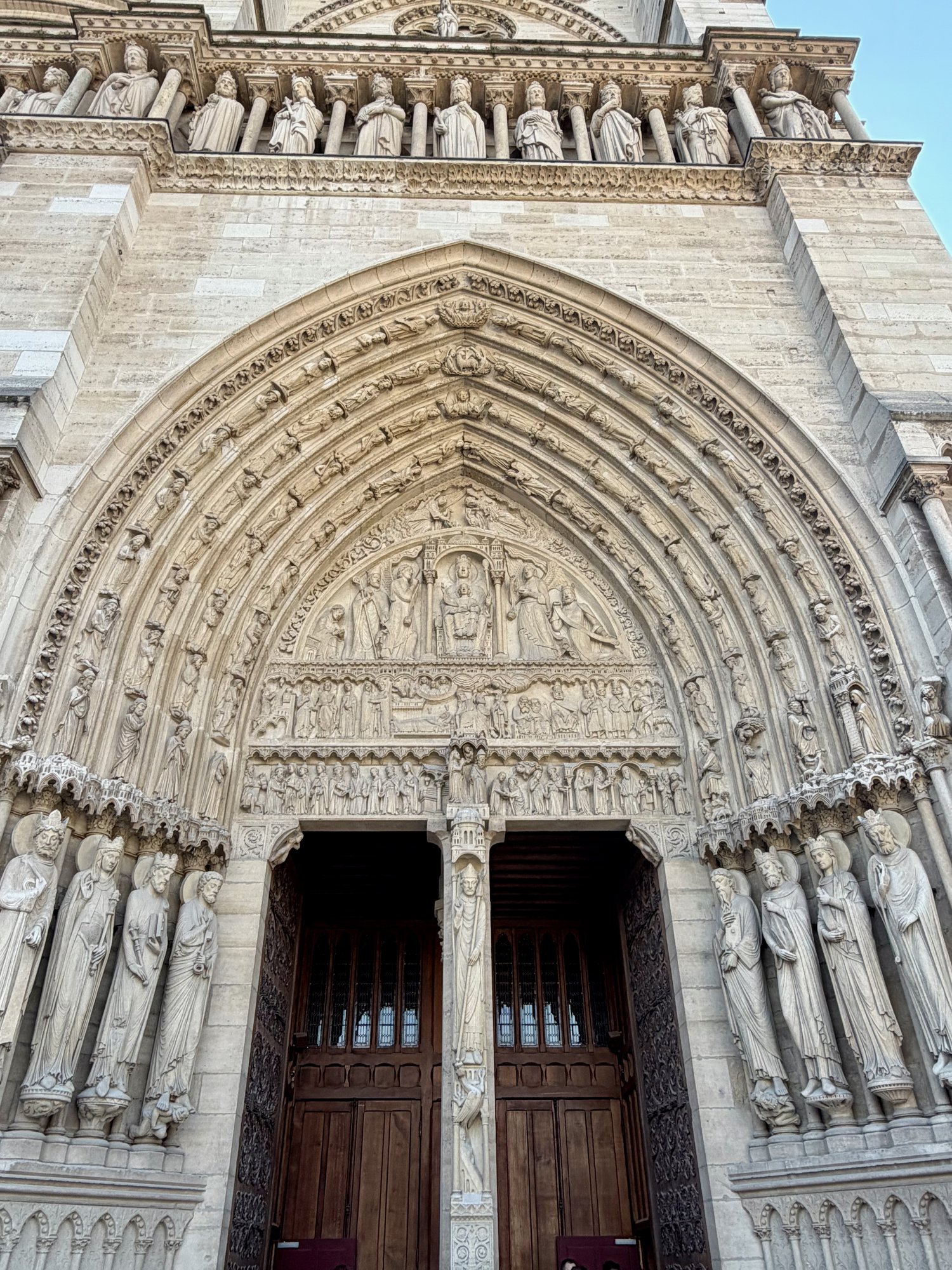
The Saint Anne Portal, on the right of the west front, holds the oldest carvings on the cathedral. The tympanum of the Virgin and Child enthroned was made around 1150, before this building even existed, and reused from its predecessor. These portals were picture books for the faithful who could not read, the Bible told in stone.
Two statues flanking the central portal are easy to walk past: Ecclesia, the Church, crowned and upright, and Synagoga, the Synagogue, blindfolded, her staff broken. The pairing appears on medieval churches across Europe, and it is not decoration. It is a statement in stone that the Church believed it had replaced a blind Judaism. The figures here are 19th-century recreations of the medieval originals, faithfully restored, blindfold and all.
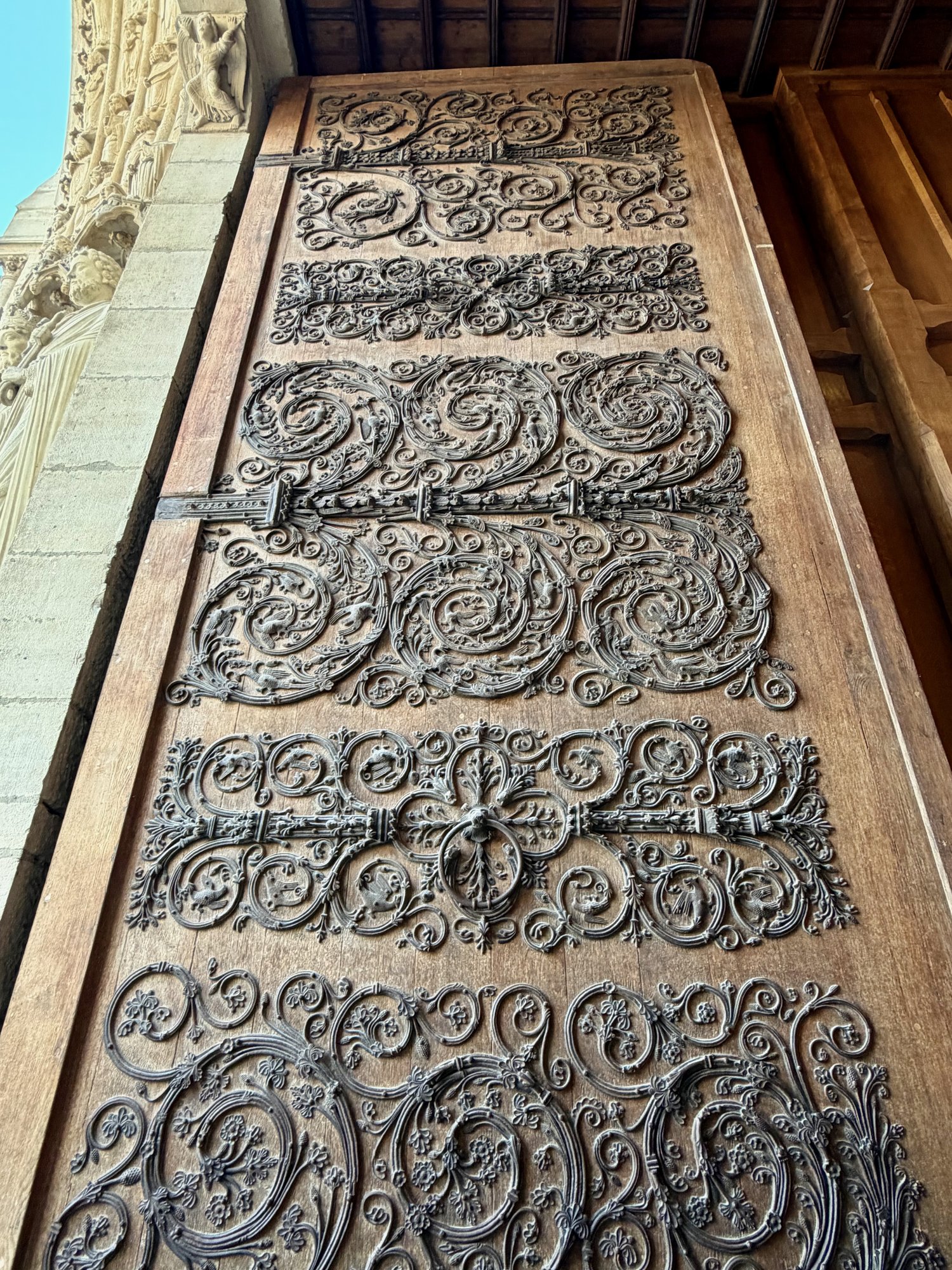
I love an ancient door!
Look at the detail of this ironwork, scrolling across the wood in tendrils, leaves and birds. Legend has it that a young smith named Biscornet sold his soul to the devil to forge work this fine, and that the doors refused to open until they were sprinkled with holy water. The central door, used for processions of the Blessed Sacrament, has no such ironwork. The devil, they say, would not touch it.
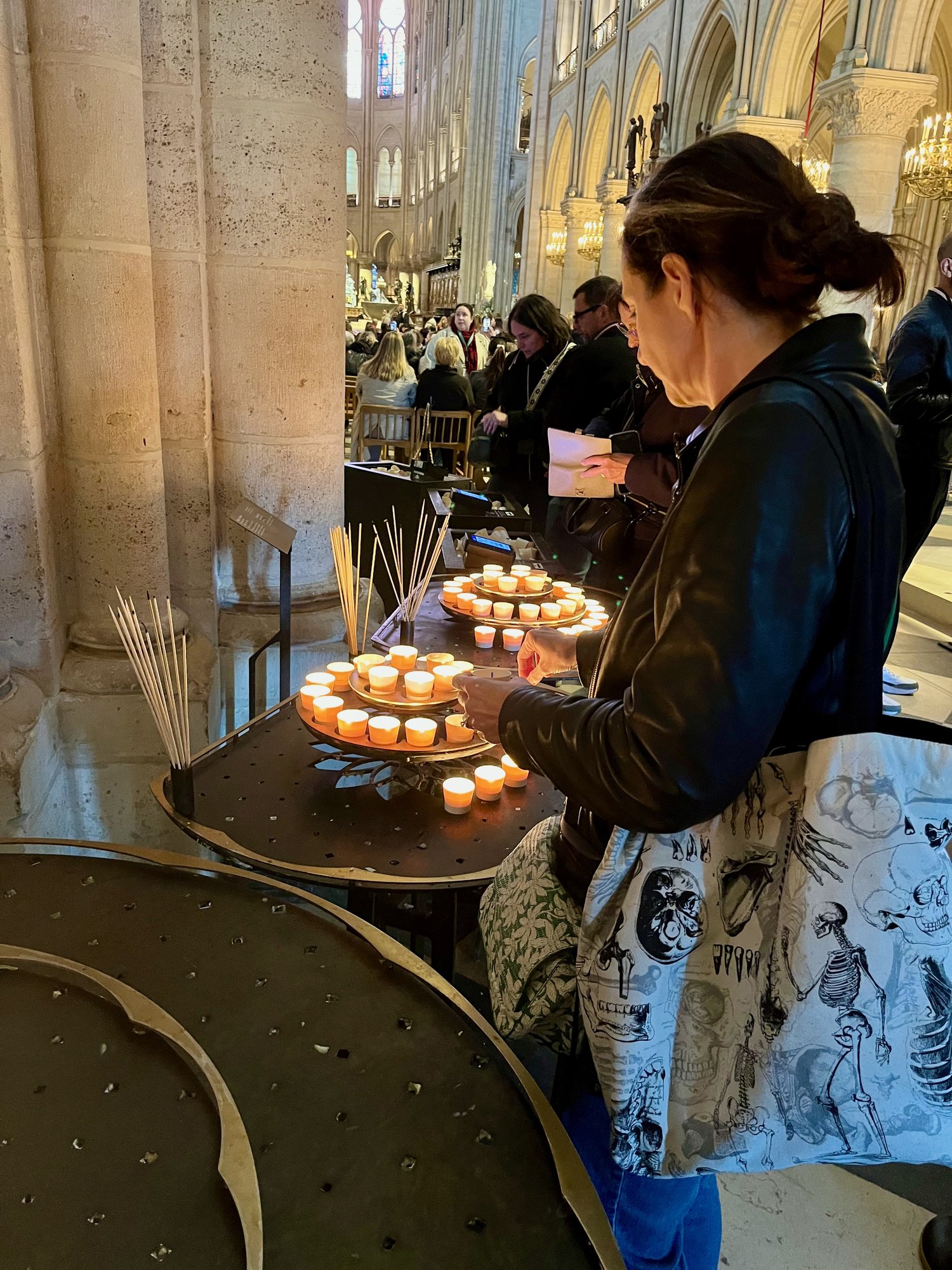
Inside, I lit a candle, as I always do. I’m not a Catholic, but I light a candle for my family in every cathedral I visit and send out a prayer for their safety and happiness.
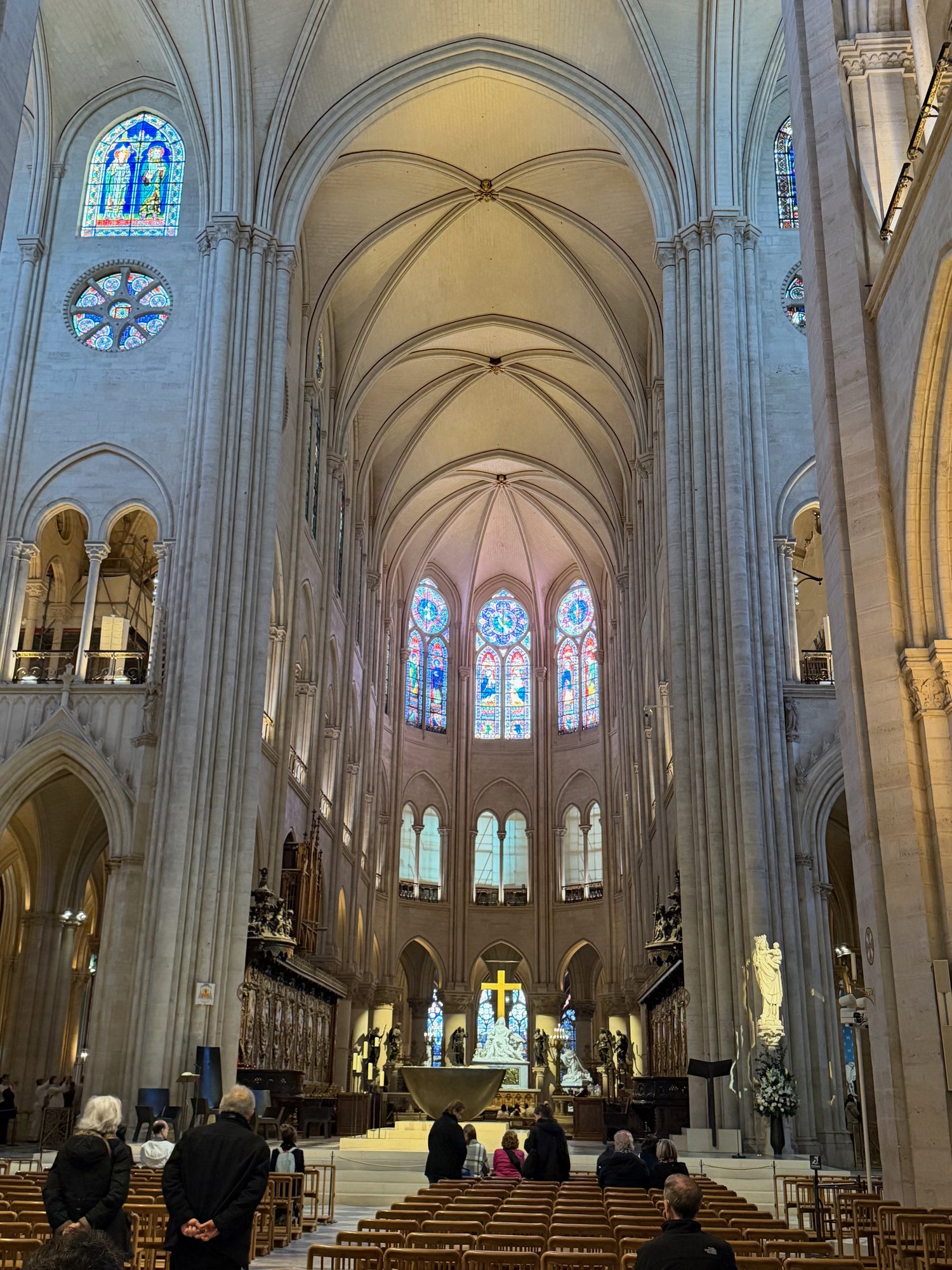
The cathedral stretches 127 metres from west to east, the long nave drawing the eye towards the choir, and since the restoration it glows. Five years of cleaning stripped away centuries of soot along with the smoke damage, and the pale limestone interior is now closer to what a medieval visitor would have seen than at any time in living memory.
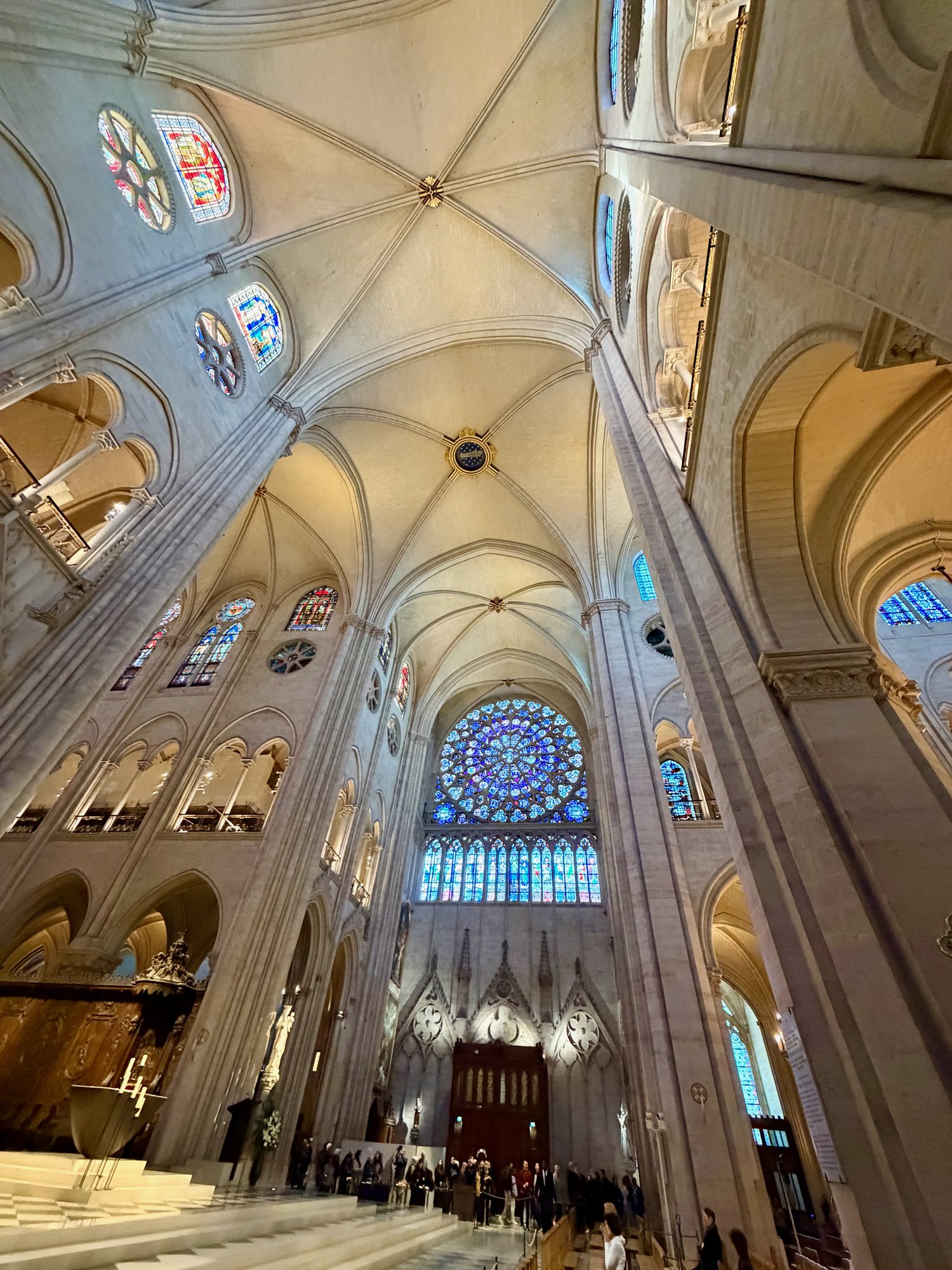
Always look up!
Above these vaults sat the roof frame known as “the forest,” because every beam came from a different oak tree. Some were felled in the 1160s, and some of those trees were already three or four hundred years old when they were cut. The whole structure burned on the night of 15 April 2019, and the spire fell through the crossing vault below.
Then around 2,000 people worked on the restoration. Specialist carpenters rebuilt the forest oak by oak with traditional hand tools, while stonemasons, glassmakers, gilders, organ restorers and dozens of other trades restored the cathedral around them. Donations of around €850 million came from some 340,000 donors in more than 150 countries, and the cathedral reopened on 8 December 2024, five and a half years after the fire. These ancient buildings need constant work to keep them from turning into ruins, and here that truth is written into the vaults themselves.

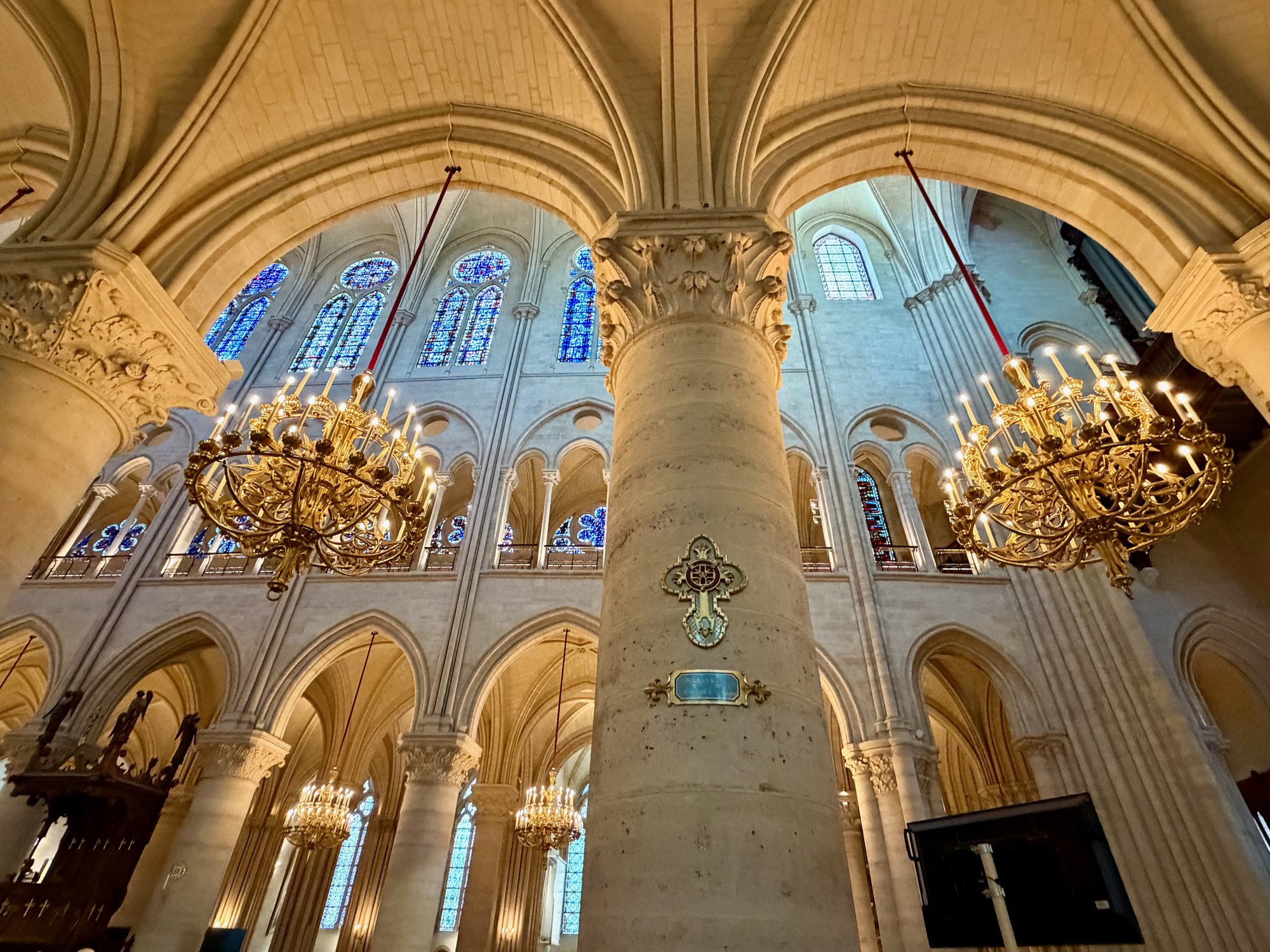
Next to the gilded chandeliers, on the pillar between, is one of the Stations of the Cross, where Jesus consoles the weeping women of Jerusalem on the road to Calvary.
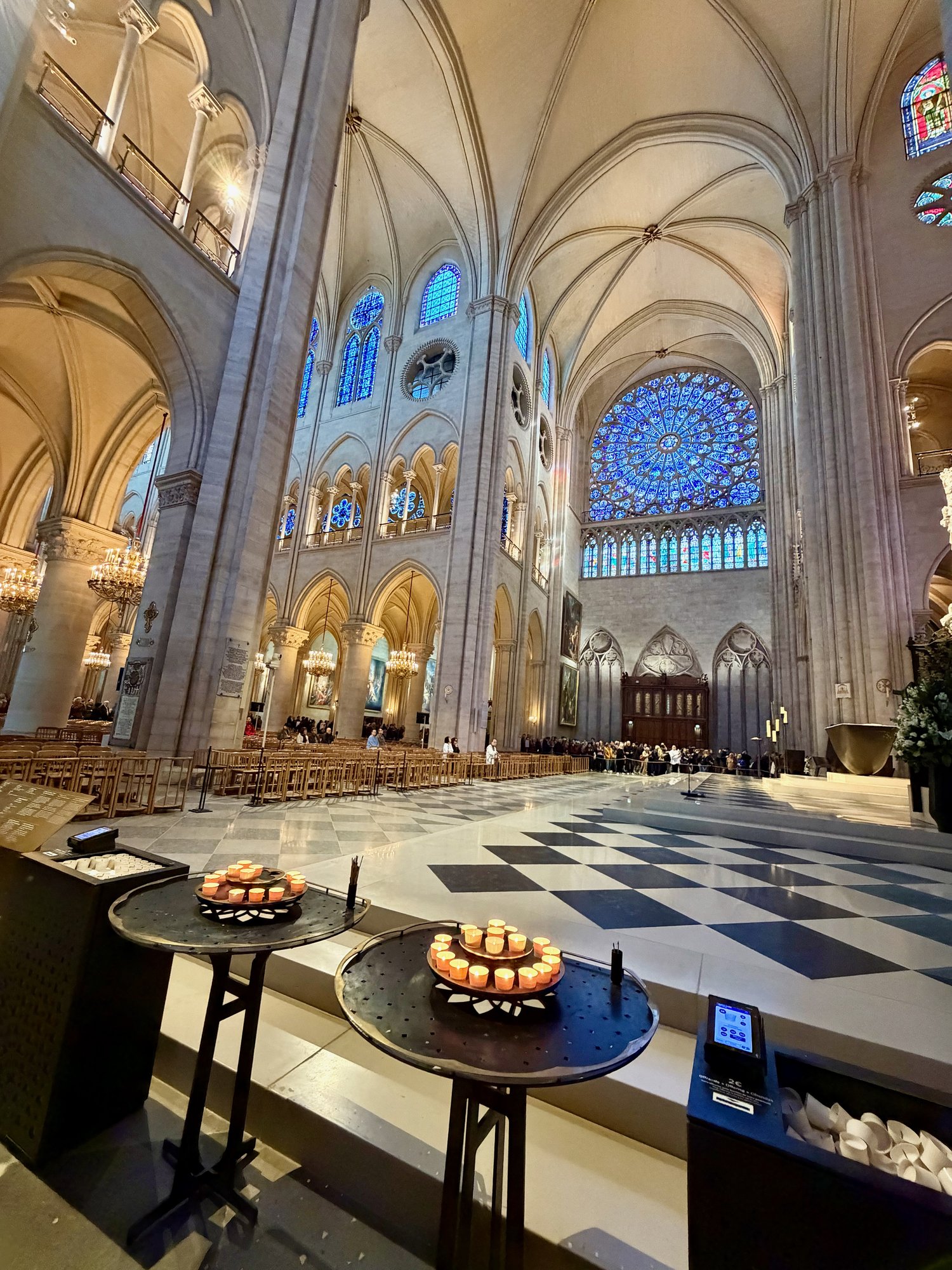
The three great rose windows survived the fire. They had already survived worse. In 1756 the cathedral’s own canons decided the building was too dark, had the walls whitewashed, and ordered the medieval stained glass destroyed and replaced with clear panes. They spared only the roses, and the north rose still holds much of its 13th-century glass.
The bronze altar beneath it is brand new, part of a complete set of liturgical furniture cast for the reopening by the designer Guillaume Bardet.
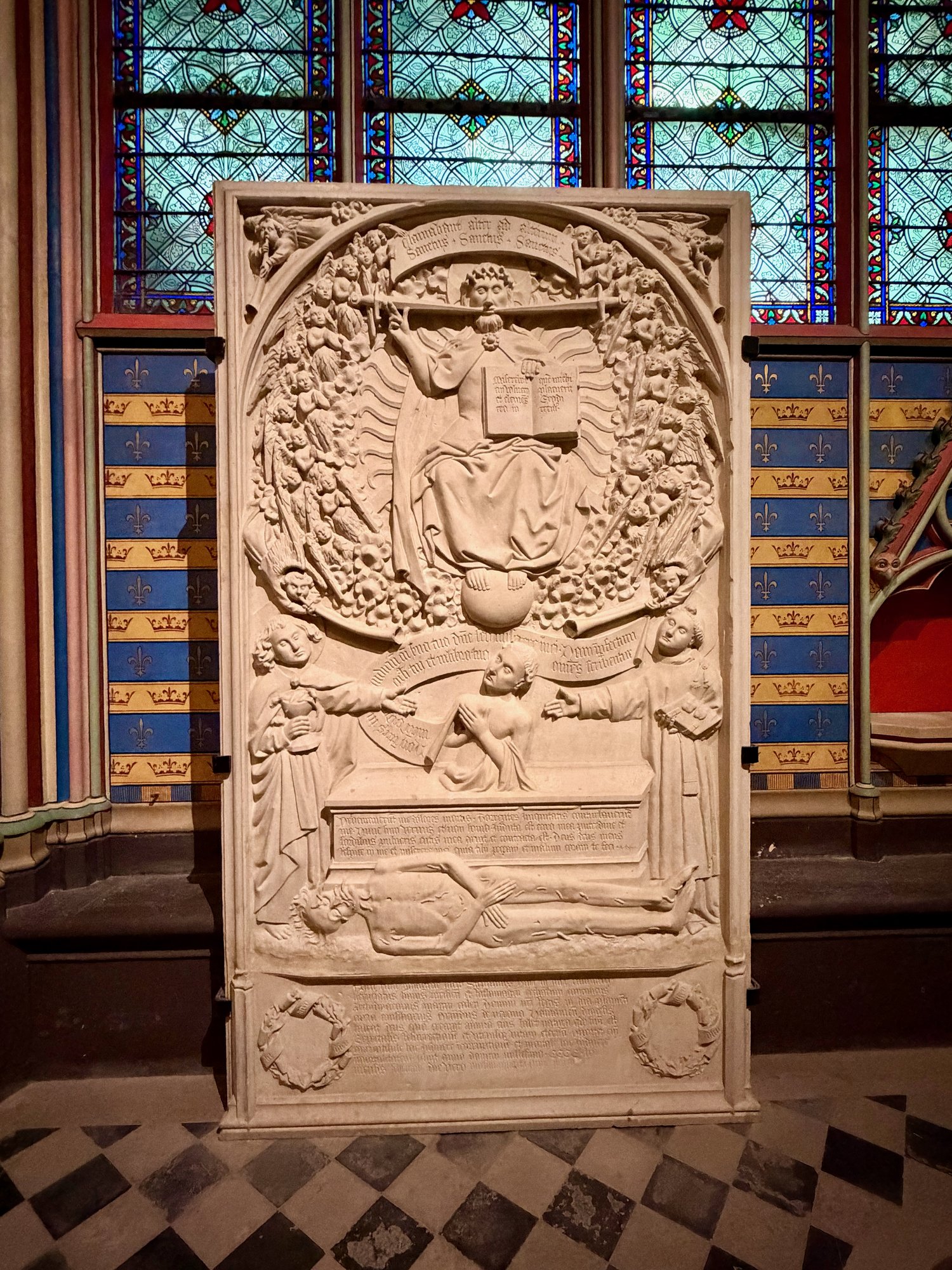
For a real sense of memento mori, you can’t beat a cadaver tomb, and I always keep an eye out for them.
This is the epitaph of Étienne Yver, a canon of Paris who died in 1467. At the bottom lies his corpse, ravaged by worms. Above, he rises from the tomb to face Christ the Judge, with saints at his side pleading his case. Death comes for us all, no matter our status.
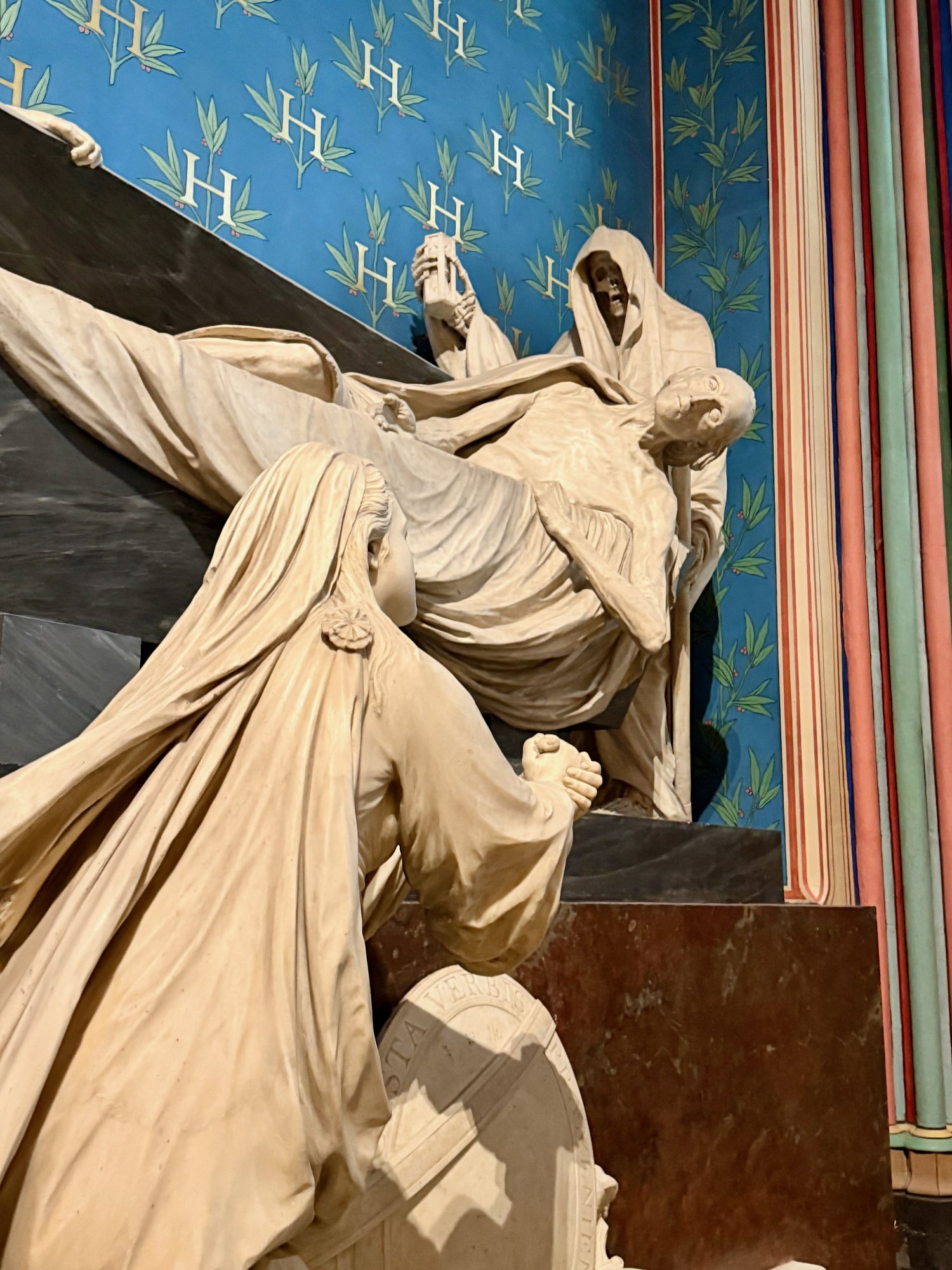
Three centuries later, death was still being carved here. In the mausoleum of the Comte d’Harcourt by Jean-Baptiste Pigalle, completed in 1776, the count rises from his tomb in his shroud while a hooded Death holds up the hourglass. His time is spent. His widow, who commissioned the monument from the most celebrated sculptor of the day, is shown reaching for him.
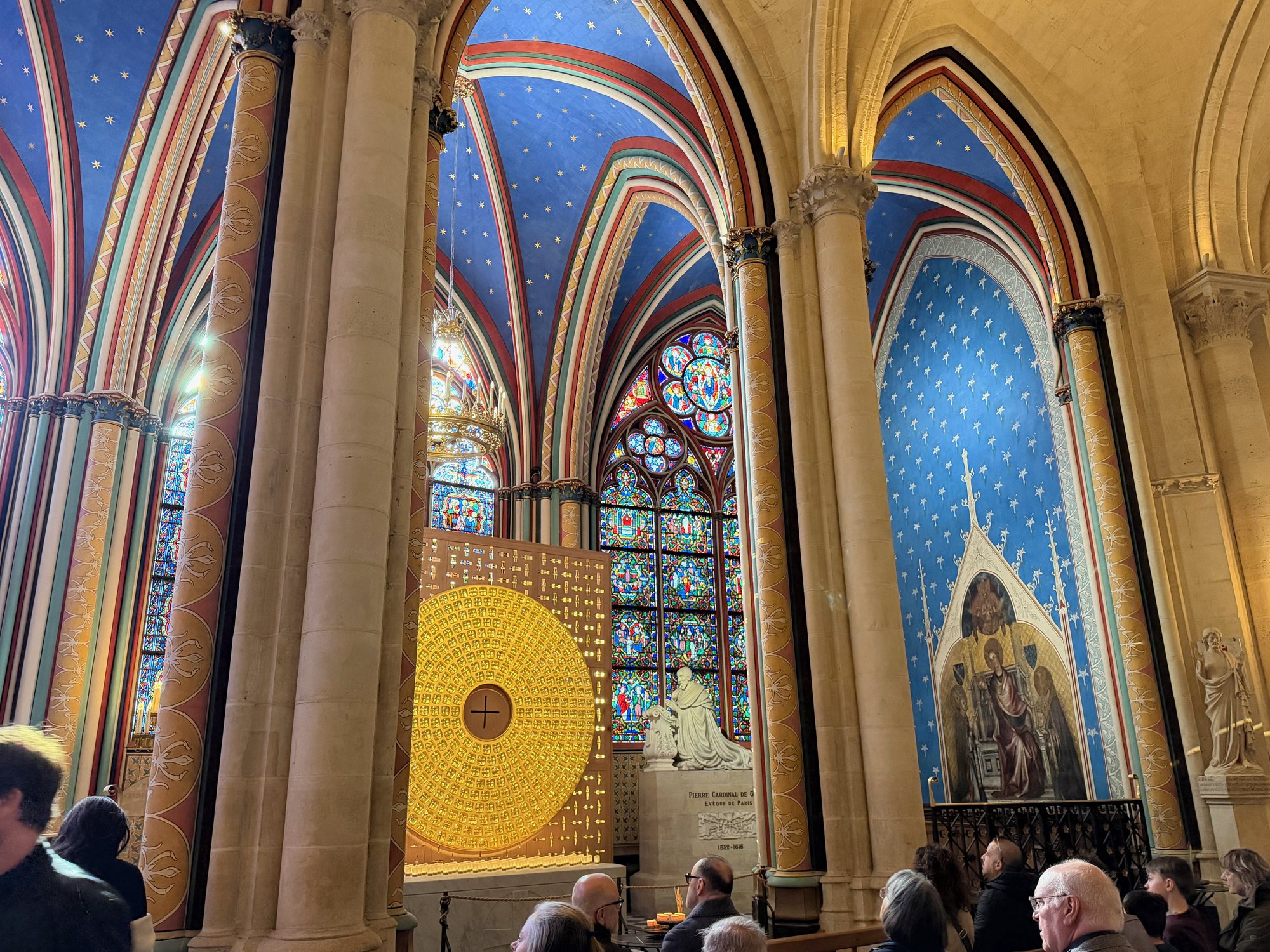
And then, the reason we came: the chapel of the Crown of Thorns.
Venerated in Jerusalem from the 4th century and later kept in Constantinople, the relic was bought in 1238 by Louis IX, Saint Louis, and carried into Paris on 19 August 1239 with the king himself among the bearers. He built the Sainte-Chapelle to house it. The Revolution melted down its reliquaries, but the relic survived.
On the night of the fire in 2019, Father Jean-Marc Fournier, chaplain of the Paris Fire Brigade, went into the burning cathedral with the firefighters to save it. The crown was locked in the treasury safe, no one could find the keeper of the code, and a team was breaking the safe open when the keys at last arrived. The crown passed out of the burning building through a human chain of rescuers and spent that night in the Paris city hall. Father Fournier is himself a knight of the Equestrian Order of the Holy Sepulchre.
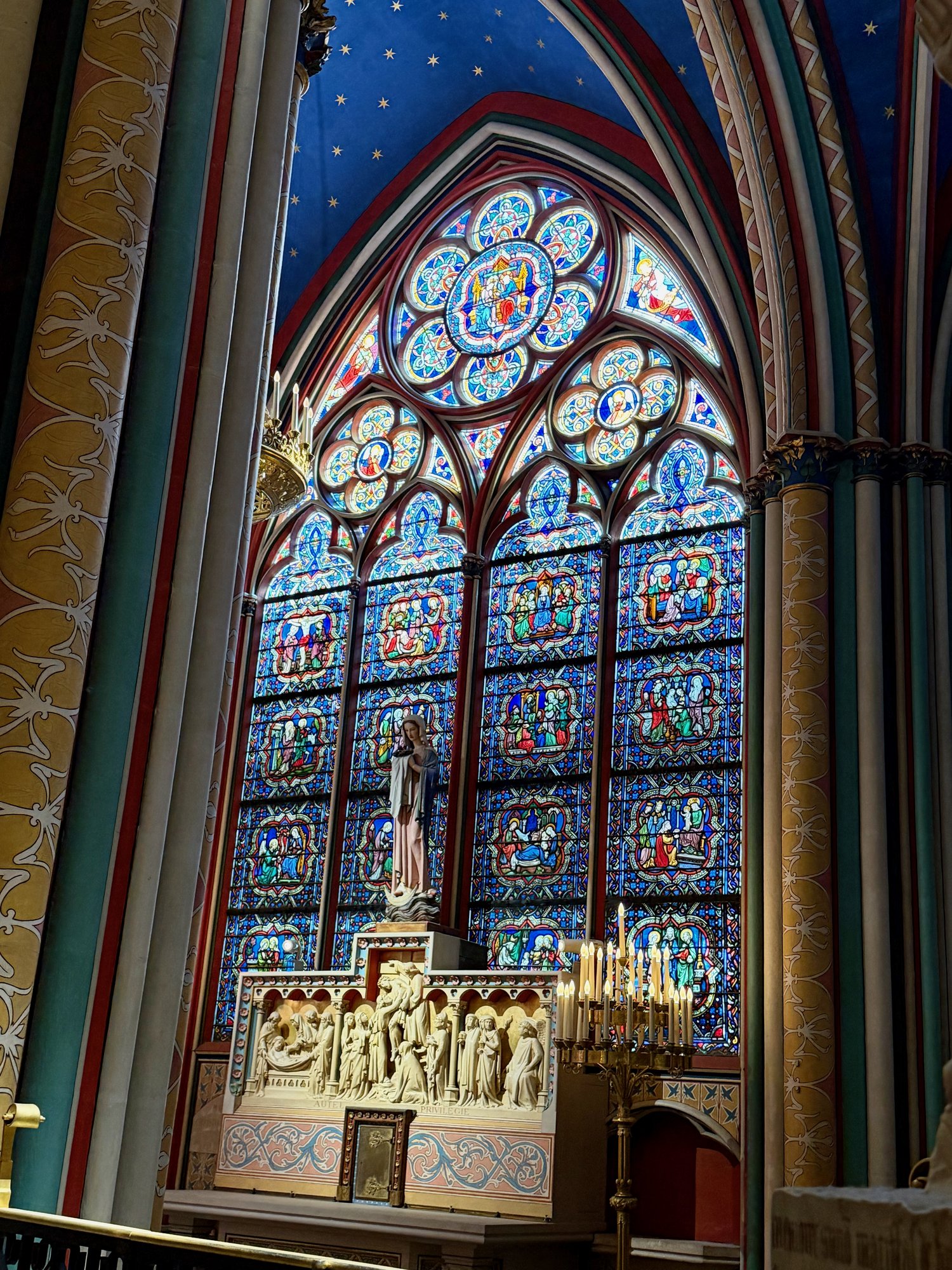
This is the chapel where the relic now lives, its older altar standing behind the golden wall of the reliquary. I love finding smaller elements of beauty in cathedrals, and this chapel is full of them: the starry vaults were repainted in rich colour during Viollet-le-Duc’s restoration, and the recent cleaning has brought them back to full brightness. These buildings were never meant to be plain.
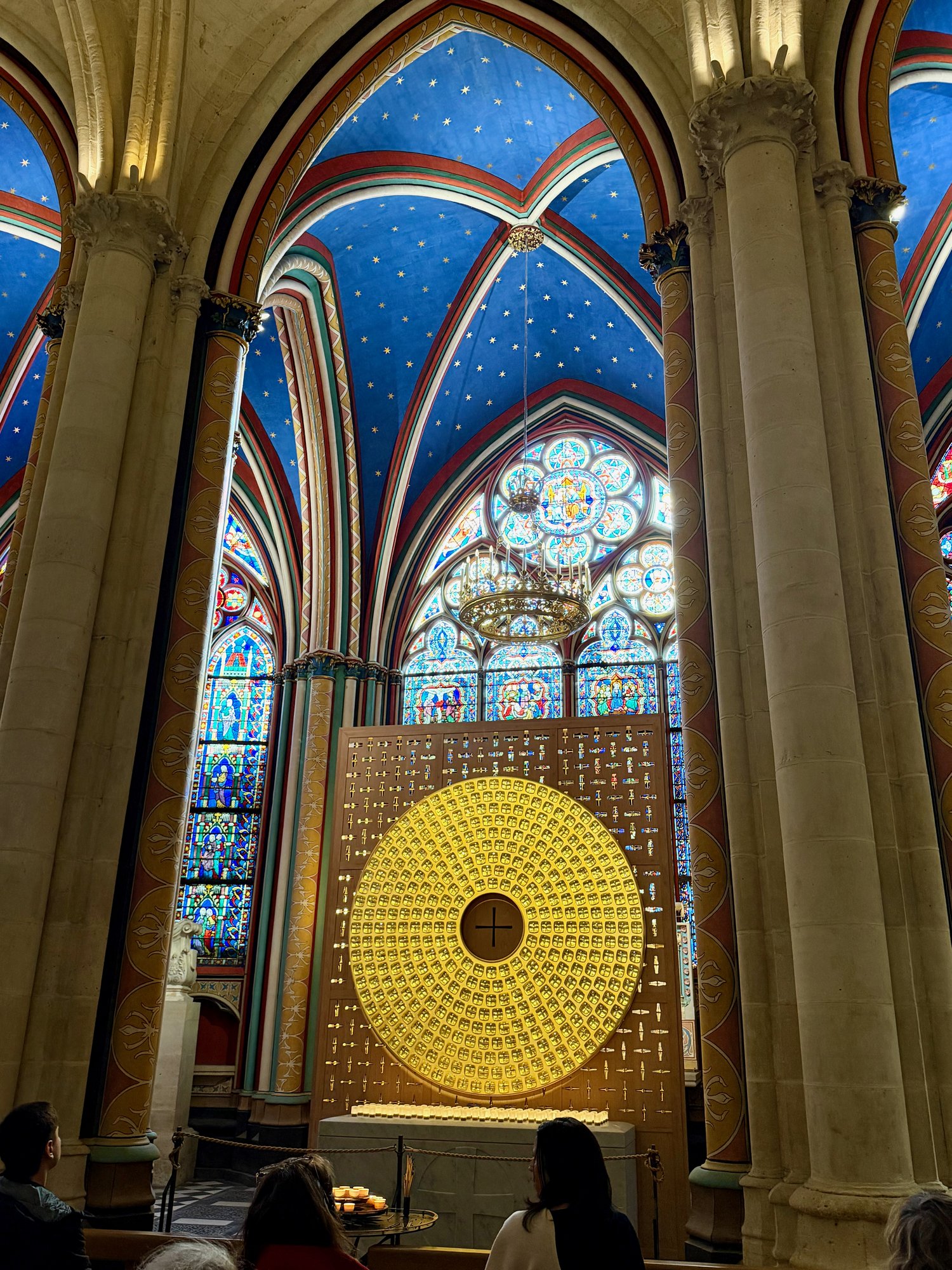
Seeing where the relic is kept was a highlight of the visit for me.
The new reliquary, by the designer Sylvain Dubuisson, is a wall of cedar wood holding a gilded disc of 396 hand-crafted glass blocks, and it glows like a second rose window at the eastern tip of the cathedral. The crown itself rests in a safe within the marble altar, and is brought out for display every Friday afternoon, when knights and dames of the Equestrian Order of the Holy Sepulchre stand guard. The same order escorted it home in procession when it returned to the cathedral in December 2024. We were there on a Friday morning, so we missed the knights, which gives me a reason to return.
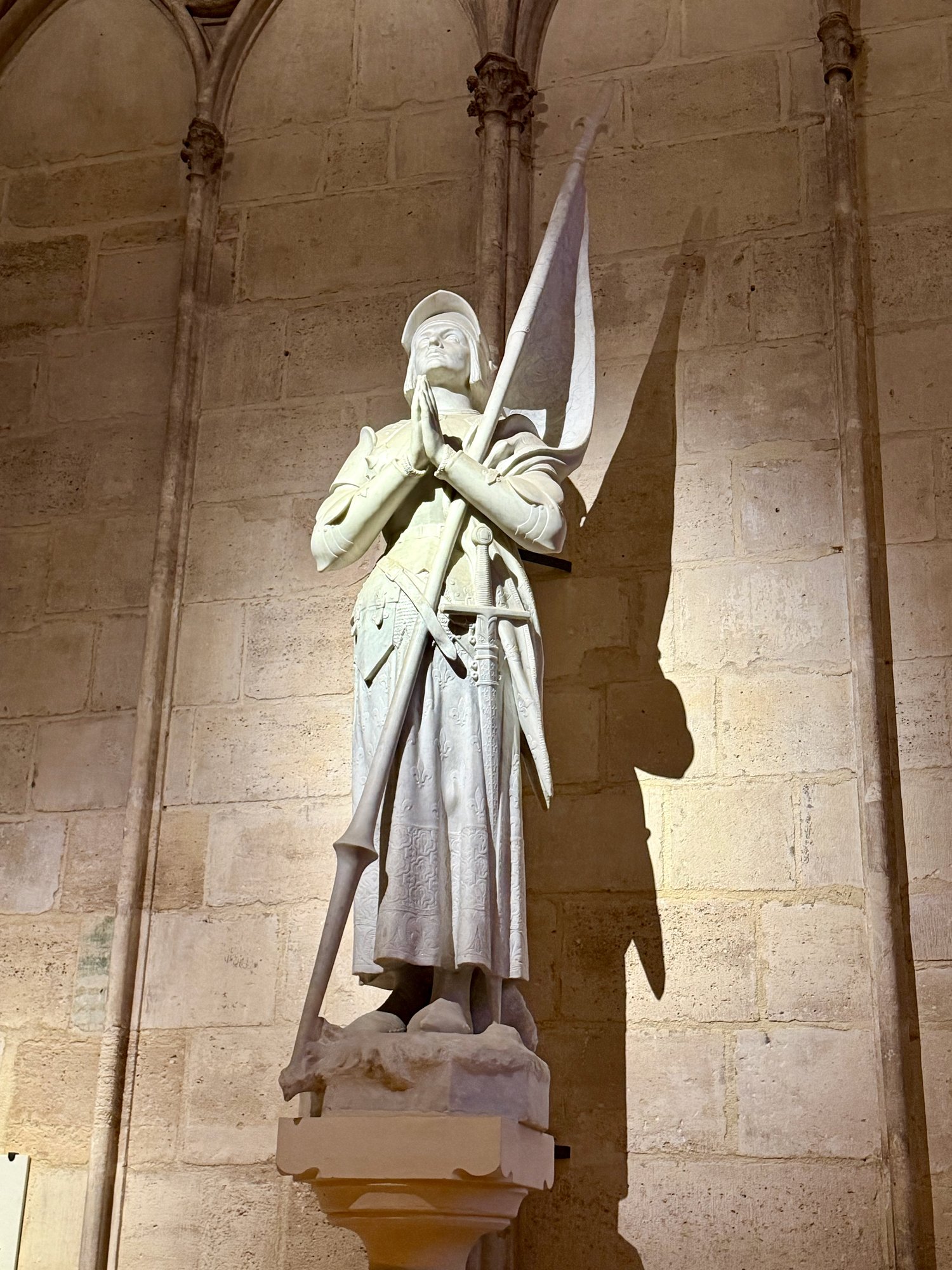
I thought this statue was a man until I read the placard, because she wears full armour. It is Joan of Arc, and the armour is the point: dressing as a man was among the charges at the trial that condemned her.
She has her statue here for good reason. In 1455, twenty-four years after she was burned at the stake in Rouen, the trial to clear her name opened at Notre-Dame before a great crowd, with her elderly mother testifying. The following year the original verdict was declared null. It took the Church until 1920 to make her a saint, and she is now a patron saint of France and of soldiers.
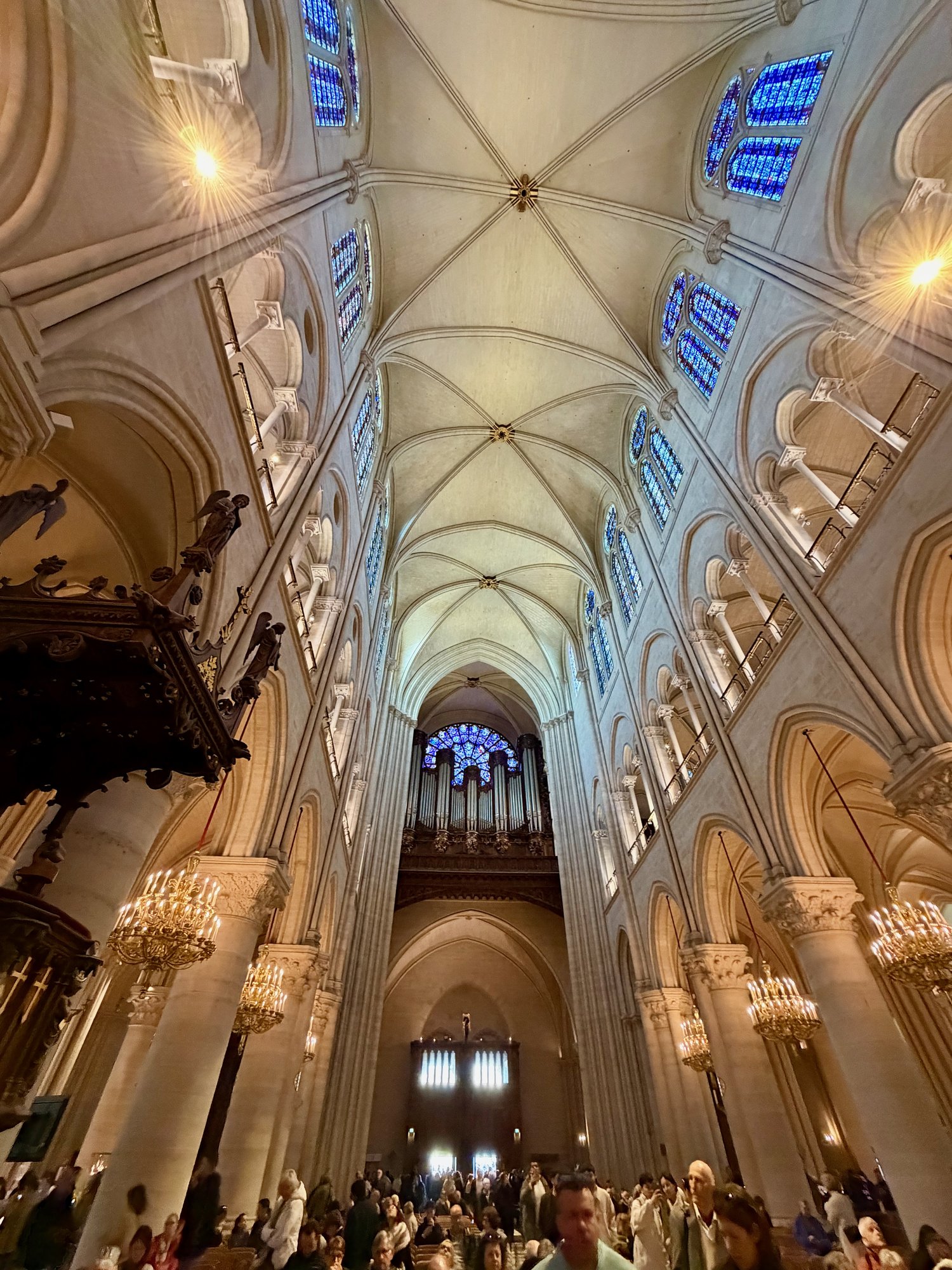
Looking back west, the grand organ fills the wall beneath the rose window. Its 8,000 pipes survived the fire but not the lead dust that settled through the building. The whole instrument was dismantled, cleaned pipe by pipe, and reassembled for the reopening.
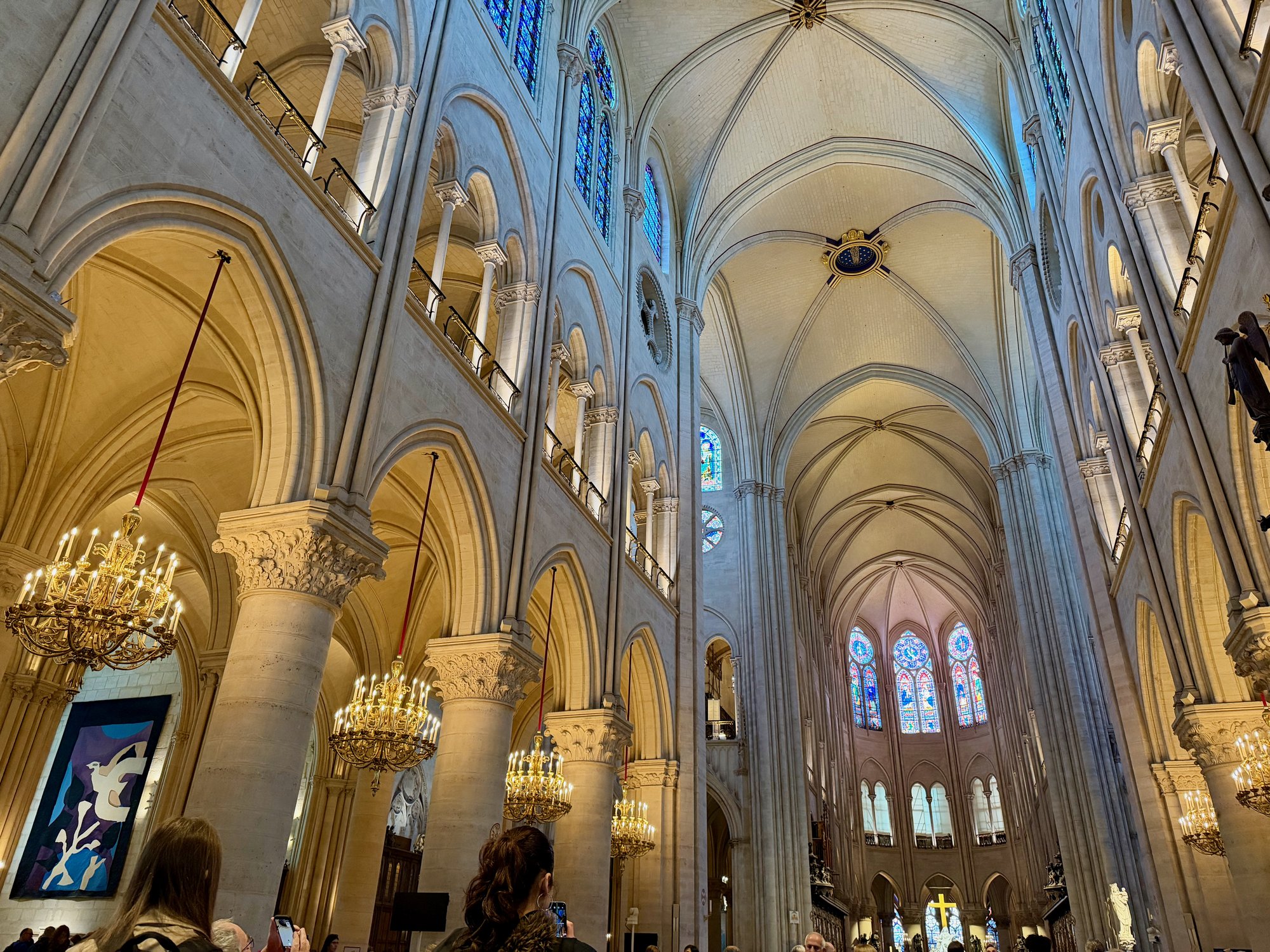
One last look down the nave before stepping back out into the sunshine.
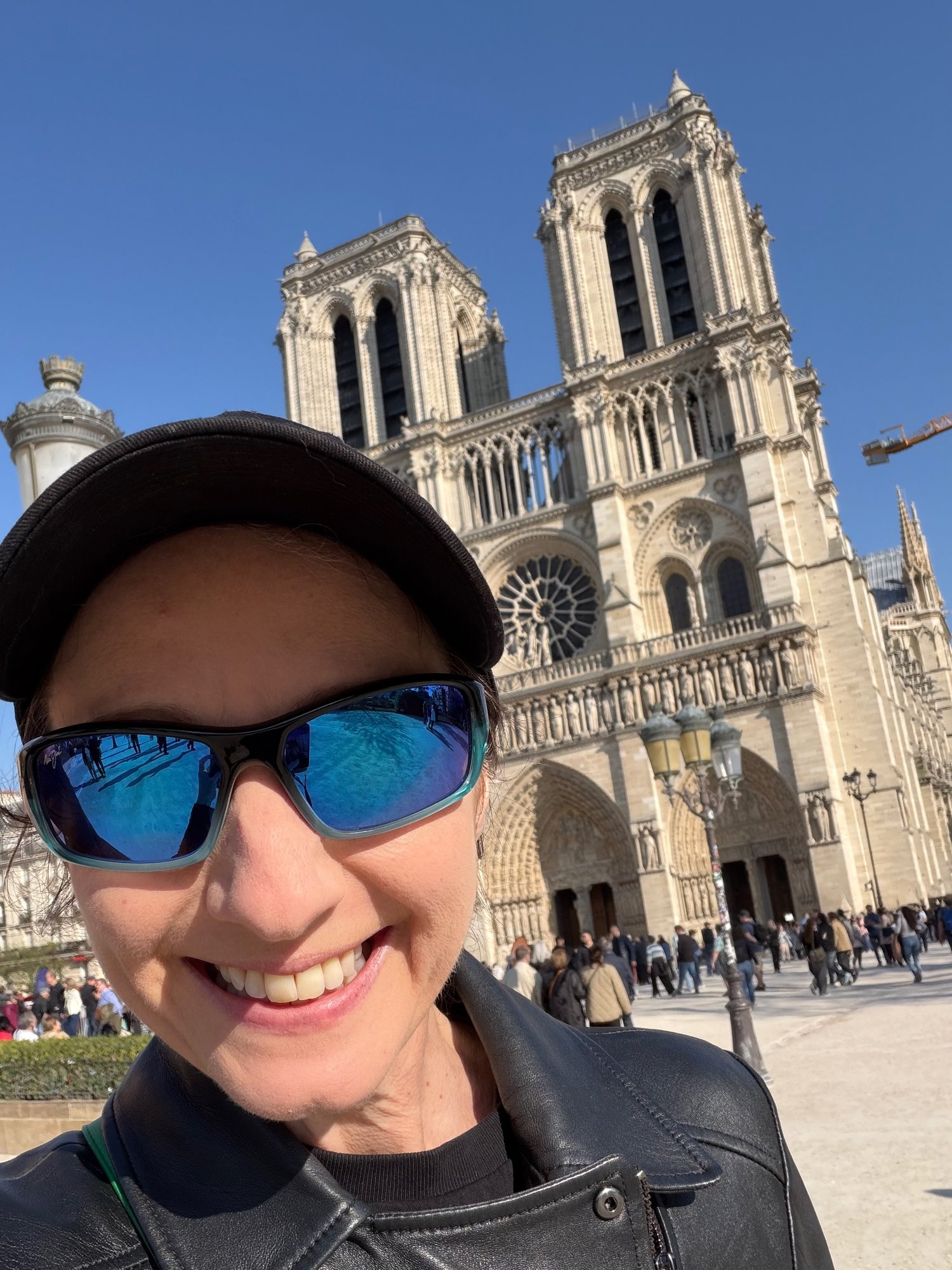
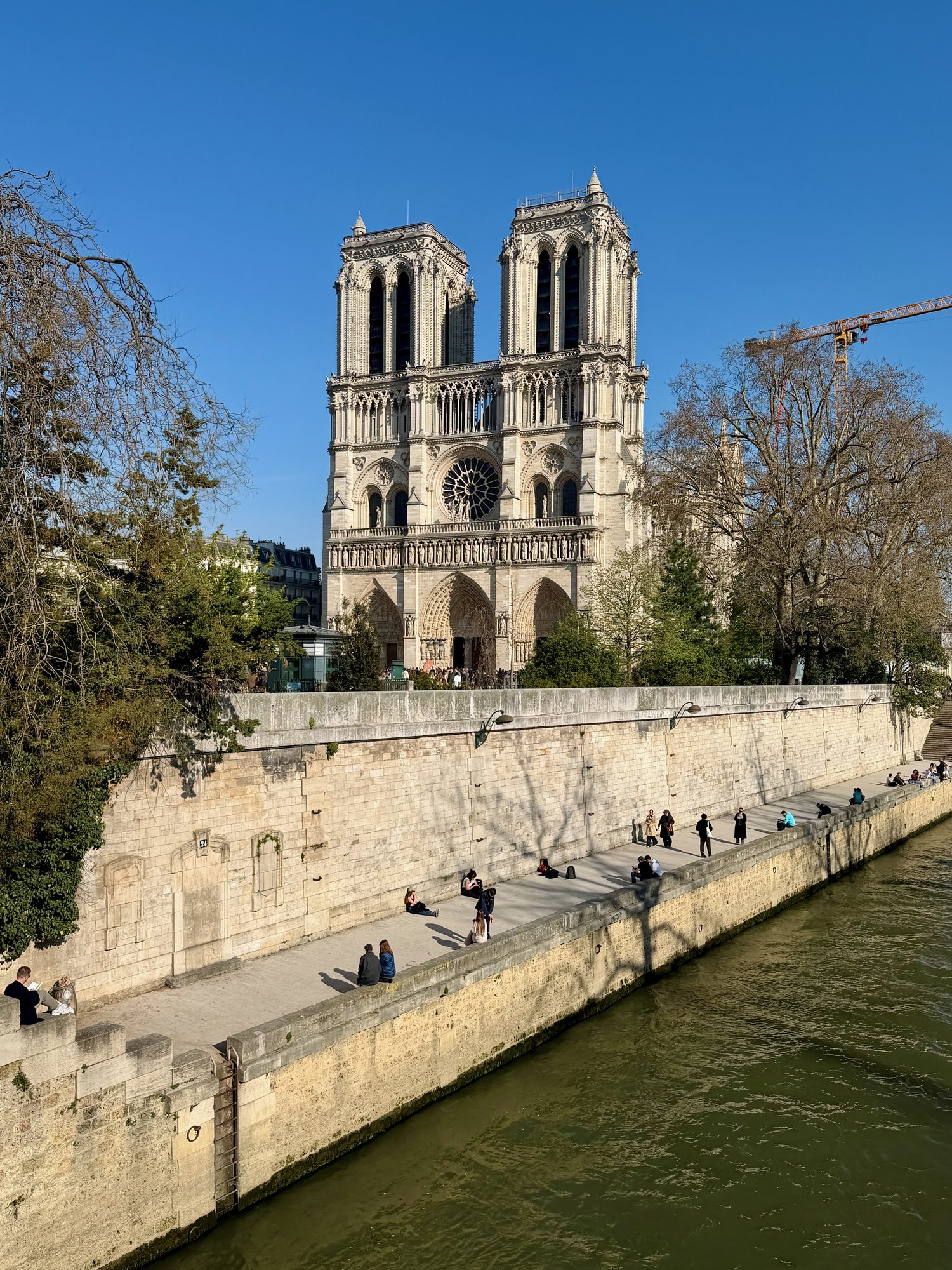
We loved our visit to Notre-Dame de Paris. There is still a crane on the skyline and scaffolding in places, with work continuing on the exterior into 2028, but the cathedral is mostly open now.
The island setting means you can sit on the banks of the Seine in the sunshine and watch the boats go past, which we did along with half of Paris. The cathedral itself disappears behind the quay wall from down there, and the best views are from the bridges, which is where I took this final photo. If you go, book ahead, arrive early, and leave time to sit by the river.
Books about or set in Paris and Notre-Dame
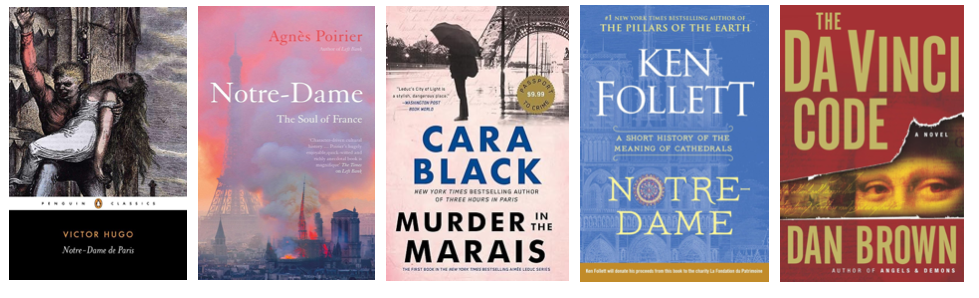

The Hunchback of Notre-Dame — Victor Hugo. The novel that saved the building. In 1831, with the cathedral so derelict that Parisian authorities were considering demolition, Hugo made the building itself the hero of his story of Quasimodo, Esmeralda and Frollo. The book’s enormous success sparked the national movement that led to Viollet-le-Duc’s restoration a decade later, so the cathedral you visit today exists partly because of this novel.
Notre-Dame: The Soul of France — Agnès Poirier. Poirier watched the cathedral burn from the quayside and opens with that night before ranging across the building’s history: Saint Louis and the Crown of Thorns, Napoleon’s coronation, de Gaulle’s Magnificat sung during the Liberation in 1944. A love letter to what the building means to France, written in the uncertain months when nobody yet knew if it could be saved. Winner of the French Heritage Society Book Award.
Murder in the Marais — Cara Black. First in the long-running Aimée Leduc investigations. A Parisian private detective takes a job decoding a photograph for a Holocaust survivor in the Marais, and the past comes up swinging. Atmospheric Paris crime with a strong sense of the city’s wartime memory.
Notre-Dame: A Short History of the Fate of the Cathedral — Ken Follett. Written in the weeks immediately after the fire by the author of The Pillars of the Earth, this is a short, personal meditation on what cathedrals are for and why the world wept for this one.
The Da Vinci Code — Dan Brown. The relic-hunting thriller that sent millions of readers to Paris. Symbologist Robert Langdon is pulled into a murder at the Louvre and a trail of clues through the city’s churches and secret societies. Whatever you think of its history, it captures the thrill of chasing sacred mysteries through real Parisian locations, which I also enjoy doing in my ARKANE thrillers.