
In February 2023, I spent a long weekend in Washington DC before speaking at a conference in Colorado Springs. That trip inspired my ARKANE thriller, Spear of Destiny, and I wrote about the classical architecture, the Library of Congress and the rest of the weekend here.
While I was there, I went out to the north-east of the city to see the Basilica of the National Shrine of the Immaculate Conception. It is the largest Roman Catholic church in North America and one of the ten largest churches in the world.
In this article, I’ll share my photos and some of the stories behind the images, so you can virtually join me.

This is a national shrine dedicated to Mary as the Immaculate Conception, patroness of the United States, and it calls itself America’s Catholic Church. I think it’s under-visited as most tourists stay around the more central government buildings and museums.
Watch a short video tour of the basilica, with my photos (4 minutes):
It took almost a century to finish. Bishop Thomas Shahan took his plans to Pope Pius X in 1913, the cornerstone was laid in 1920, and the first Mass was said at Easter 1924 in a crypt that was still a building site.
Then the Great Depression and the Second World War stopped the work for more than two decades. The upper church was finally dedicated on 20 November 1959.

The style is Romanesque-Byzantine, chosen partly to set it apart from the Gothic-style cathedral. The walls are Indiana limestone, the Great Dome is covered in coloured tiles, and the bell tower stands 329 feet to the top of its cross.
According to the shrine, it was built of stone, brick, tile and mortar, without structural steel beams or columns.
I walked round to the east side first.

Above the east portico, a Franciscan friar lifts a little mission church to the sky with the Pacific at his feet. The lettering reads “Junípero Serra at Monterey”.

Below it, the same man stands in white marble. He holds up a two-barred Caravaca cross and cradles the mission of San Carlos Borromeo in his left hand. The statue marks the spot where Pope Francis made him a saint on 23 September 2015, the first canonisation held in the United States.
I stopped here because Serra is in one of my books. I saw his relic beside the altar at Mission Dolores in San Francisco, and it became part of Valley of Dry Bones.
In the novel, the hunt for the Hand of Ezekiel passes through the basilica in Palma, Majorca, where Serra preached before he sailed for the New World, and Morgan Sierra follows his relic to Mission Dolores.
But Serra is a contested saint. Born in Majorca in 1713, Serra founded the first nine of California’s Spanish missions, and many Native Americans in California say he enslaved converts and helped spread the diseases that devastated their peoples.
While the Pope said Mass here, about a dozen people stood in silent protest in the cemetery of the Carmel mission, where Serra is buried. Pope Francis said Serra sought to defend the dignity of the native community. The base of the statue reads “Saint Junipero Serra, Apostle to California”.
Downstairs, the Crypt Church is low, broad and dim, more Roman catacomb than cathedral.

The ceiling is Guastavino tile, a Catalan technique of thin tiles bonded in layers, with about 35,000 visible tiles set in a herringbone pattern.

The shrine has more than 80 chapels and oratories, representing the peoples and traditions of American Catholics: African, Chinese, Filipino, Hungarian, Irish, Polish, Slovak, Vietnamese and more.
I love finding smaller things in a building this size, like this flowing bronze figure, crowned and holding a cross against a wall of radiating gold lines.
In the Byzantine-Ruthenian Chapel, Mary holds out her veil beneath a jewelled cross.

The devotion is called Pokrov, the Protection. It comes from Constantinople, where the Mother of God was said to have spread her veil over the people sheltering in the Church of Blachernae.

Memorial Hall is lined with 14,400 tablets of marble and granite, carved with the names of the people who helped pay for the building. Families from Chicago, Cleveland, Philadelphia and Erie.

Upstairs, in the Mary, Queen of Ireland Oratory, Mary and her child sit on hexagonal columns in a pool. The columns are the Giant’s Causeway.

I don’t have a photo of myself at the basilica, so here I am the day before at the Lincoln Memorial, wrapped up against the February cold.
The first thing I do in any great church is stand at the back and take a picture down the nave. There are no Gothic ribs here. There is gold instead, dome after dome of it, and an enormous figure in red at the far end.

Almost every surface above the marble is mosaic. The five domes down the centre are meant to be read in order, from the door to the altar: Incarnation, Redemption, Trinity, the Descent of the Holy Spirit and the Triumph of the Lamb.

The Miraculous Medal Chapel is blue and gold, with a gilded carving of Mary as she appeared to a French novice, Catherine Labouré, in 1830.

Always look up! This is the ceiling of the same chapel, a ring of red flame around a stained-glass window in a field of gold.

Look up again in the middle of the church. The Trinity Dome is the largest of the five, and its mosaic is made of about 14 million pieces of Venetian glass weighing more than 24 tons.
It shows the Trinity, Mary, and a procession of saints linked to the United States, Serra among them, with the four Gospel writers in the corners. The mosaic was dedicated in December 2017, which completed the building to its original plan. When I visited, it was just over five years old.

The two transepts hold the beginning and the end of the story, both designed by Mary Reardon and dedicated in 1973. In the west, an 18-foot Christ arrives in clouds for The Second Coming. The twisted figures in blue and green are those who turned away.
Among the unnamed saints on one side are a soldier, a frontier woman with her child, a labourer and a modern businessman.

Opposite is The Creation, with the hand of God giving life at the centre. Reardon spent three years on the design with biologists and wildlife experts, which explains the volcano, the sea creatures and the dinosaurs. There is even a DNA double helix worked into the corner panels.
Dinosaurs in a church! Very cool.

The Blessed Sacrament Chapel uses 100 shades of gold. The altar is carved with the words “Food of angels, food for men, all you lowly come and eat”.

That cascade of gold pieces above the tabernacle is manna, the bread that fell from heaven for the Israelites in the desert.

The sanctuary, with a television camera set up in the aisle and people at prayer.

Christ with the flames. He is huge! Christ in Majesty covers 3,610 square feet and measures 34 feet from hand to hand, one of the largest mosaics of Christ in the world. John de Rosen designed it, and it was the only mosaic in the upper church on the day it was dedicated in 1959.
This is Christ as he is expected to appear at the end of time, and it is not a gentle image. The flames behind his head form a cross of fire, for the glory of God’s presence. The scarlet cloak marks him as Redeemer, and the bare shoulder shows his humanity and his wounded side.
Look at his face. One eyebrow is raised for judgment and the other is relaxed for mercy.
There is symbolism everywhere. He sits on a rainbow, the sign of pardon given to Noah. The signs of the zodiac run round the arch above him, to show him as master of the universe. And one of the white-robed angels at his feet is holding a model of the shrine itself.

Above the high altar is The Triumph of the Lamb, designed by Millard Sheets and given by Polish Americans in 1966. It comes from the Book of Revelation. At the centre is a lamb with seven horns and seven eyes, the only one worthy to open the scroll with seven seals.

The marble canopy over the altar is called a baldachin. Around the Lamb, the 24 elders in white form a Greek cross.

To the left of Christ, in the west apse, is the beast with Mary. The Woman Clothed with the Sun is chapter 12 of Revelation.
A woman appears in the sky, clothed with the sun, with the moon under her feet and a crown of twelve stars. She is about to give birth. A great red dragon with seven heads and ten horns waits to devour the child, and its tail sweeps a third of the stars from the sky.
The child is snatched up to God, and the woman escapes.

Here, Mary stands on a crescent moon inside a blaze of flame while the dragon coils beneath her, and two angels carry the child away. The woman is read as both Mary and the Church. I write thrillers about this kind of thing, so of course I loved it!

One more look up at the Trinity Dome on the way out.

So much of the basilica is gold and enormous, so this chapel is a contrast. It was a gift of the Slovak Union of the United States and Canada. A life-size marble Mary holds her dead son against dark green stone.

I love a great door! Over this one is a carved Annunciation, with Ivan Meštrović’s Mary Immaculate with Angels above. The panels on either side show women of the Bible.

The bell tower was the gift of the Knights of Columbus. It stood silent after its dedication in 1959, until a further gift paid for the 56 bells installed in 1963.

The basilica is open every day and entry is free.
If you love sculptures, walk across the grass outside the basilica to Angels Unawares.

Angels Unawares stands next door in Welcome Plaza, on the campus of the Catholic University of America, with the basilica as its backdrop.
The sculptor is Timothy Schmalz, a Canadian. This is the second casting of a work commissioned by the Vatican. Pope Francis unveiled the first in St Peter’s Square in Rome in 2019, and this plaza was dedicated in April 2022, less than a year before I stood in it.
About 20 feet long, it shows 140 migrants and refugees from different centuries crowded shoulder to shoulder on a boat. There is a Jewish man with suitcases escaping Nazi Germany, a Muslim woman fleeing Syria, an Irish boy leaving the famine and a Cherokee man on the Trail of Tears. The Holy Family are in there too, on their flight into Egypt.
From the middle of the crowd rises a pair of angel wings.

The title comes from the verse on the plaza sign, Hebrews 13:2: “Do not neglect to show hospitality to strangers, for thereby some have entertained angels unawares.”
I loved my visit to the Basilica of the National Shrine. If you’re in Washington DC, it is well worth the Metro ride out to Brookland-CUA.

My ARKANE thrillers are inspired by religious events and places, and can be read in order or as stand-alone stories.
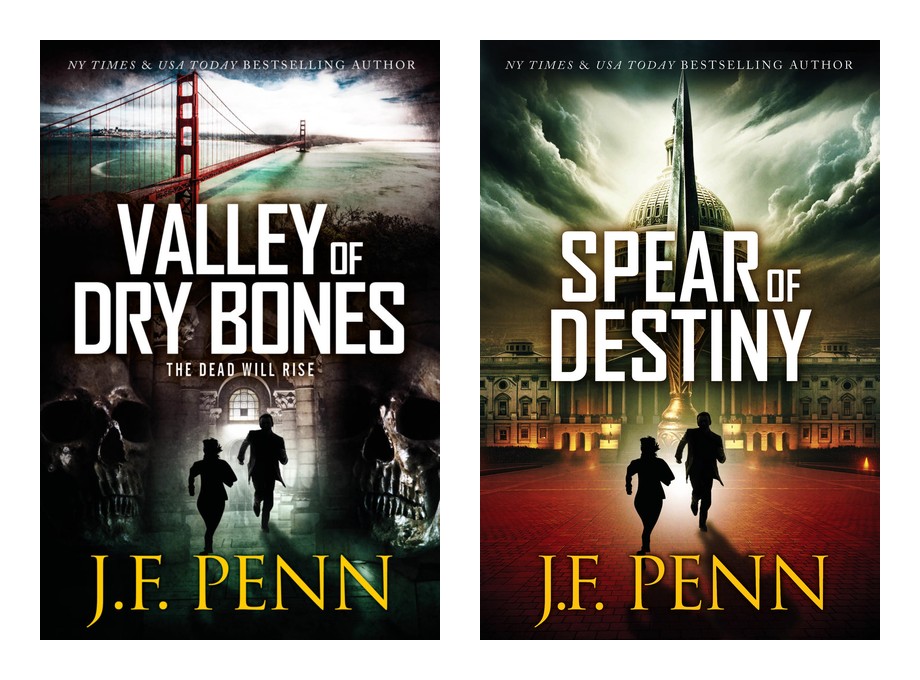
Valley of Dry Bones (ARKANE book 10). When a monk is found murdered beneath a New Orleans cemetery, his flesh carved with occult markings, ARKANE agents Jake Timber and Morgan Sierra discover that someone is hunting the Hand of Ezekiel, a relic said to have the power to raise the dead.
The trail runs from New Orleans to Spain, the Philippines and San Francisco, through the basilica in Palma where Junípero Serra preached and on to his relic at Mission Dolores.
Spear of Destiny (ARKANE book 13). When a relic is stolen from a museum in Vienna, Morgan and Jake race to find the Spear of Destiny, the holy lance said to have pierced the side of Christ, while Morgan fights a curse that now threatens her niece’s life.
The hunt takes them through Nazi ruins and Tibetan temples to the Library of Congress and the Capitol, which I visited on the same weekend in Washington DC as the basilica.


Leave a Reply