
I worked in Brussels in the late 90s, commuting from London on the first Eurostar on a Monday morning, working long hours on a millennium bug project at a factory site, and coming home Friday for weekends in London. I didn’t spend any time exploring the city and other places in Belgium back then, and returning over 25 years later was a strange encounter indeed. Much has changed, and even more has not!
I visited in early July 2026 for a long weekend with my husband split between Brussels and Bruges, taking the Eurostar from London St Pancras to Brussels-Midi, which takes under two hours, faster than many domestic journeys and with no airport hassles.
We stayed at The Dominican, a hotel built on the site of a fifteenth-century Dominican monastery near La Monnaie opera house. The lifts play Gregorian plain chant as you ride between floors, which set the tone for a weekend of relics and sacred places. The painter Jacques-Louis David lived and died in exile in a house on this site, another layer of history under the breakfast room.
If you can’t visit in person, walk with me through the city in the photos below.
Cathedral of St Michael and St Gudula
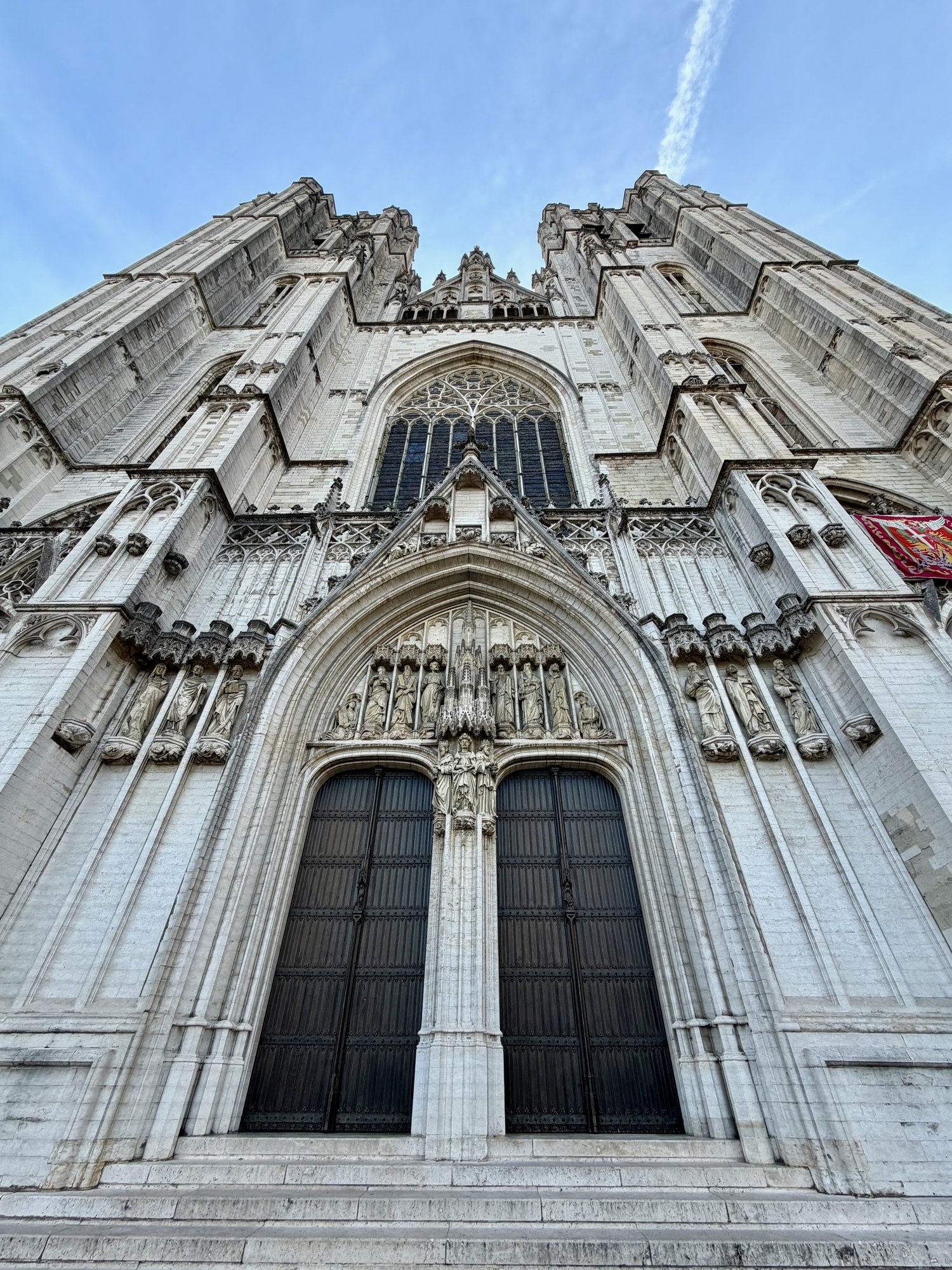
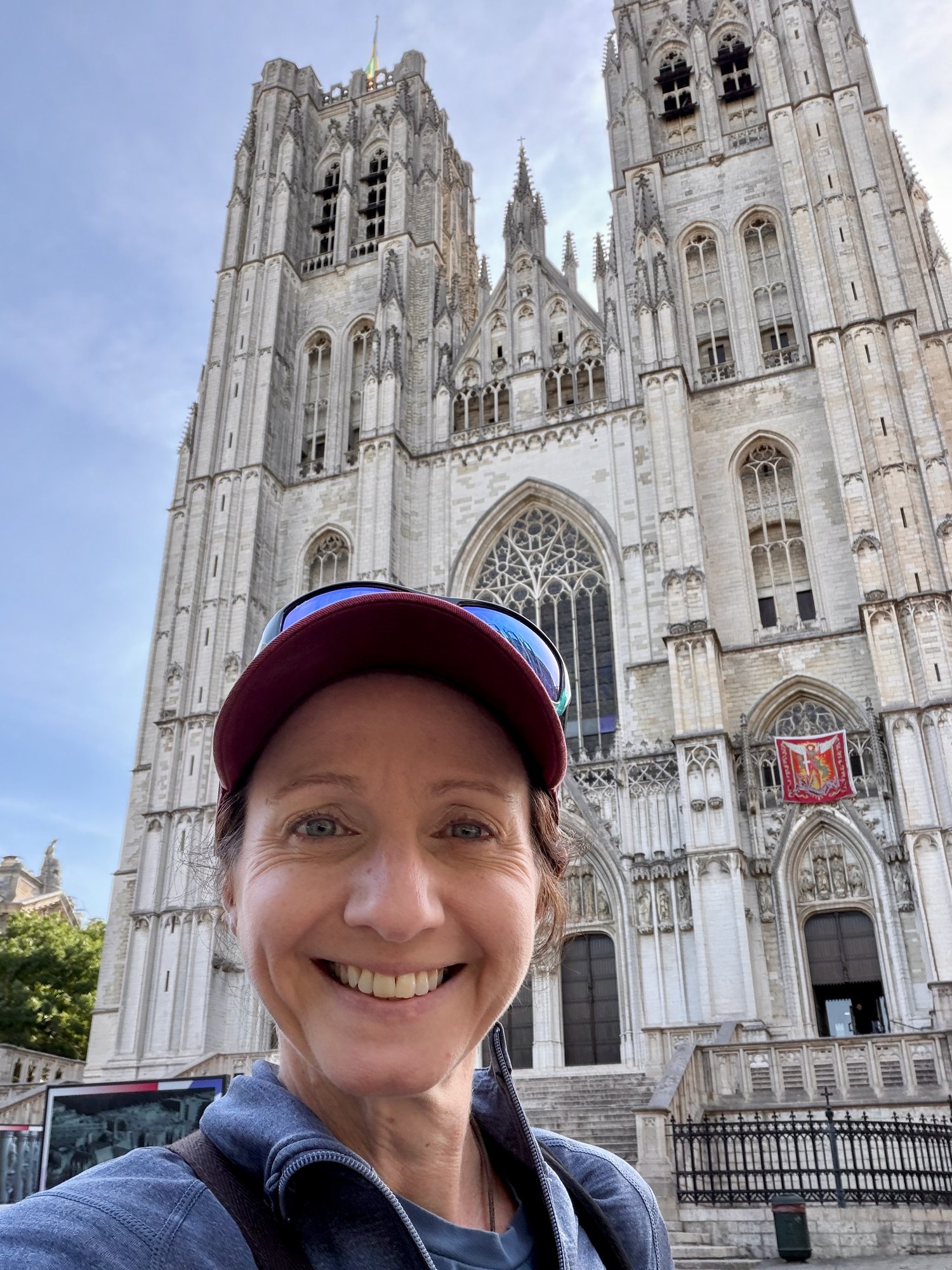
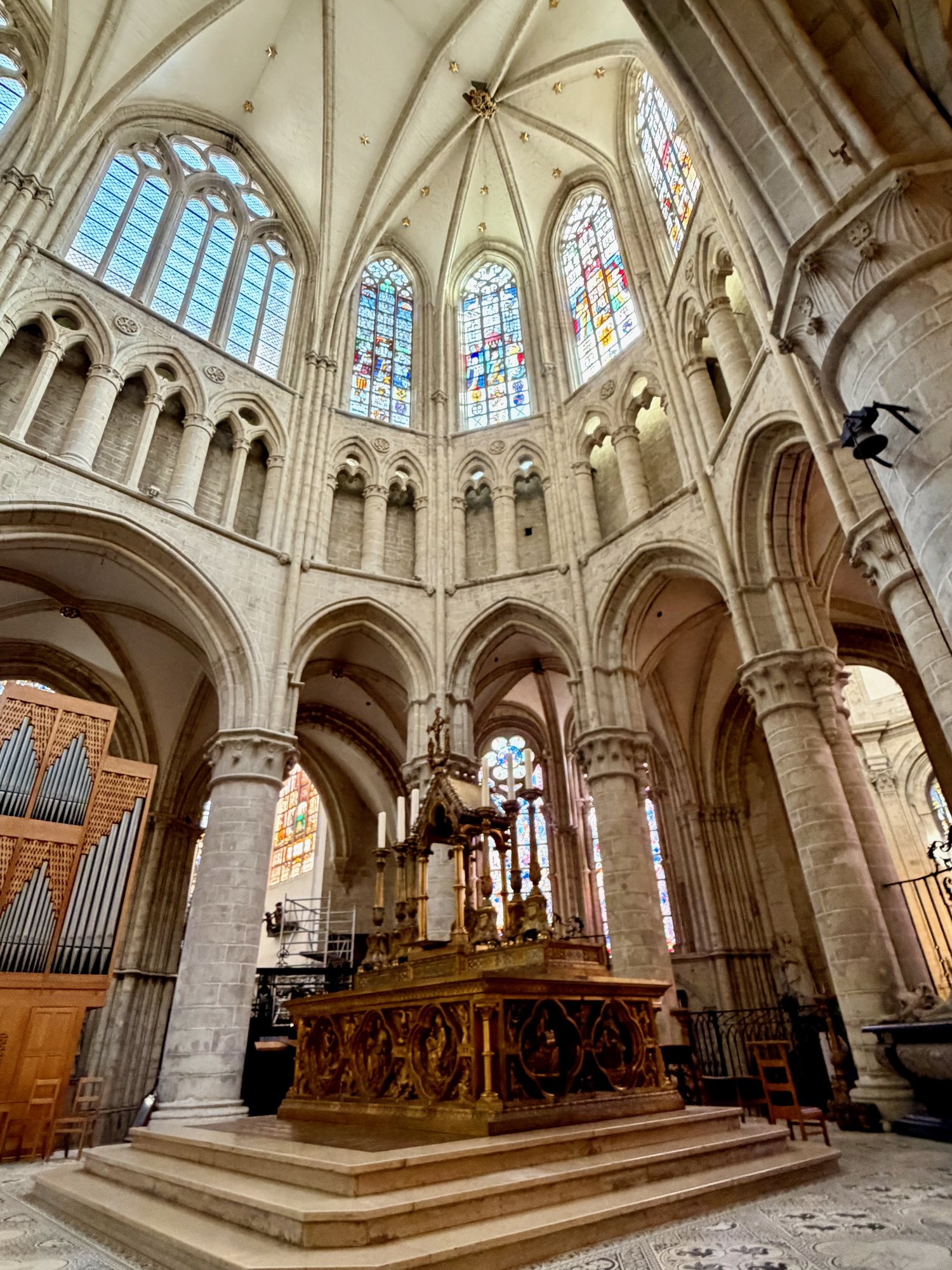
The cathedral celebrates its 800th anniversary in 2026, counting from the Gothic rebuilding begun around 1226. The twin west towers went up between 1470 and 1485, and the whole church was only completed in 1519.
Its patron Gudula died in 712, and legend says the devil kept blowing out her lantern on the way to morning prayers until an angel relit it. The cathedral describes her lantern as “the small flame of Christian faith, shining in a troubled time.”
This is where Belgian royalty marry, including King Baudouin and Fabiola in 1960, and the current King Philippe and Queen Mathilde in 1999.
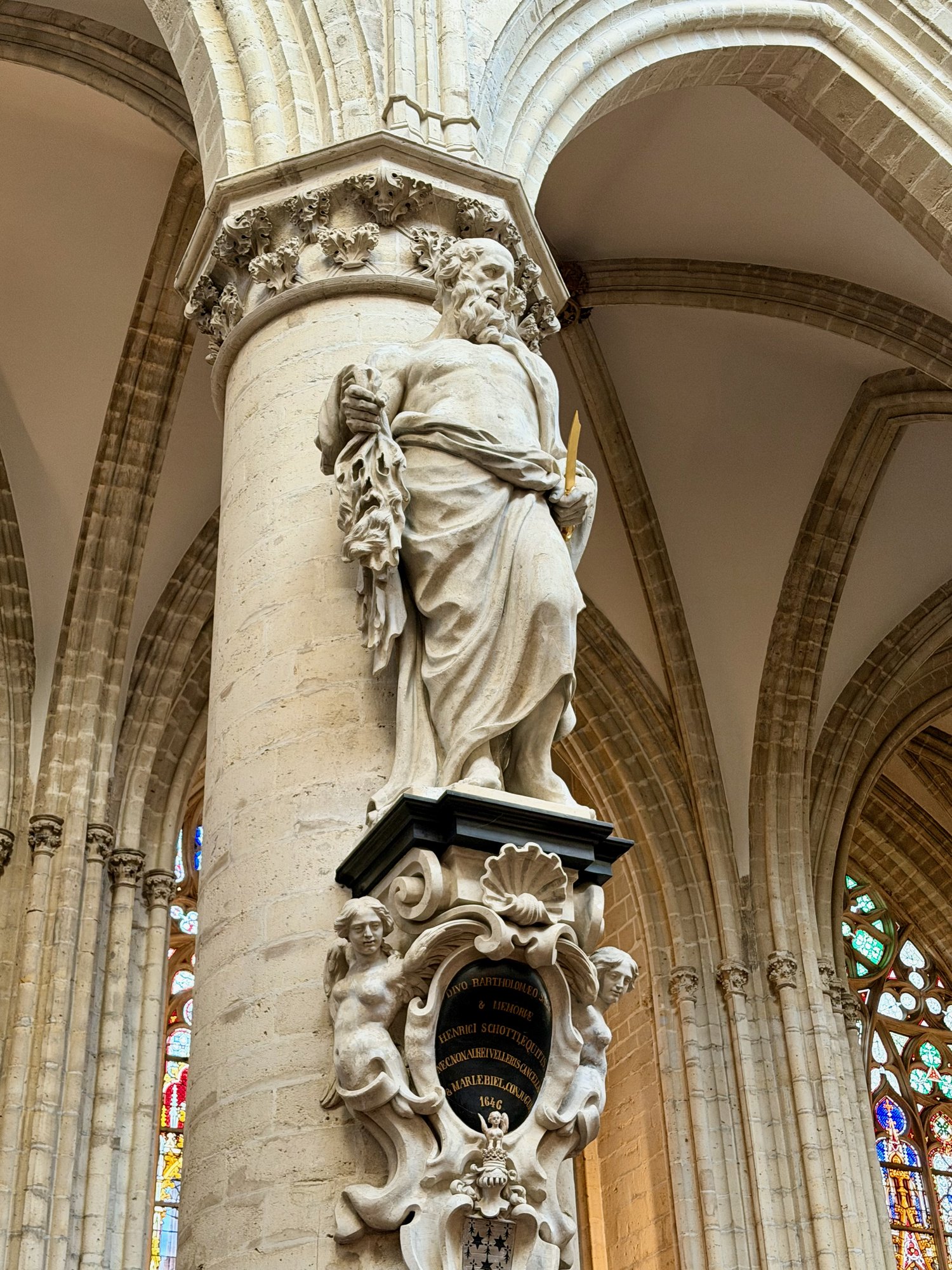
Inside, the most noticeable thing is the apostles. Twelve huge statues lean out from the nave columns, carved in the seventeenth century to replace those destroyed by Calvinist iconoclasts in 1579, most carrying the instruments of their own martyrdom. They are quite gruesome. Below, St Bartholomew holds his flayed skin draped over one arm like a folded coat, the skinning knife ready in his other hand.
Look up mid-sermon and you would remember exactly what faith once cost.
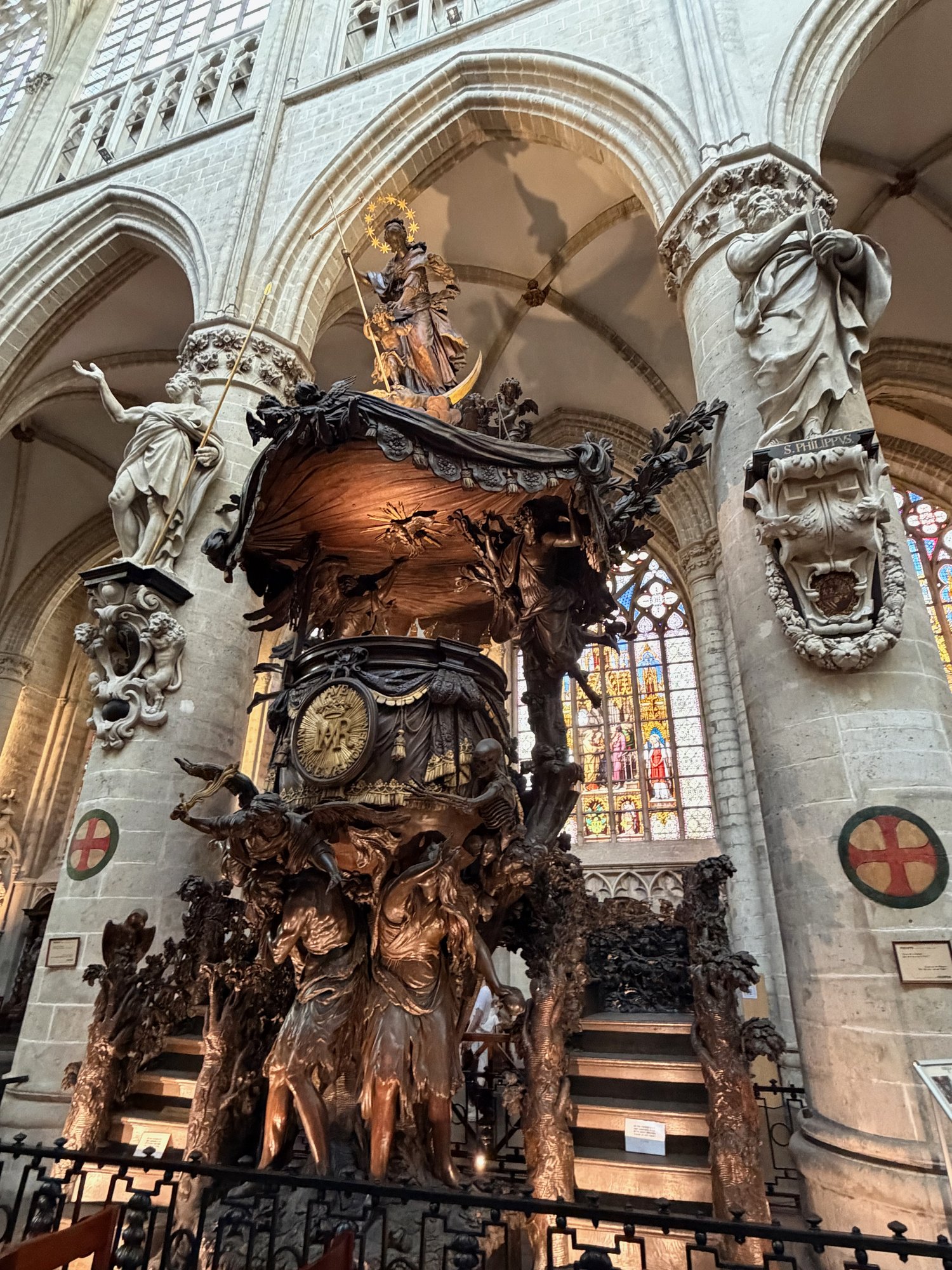
The pulpit is a whole sermon in carved oak. Henri-François Verbruggen made it in 1699 for a church in Leuven, and it was installed here in 1776.
At the base, Adam and Eve are driven out of Eden while a skeleton claws at them from beneath the tree. The cathedral’s guide says “a grimacing skeleton represents the mortal nature of man, fallen into sin.” At the very top, the Virgin and Child pierce the serpent’s head with a cross. Fall at the bottom, redemption at the top, and Death in the middle where the preacher stands.
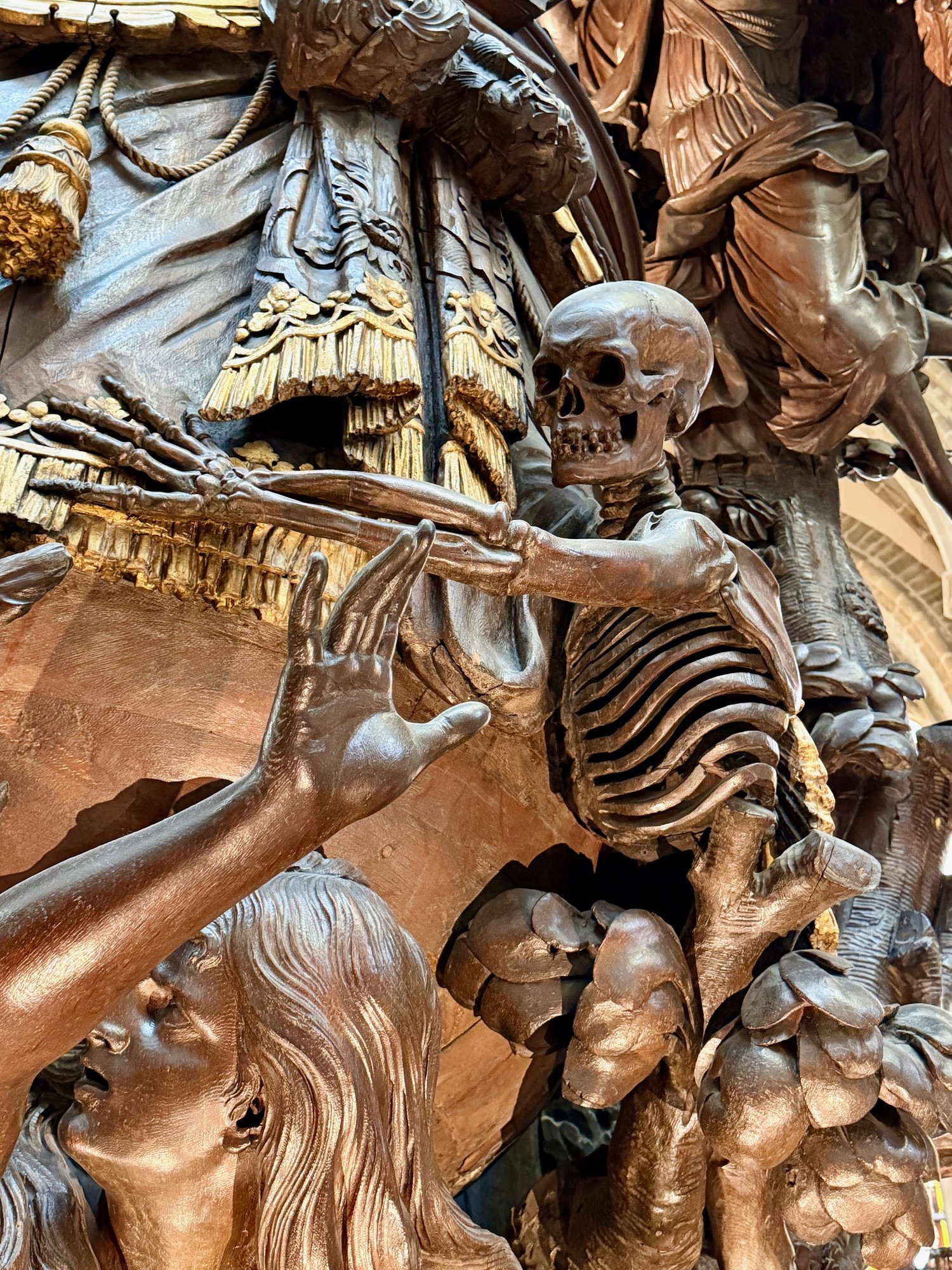
I collect memento mori on my travels, and so I had to get a close up of the skeleton, reaching out of the carved undergrowth as Adam and Eve flee.
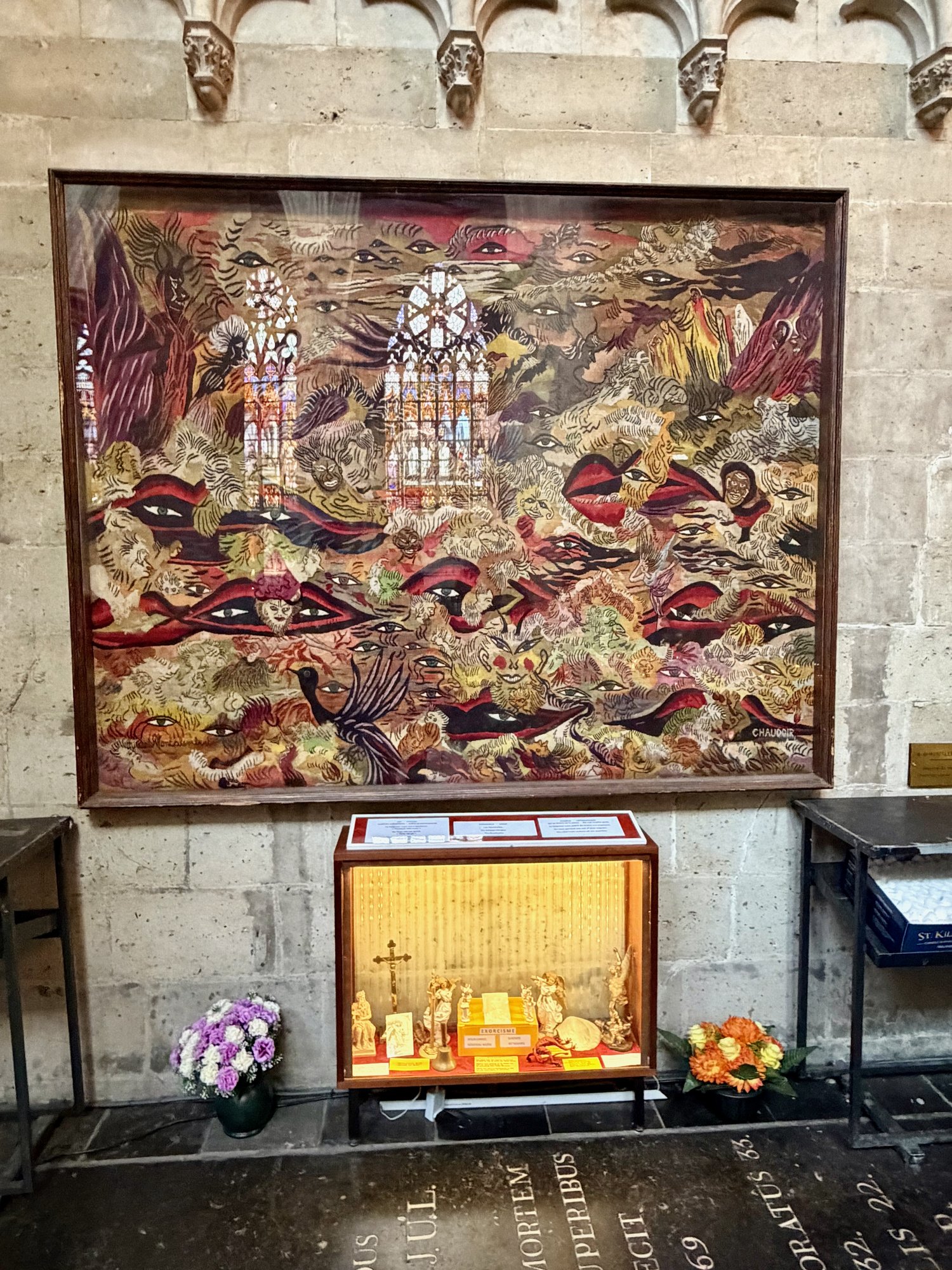
In a side aisle, I found a display case labelled EXORCISME beneath a tapestry covered in staring eyes, signed Chaudoir, one of the historic Brussels tapestry workshops. I could find nothing published explaining the display, which somehow makes it better as it is pretty weird.
Bruegel, biscuits, and street art
From the cathedral, we walked up through the Mont des Arts toward the Sablon.
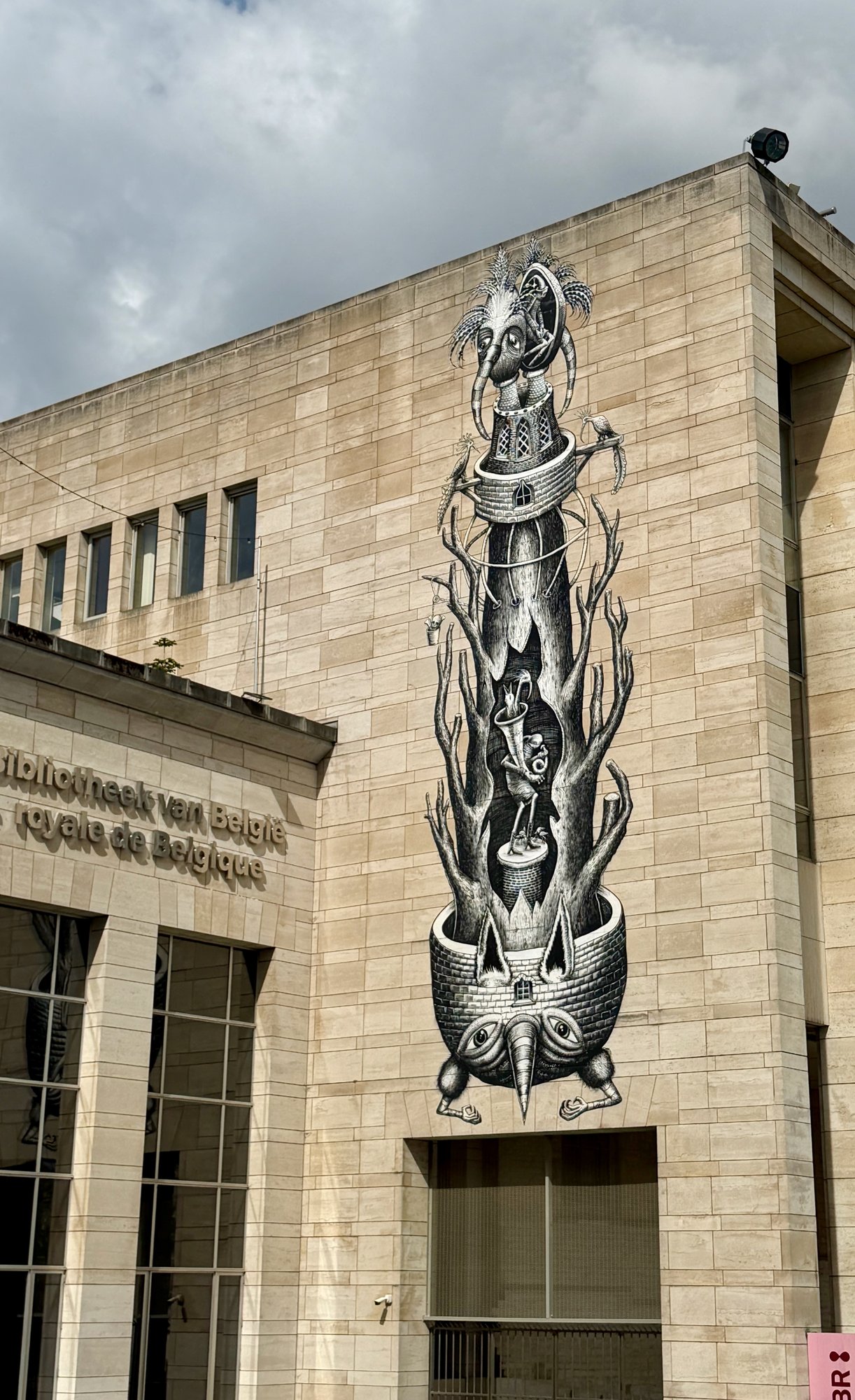
The Royal Library of Belgium has a black-and-white mural by the Sheffield street artist Phlegm, painted in 2019 for the 450th anniversary of Pieter Bruegel the Elder’s death, its tumbling totem of grotesque creatures echoing Bruegel’s prints. Bruegel would have recognised the spirit immediately.
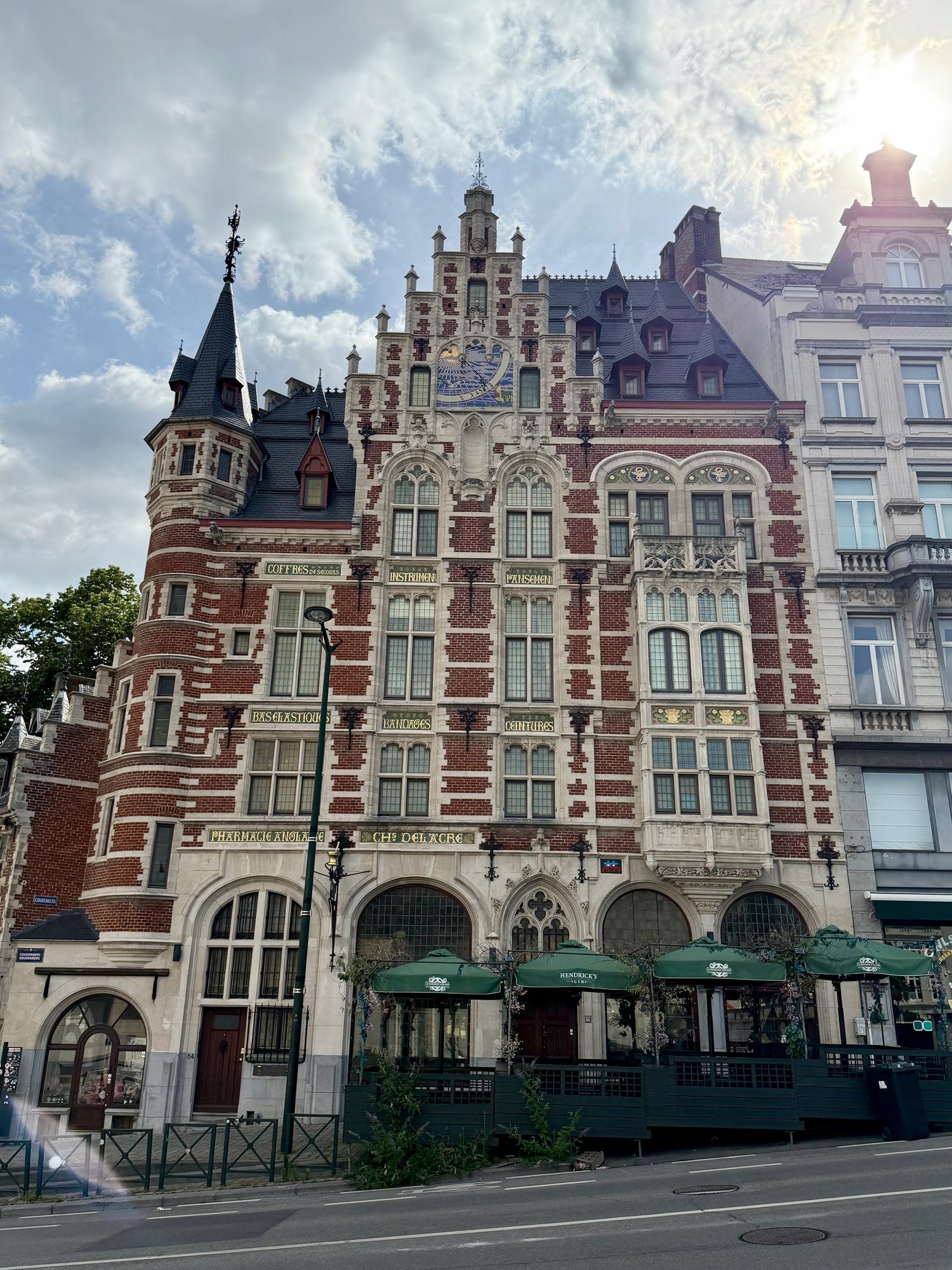
On Coudenberg, the turreted neo-Gothic corner building was once the Pharmacie Anglaise, built in 1900 for Charles Delacre, a pharmacist who sold chocolate as a fortifying medicine before founding the Delacre biscuit company. Chocolate as medicine is a Belgian origin story I can fully support. It’s now a cocktail bar.
Notre-Dame du Sablon
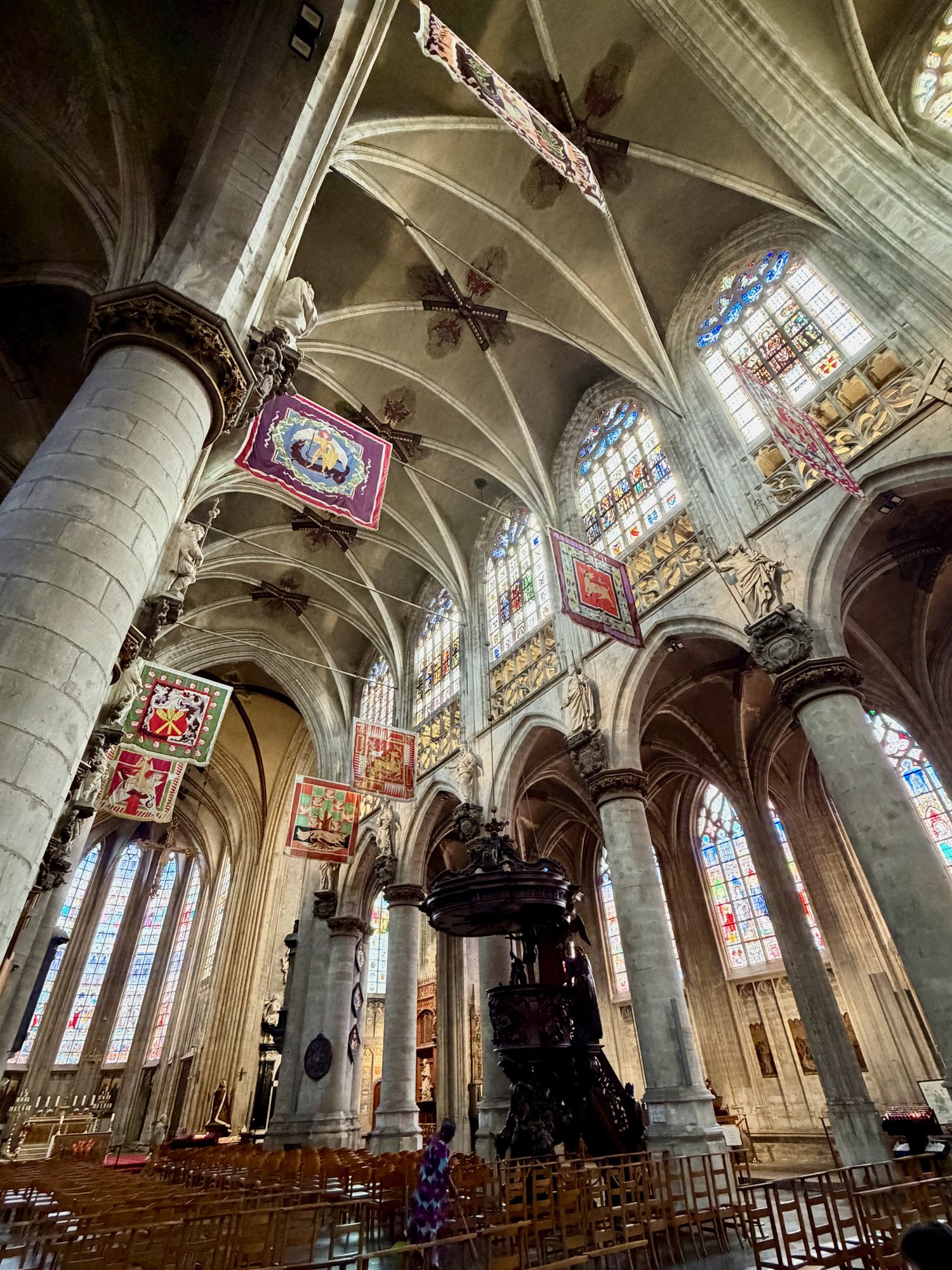
The Sablon church began as a chapel for the city’s crossbowmen’s guild in the early 1300s. In 1348, according to legend, a pious woman named Beatrice Soetkens stole a miracle-working statue of the Virgin from Antwerp on the orders of a vision, and sailed it to Brussels by boat. The crossbowmen enshrined it, pilgrims followed, and their donations built the Flamboyant Gothic church that stands today. The city’s great Ommegang procession began as the annual celebration of that statue.
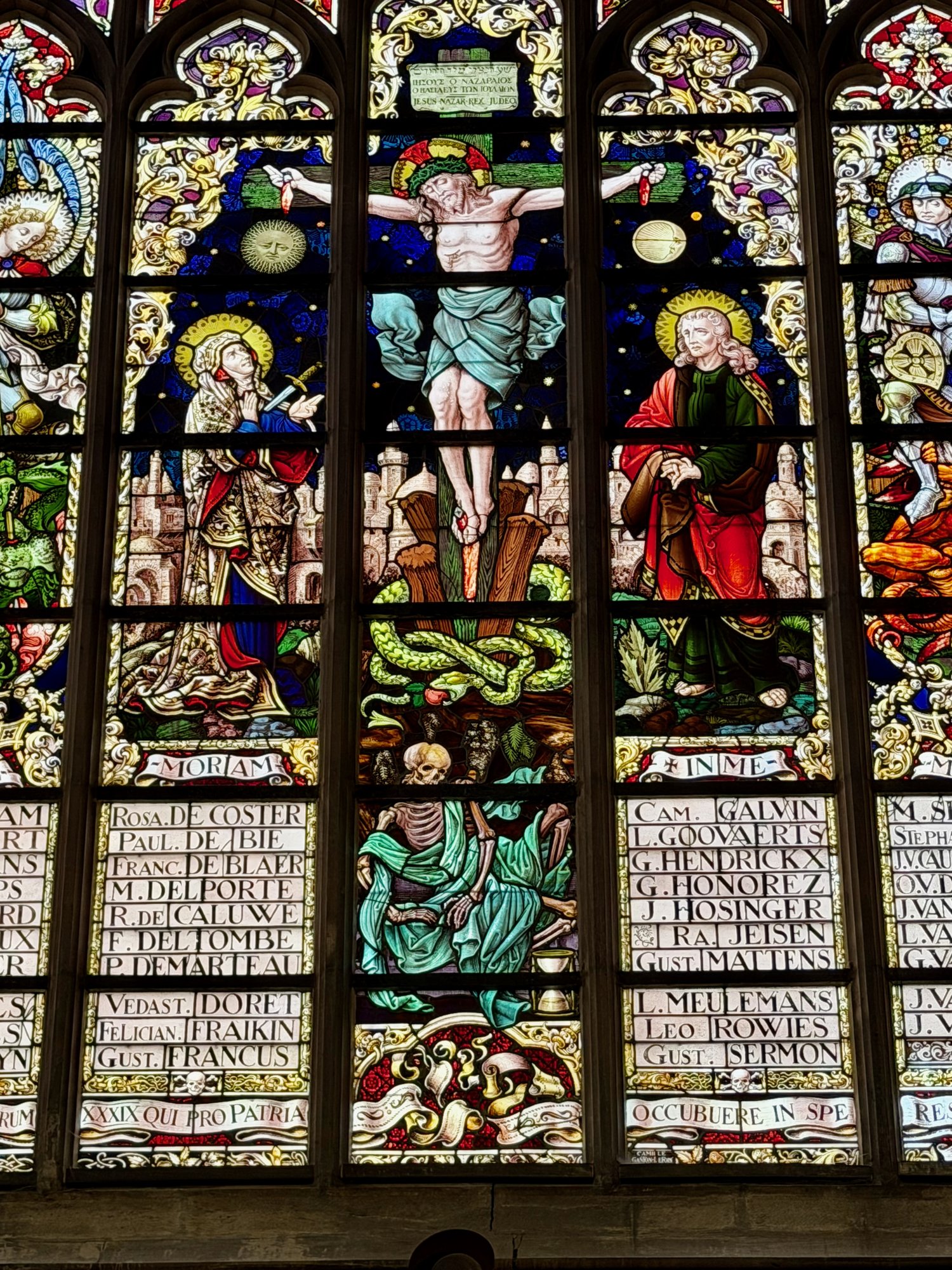
One window stopped me on the way in. Below a crucifixion, a skeleton Death holds an hourglass over a list of names of the parish dead of the First World War, with the Latin line QUI PRO PATRIA OCCUBUERE IN SPE, who died for the fatherland in hope. War memorials usually reach for angels. This one reached for the older, harder imagery.
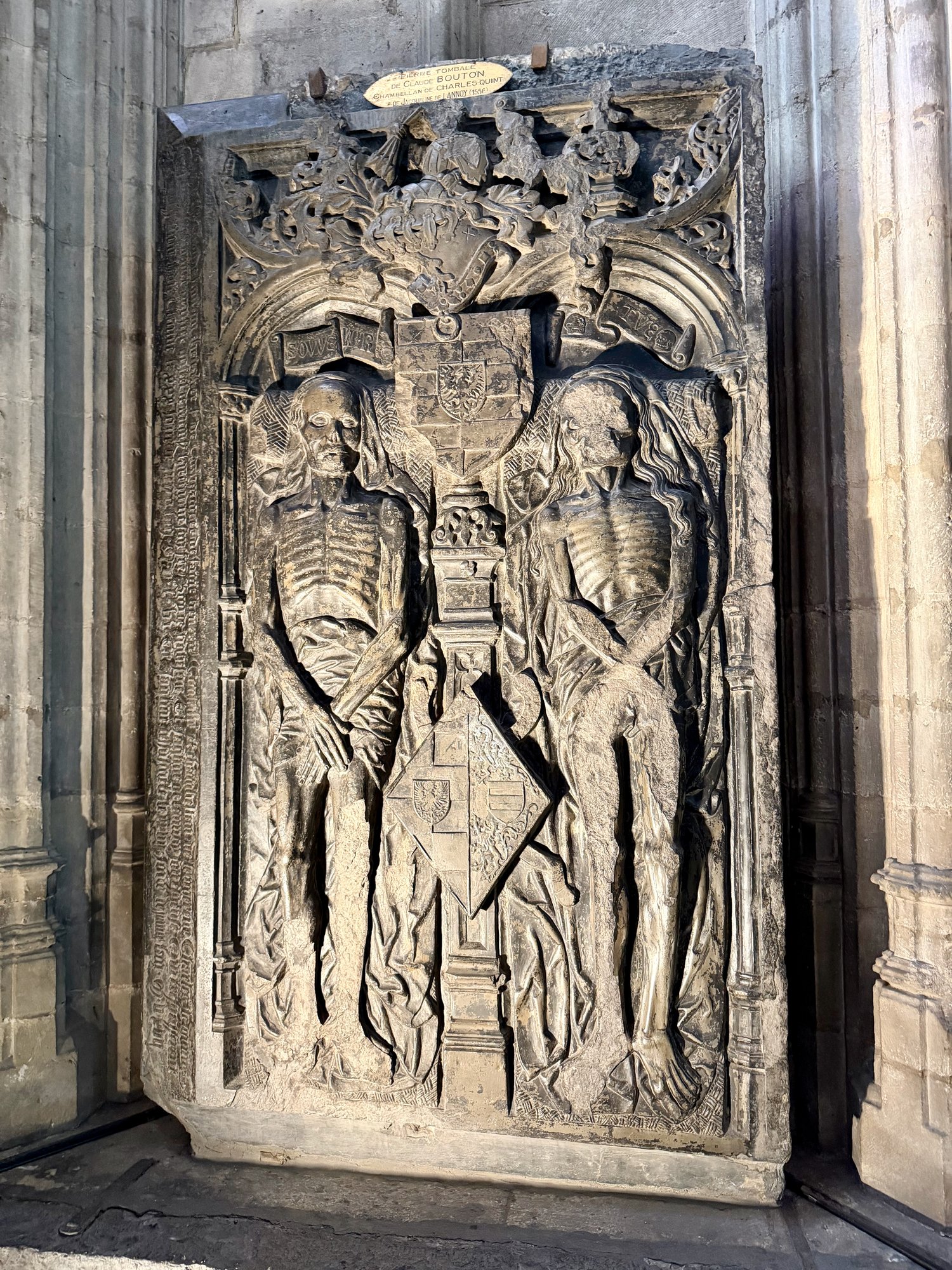
More memento mori in the 1556 tombstone of Claude Bouton, chamberlain to Emperor Charles V, showing Bouton and his wife Jacqueline de Lannoy as cadavers side by side, her skeleton still trailing long carved hair.
Above their heads runs the motto Souvenir tue, remembrance kills.
Notre-Dame de la Chapelle and Bruegel’s grave
Ten minutes south, in the Marolles district, Notre-Dame de la Chapelle is one of the oldest churches in Brussels, documented from 1134, with a choir from the 1250s and a nave rebuilt in the fifteenth century after a fire in 1405.
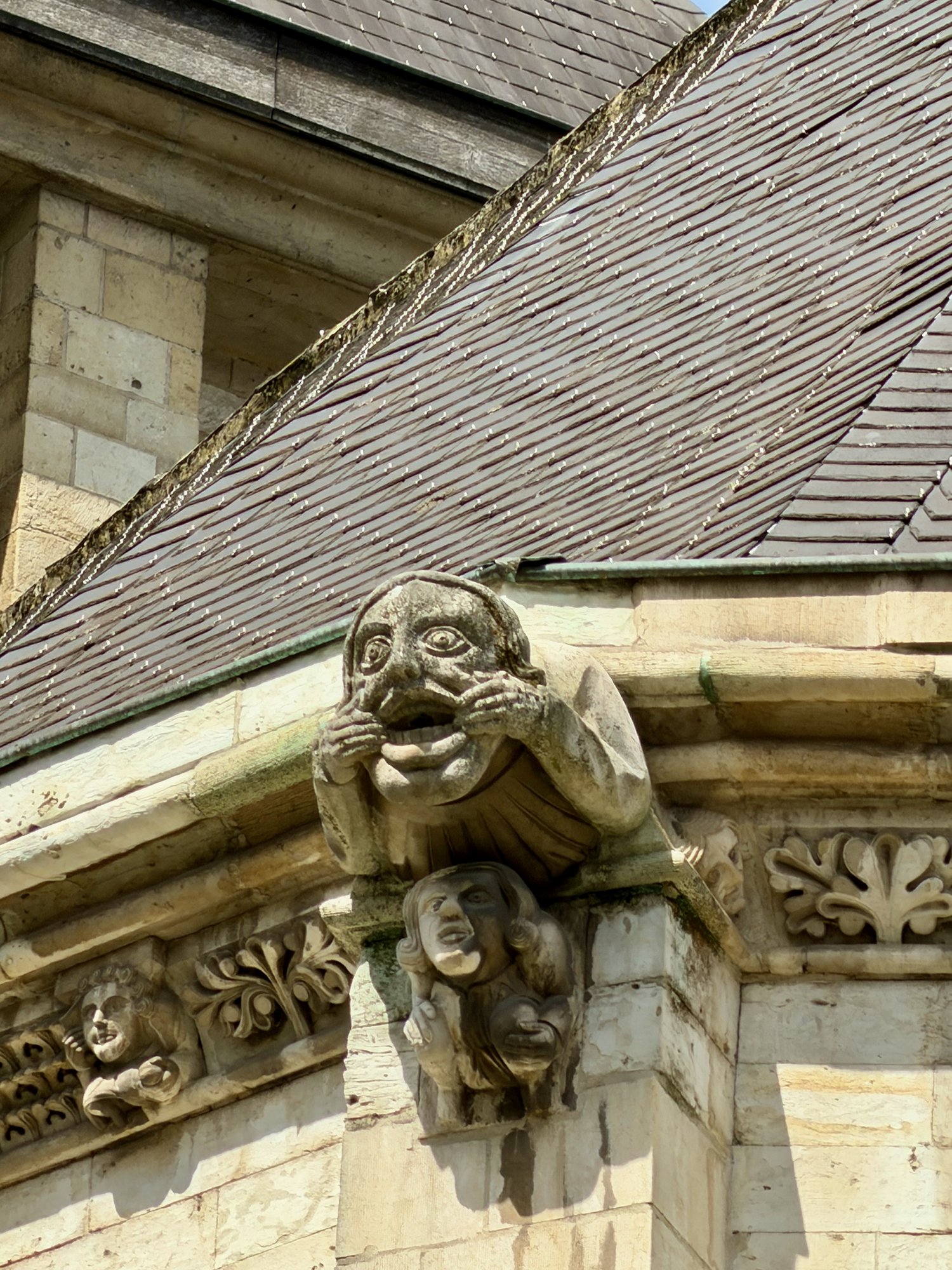
A grotesque on the outside cornice pulls its mouth open with both hands, a medieval face-puller keeping watch over the tourists below.
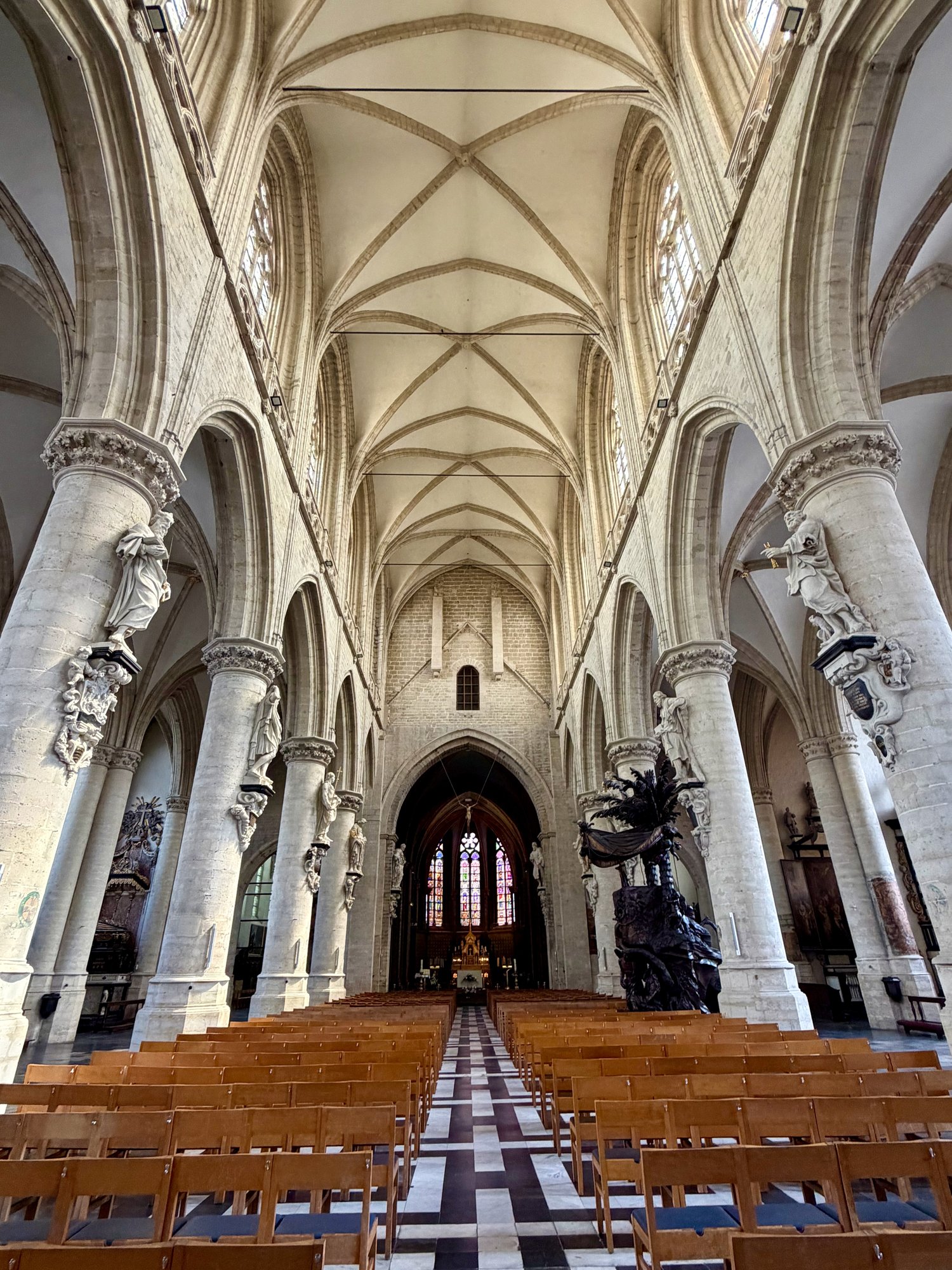
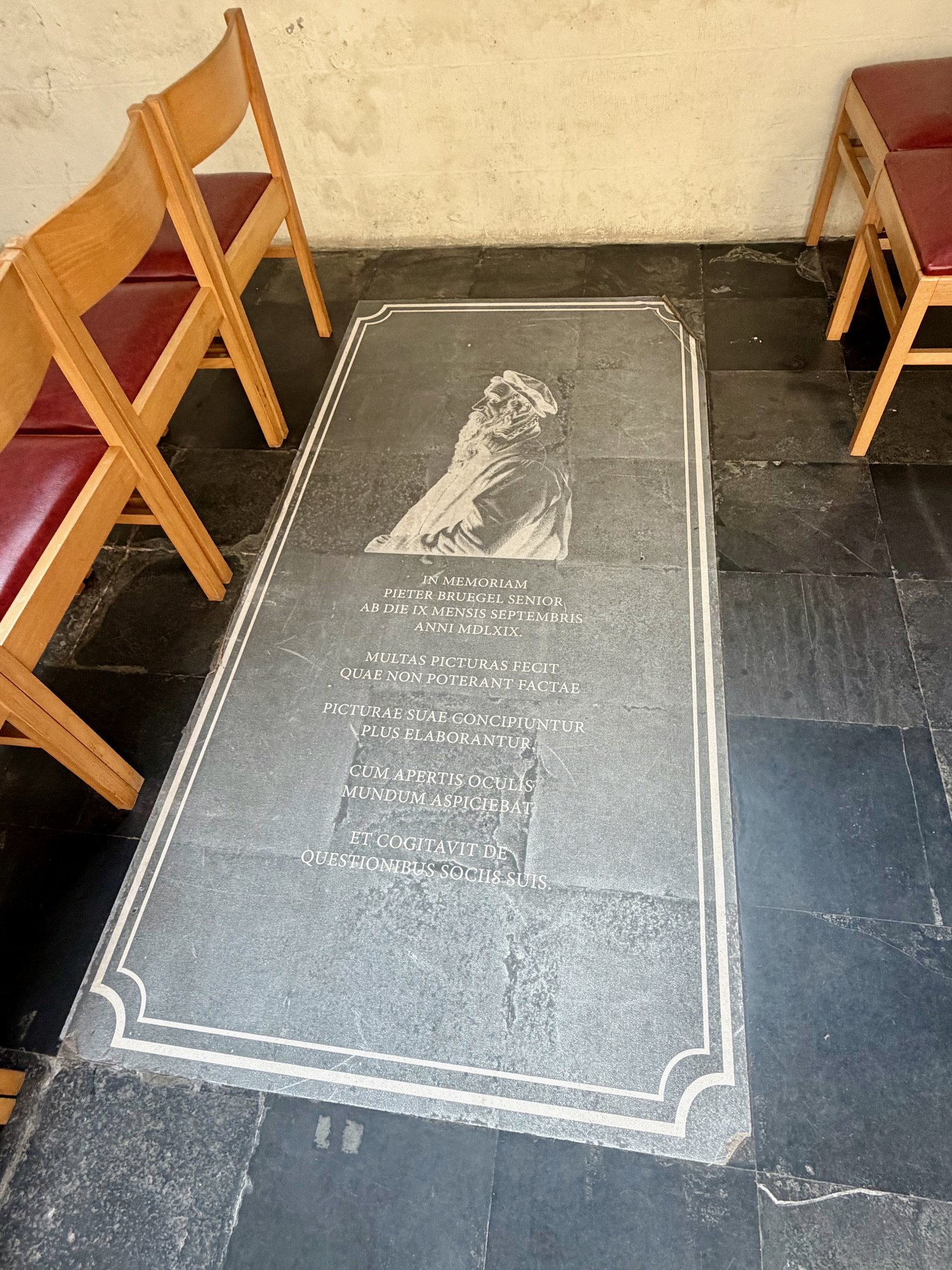
Pieter Bruegel the Elder married in this church in 1563 and was buried here in 1569. His son Jan erected a memorial to his parents, and Rubens, his friend, painted Christ Giving the Keys to Saint Peter for it. The original was sold off in 1765 and replaced with the copy that still hangs above the epitaph.
A modern slab in the floor simply reads IN MEMORIAM PIETER BRUEGEL SENIOR. The greatest painter of Flemish peasant life lies in a quiet side chapel, a few streets from where he lived on the Rue Haute.
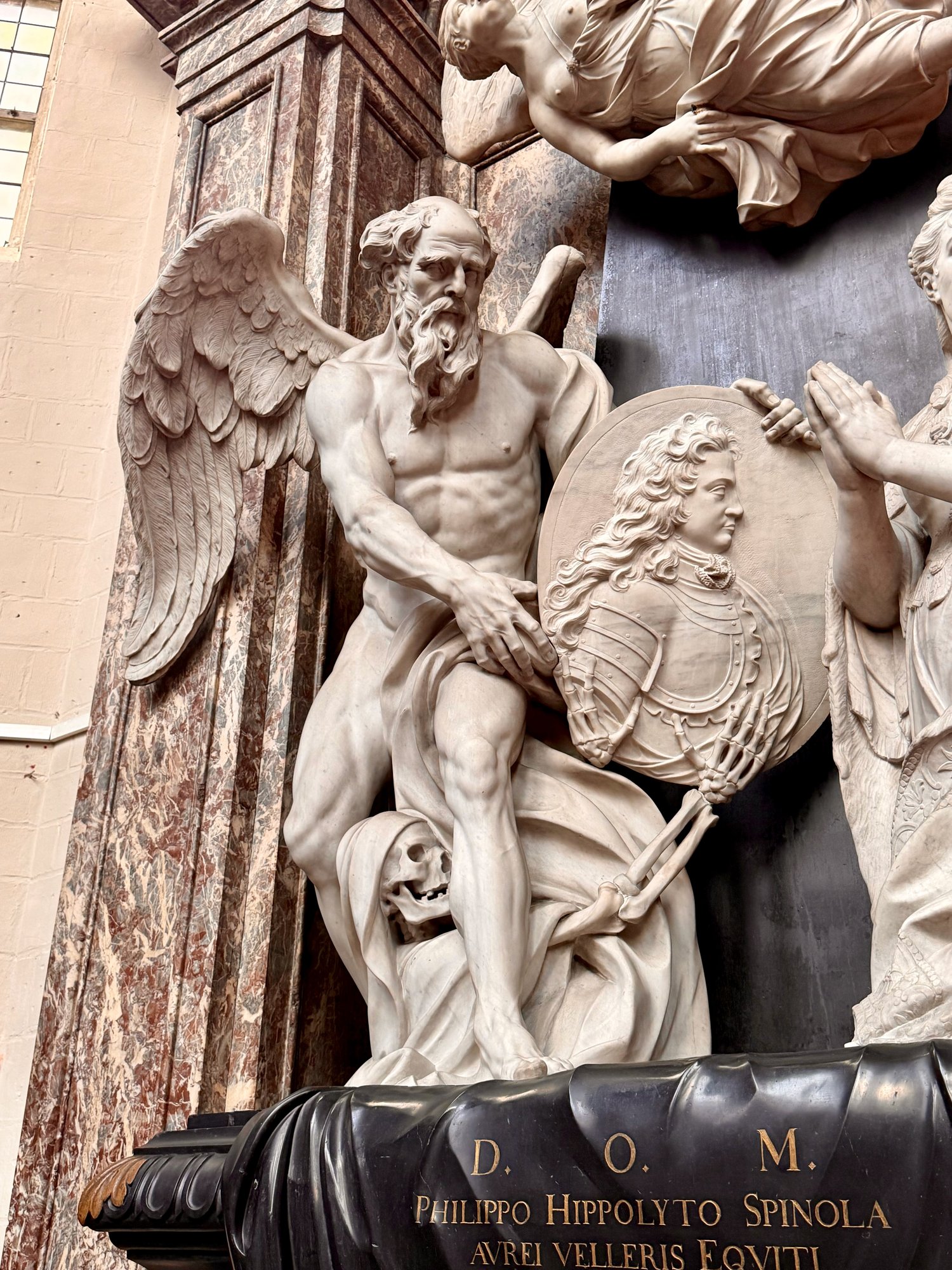
The baroque monument to Philippe Hippolyte Spinola, a Knight of the Golden Fleece who died in 1670, was completed by Pierre-Denis Plumier in 1717. Winged Time holds up the count’s portrait while Death waits beside him with a skull. Even the grandest military career ends the same way, and the sculptors of the age made sure you knew it.
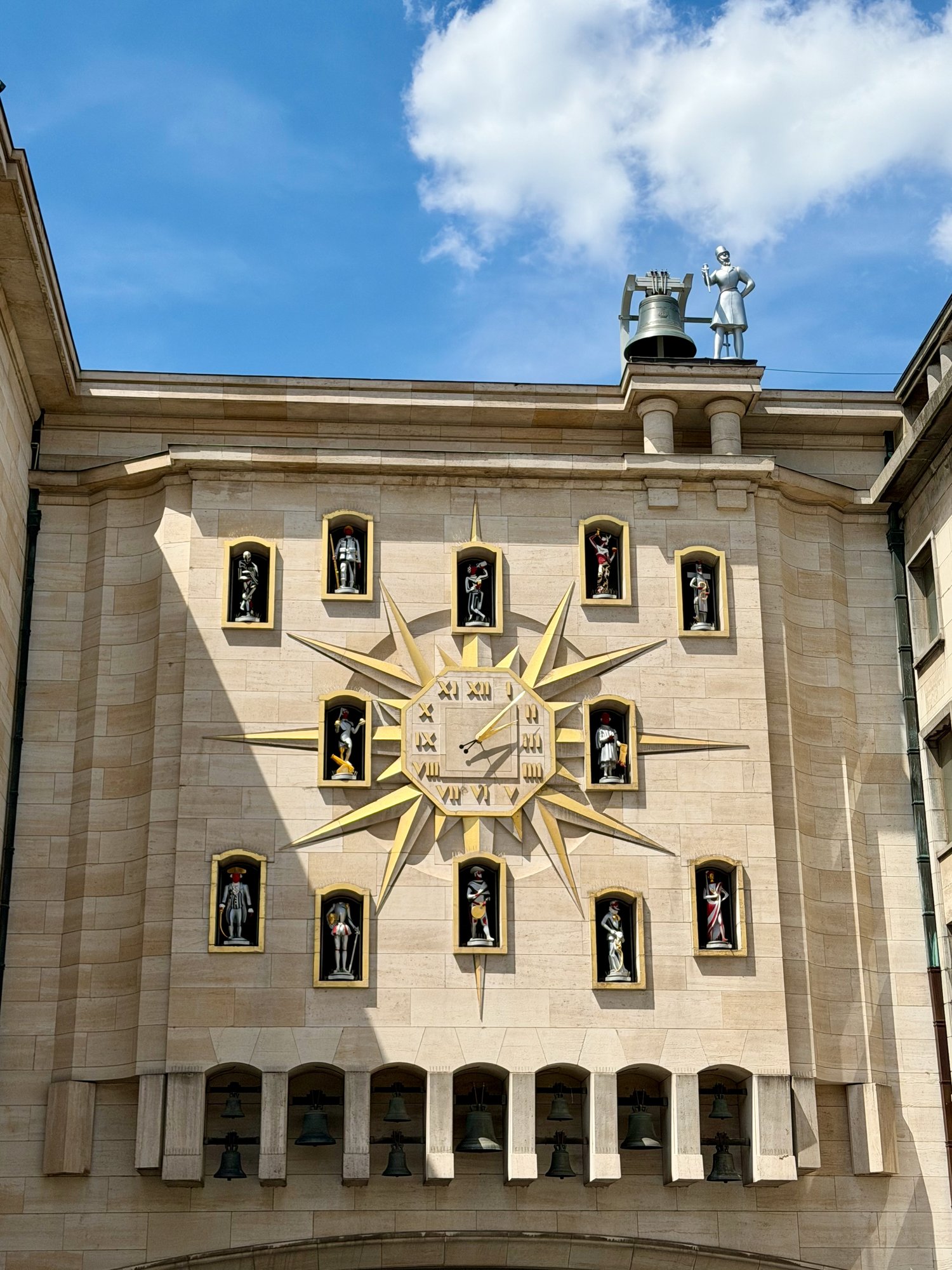
Walking back through the Mont des Arts, we passed under the carillon clock, added in the 1960s to a building constructed for the 1958 World’s Fair. Its star-shaped dial is ringed with twelve niched figures from Brussels history and folklore, watched over by a bronze gentleman in a top hat who hammers the bell.
The Grand-Place
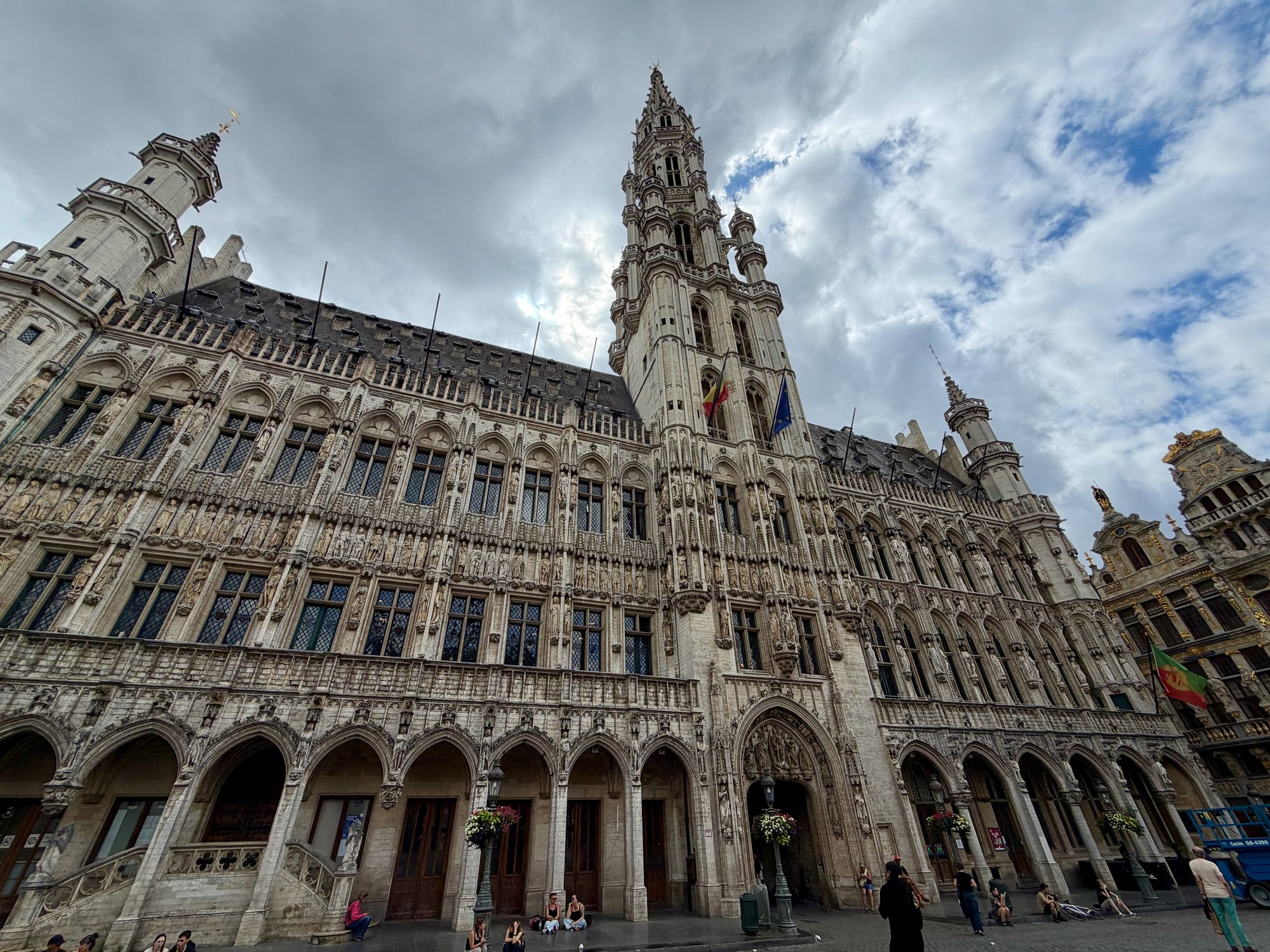
We spent the middle of the weekend in Bruges, and had a few hours back in Brussels before the Eurostar home, enough for a quick visit to the Grand-Place, which UNESCO calls “a remarkably homogeneous body of public and private buildings, dating mainly from the late 17th century.”
The Town Hall is the Gothic exception, built from 1401, its 96-metre tower topped by a gilded St Michael slaying a demon, a weathervane since 1455. Today’s figure is a modern copy, and the original is kept in the Brussels City Museum across the square.
Beware, this is a hugely busy tourist area and while worth visiting out of normal hours, can be heaving if you go during busy times.
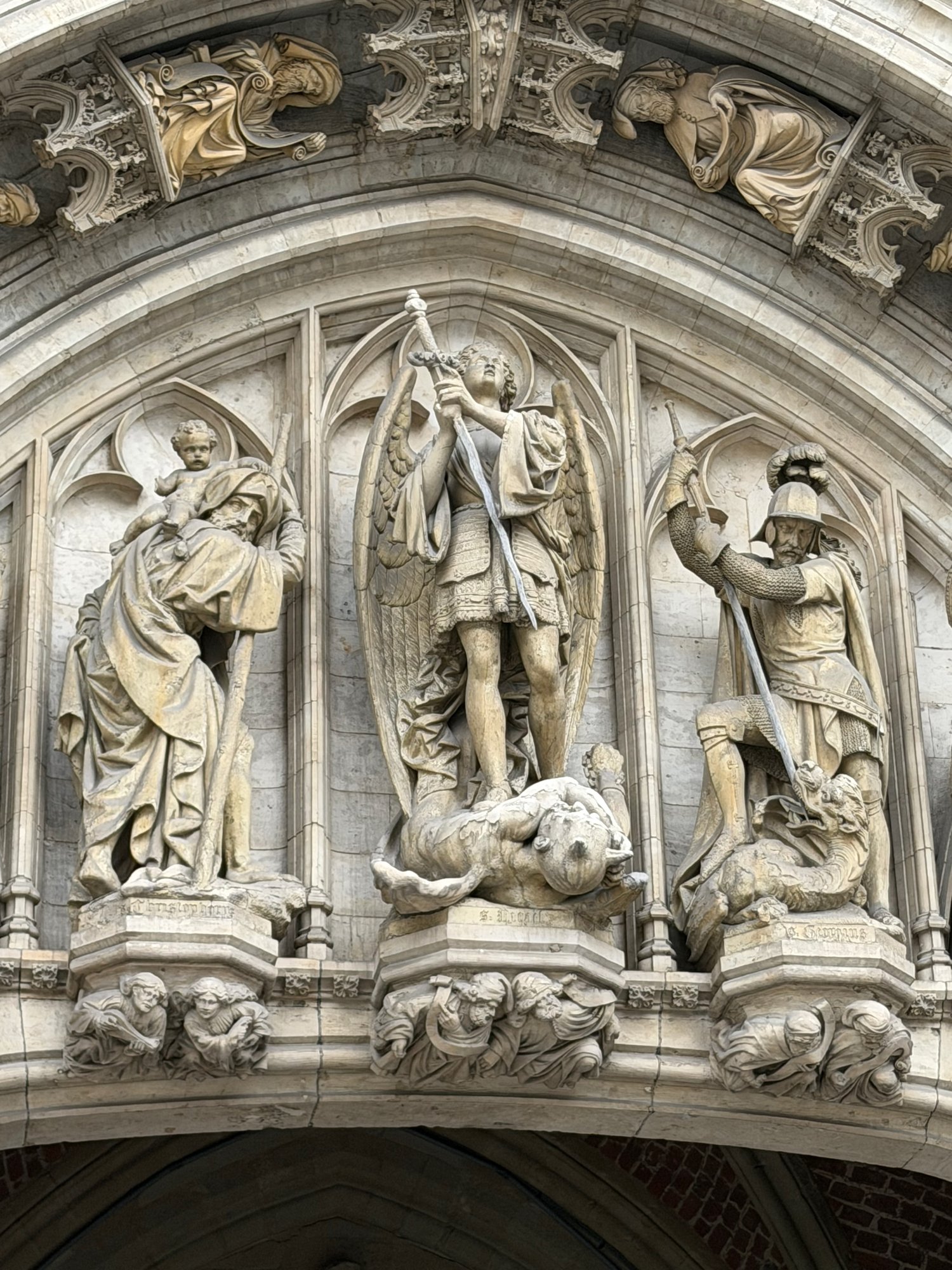
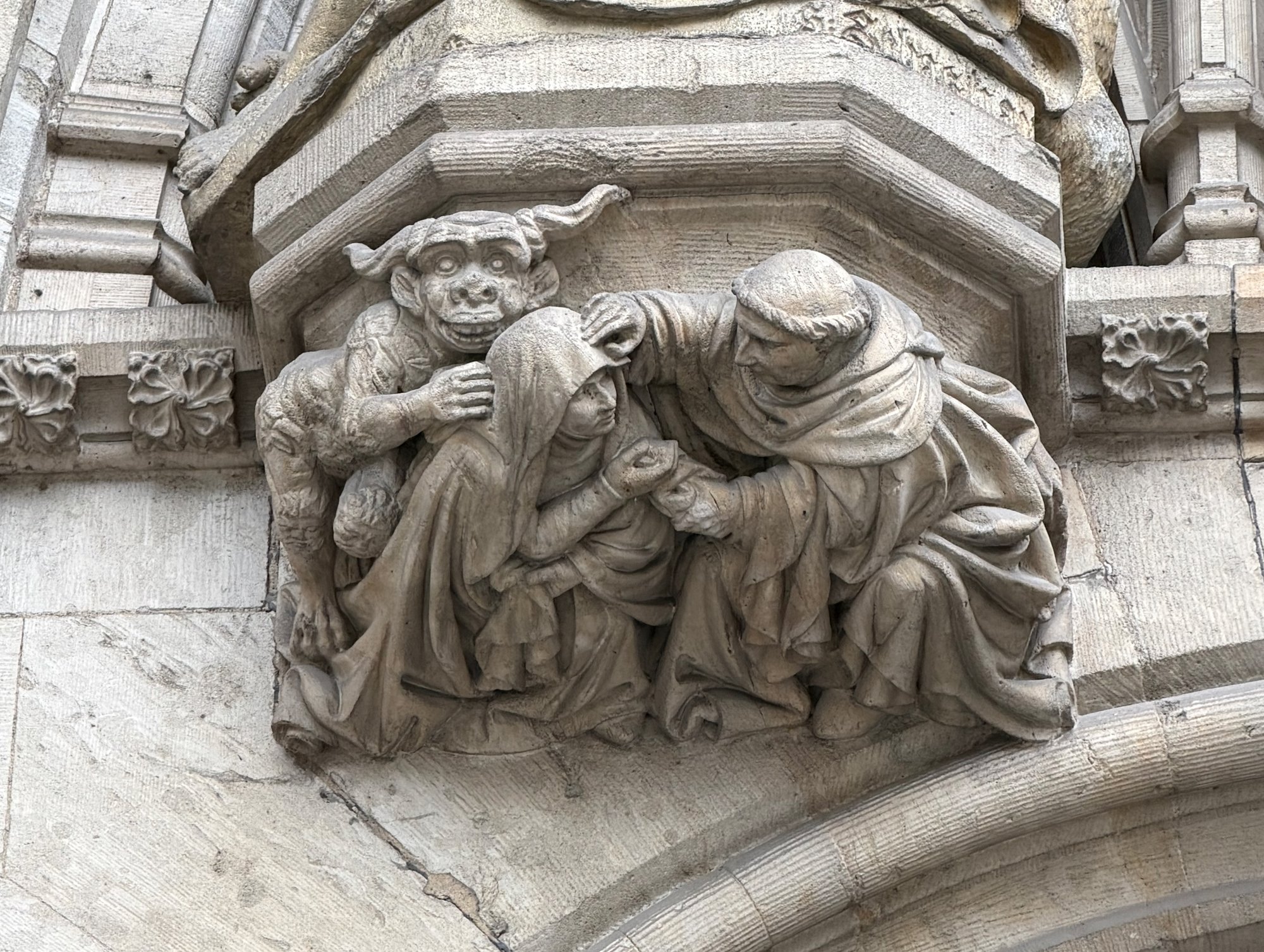
The saints over the portal have their own demons to manage, and on a corbel nearby a horned devil leans companionably over two seated figures.
After a weekend of relics and memento mori, it seemed right to end with the city’s patron running his sword through the darkness in gold, high over the square.
Brussels rewards looking up: saints, skeletons, gilded archangels, and a demon or two. My kind of city break.
Recommended books for Brussels
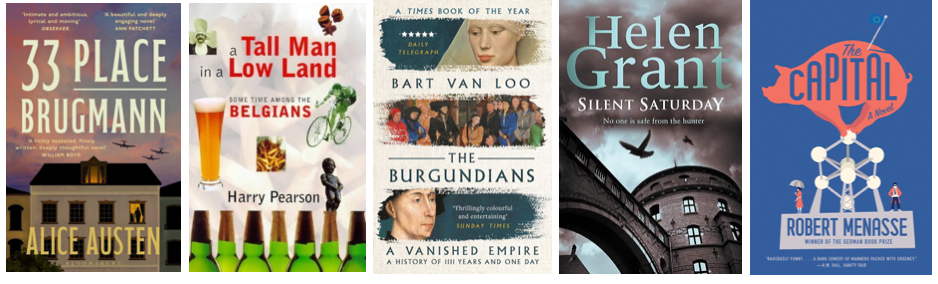
33 Place Brugman — Alice Austen. Charlotte Sauvin has always seen the world differently. At home on 33 Place Brugmann, in the heart of Brussels, her father and her closest friends and neighbours – the Raphaëls from the fourth floor, and Masha from the fifth – have ensured her secret is safe. But when the Nazis invade Belgium, and Masha and the Raphaëls disappear, Charlotte must navigate her new world alone.
A Tall Man in a Low Land: Some Time Among the Belgians — Harry Pearson. It is normal for British travel writers to head south for a destination that is hot, exotic, dangerous, or all three. The author of this book chose a country which is damp, safe and of legendary banality: Belgium. But can any nation whose most famous monument is a statue of a small boy urinating really be that dull?
The Burgundians: A Vanished Empire — Bart van Loo. This is the story of a thousand years, a compulsively readable narrative history of ambitious aristocrats, family dysfunction, treachery, savage battles, luxury and madness. It is about the decline of knightly ideals and the awakening of individualism and of cities, the struggle for dominance in the heart of northern Europe, bloody military campaigns and fatally bad marriages. It is also a remarkable cultural history, of great art and architecture and music emerging despite the violence and the chaos of the tension between rival dynasties.
Silent Saturday — Helen Grant. Seventeen-year-old Veerle is frustrated with life in suburban Brussels. But a chance encounter with a hidden society, whose members illegally break into unoccupied buildings around the city, soon opens up a whole new world of excitement – and danger. When one of the society’s founding members disappears, Veerle suspects foul play. But nothing can prepare her for the horror that is about to unfold when an old foe emerges from the shadows… No one is safe, and The Hunter will strike again…
The Capital — Robert Menasse. A highly inventive novel of ideas written in the rich European tradition, The Capital transports readers to the cobblestoned streets of twenty-first-century Brussels. Chosen as the European Union’s symbolic capital in 1958, this elusive setting has never been examined so intricately in literature.
Leave a Reply