
I love Gothic cathedrals, but I love modern art and architecture just as much, and the two don’t often meet well. Coventry is the exception. It’s the best example I’ve seen of modern ecclesiastical architecture done properly, and I visited in July 2026 to see it for myself. I hope you enjoy the virtual tour.
Coventry Cathedral is not one building, but two, standing at right angles to each other, the old and the new.
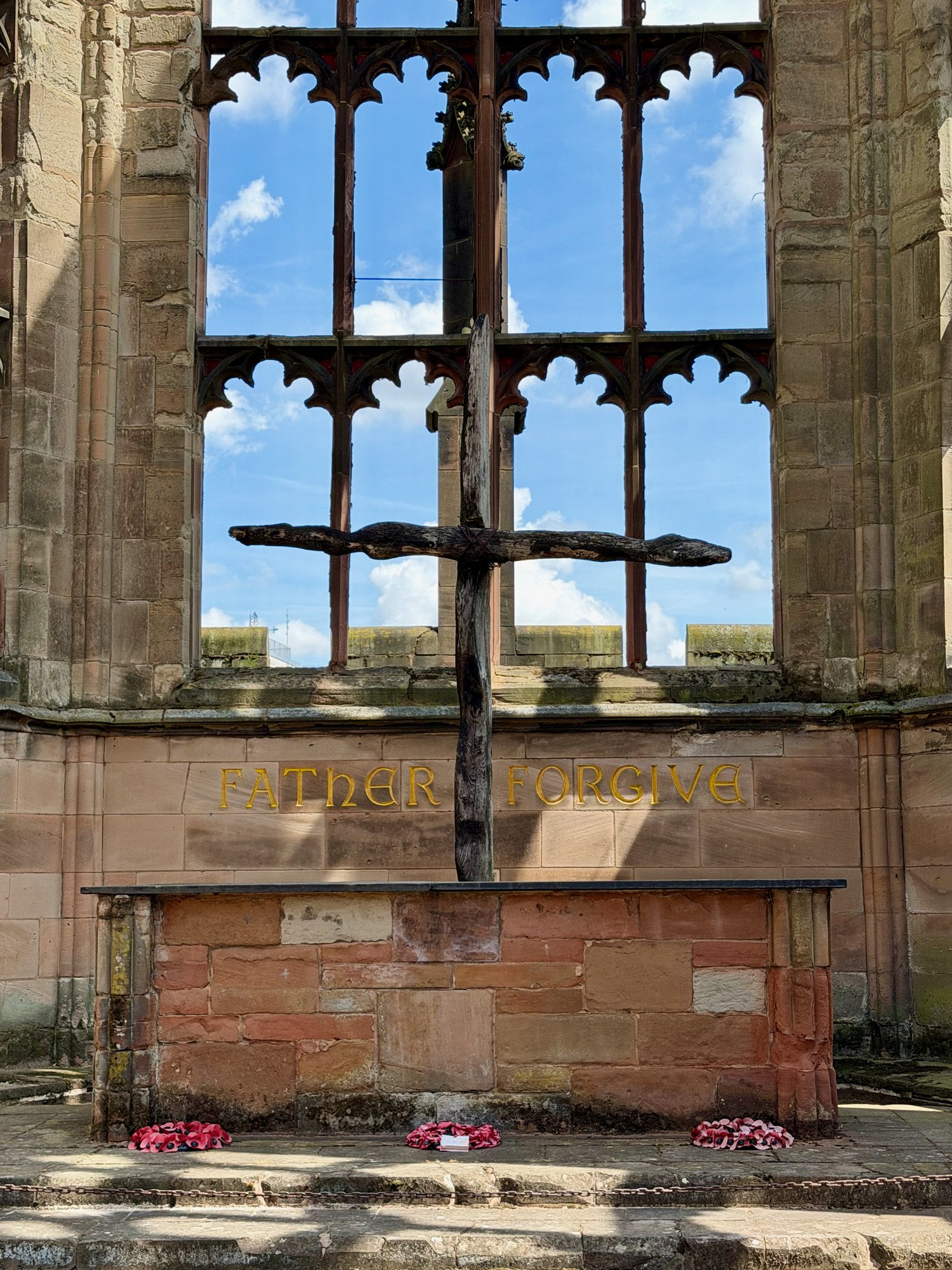
I started in the ruins of the destroyed old cathedral, kept in remembrance.
On the night of 14 November 1940, the Luftwaffe flew an operation they had code-named Moonlight Sonata. 515 bombers came over Coventry and stayed for more than eleven hours, dropping high explosives, incendiaries and parachute mines. 568 people were killed. 4,300 homes were destroyed. The medieval cathedral of St Michael’s burned.
Shortly afterwards, the cathedral’s stonemason, Jock Forbes, noticed that two charred roof timbers had fallen across each other in the shape of a cross. He stood them up in the wreckage on an altar built of rubble. On the sanctuary wall behind, two words were carved.
Father Forgive.
Not Father forgive them, which is what Jesus says from the cross. The words were deliberately cut short, and the cathedral’s own explanation is that it is there to remind us we all need forgiveness, not only those who have harmed us. Provost Dick Howard had those words inscribed after the Blitz, but while Britain was still at war.
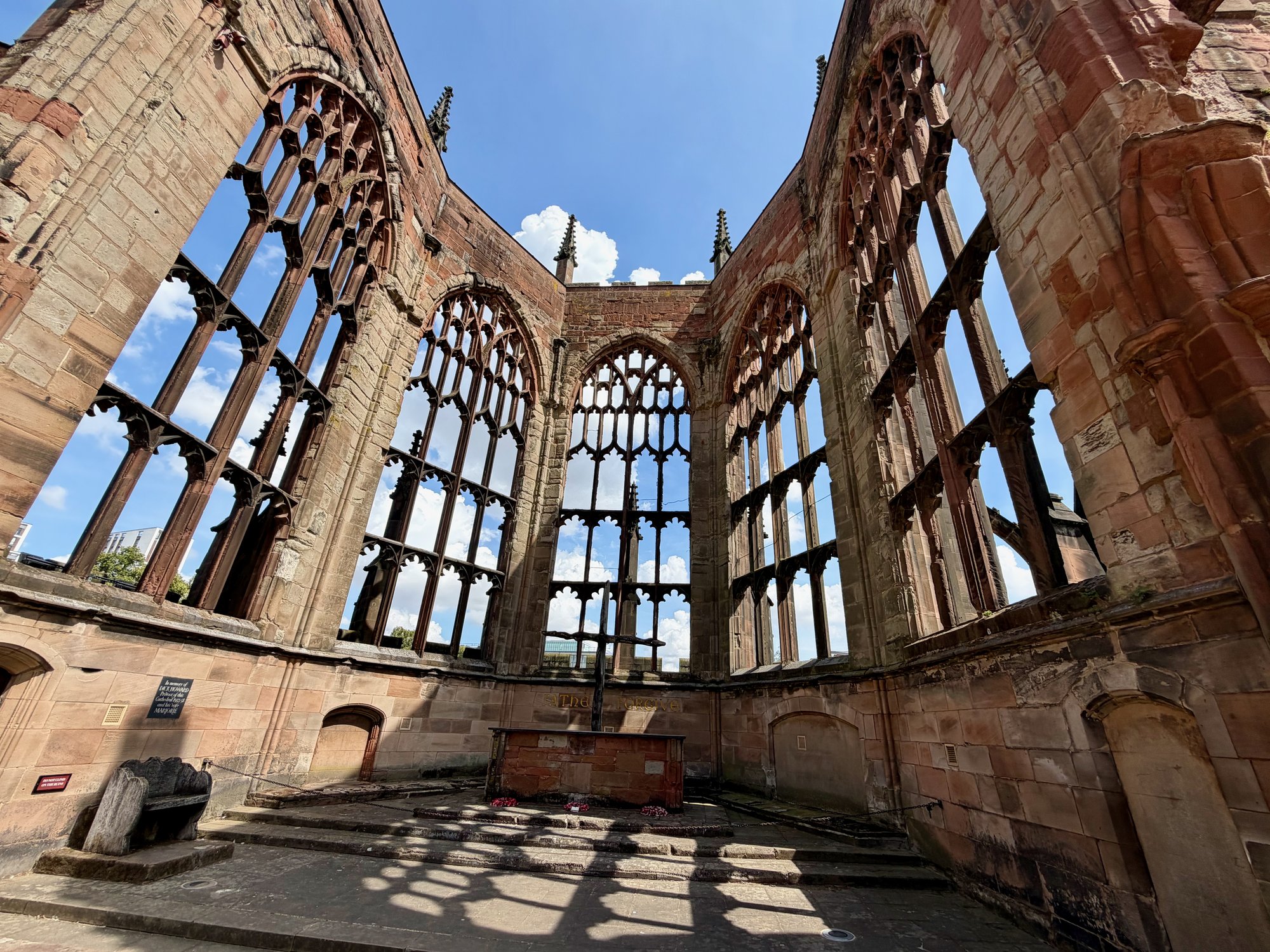
The first thing I do in cathedrals is stand at the back and take a photograph down the nave, and I love a good Gothic ribbed ceiling. Here I stood at the back, looked up, and there was nothing at all. Just tracery, and sky, and weather coming through where the roof used to be. Perhaps even more of a way to think about God …
Coventry has had three cathedrals over the last thousand years. The first was St Mary’s Priory, founded in 1043 by Leofric, Earl of Mercia, husband of Lady Godiva. It was pulled down in 1539 under Henry VIII.
The second was St Michael’s, a parish church begun around 1150 and rebuilt in red sandstone in the 14th and 15th centuries. It was one of the biggest parish churches in the country, and it only became a cathedral in 1918. It only had twenty-two years intact, but as a ruin and a war memorial, it still serves the community.
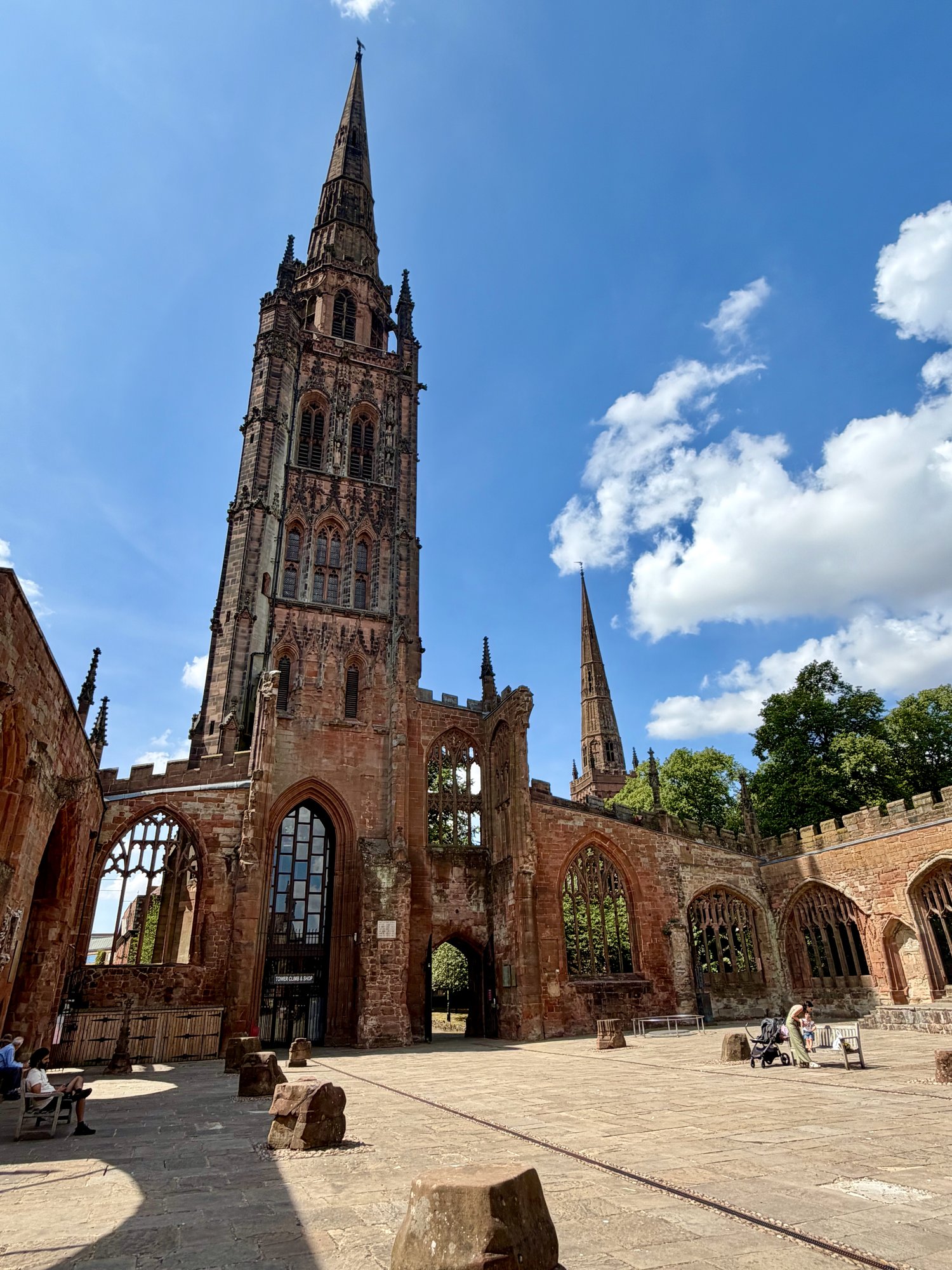
The tower and the spire survived the night that took everything else. The spire is 284 feet to the base of the weathervane, which makes it the third tallest cathedral spire in England after Salisbury and Norwich, and it’s the tallest of Coventry’s famous three spires. You can just see another of the three off to the right.
There’s a tower climb, and a sign for it at the base, but it was closed when we visited.
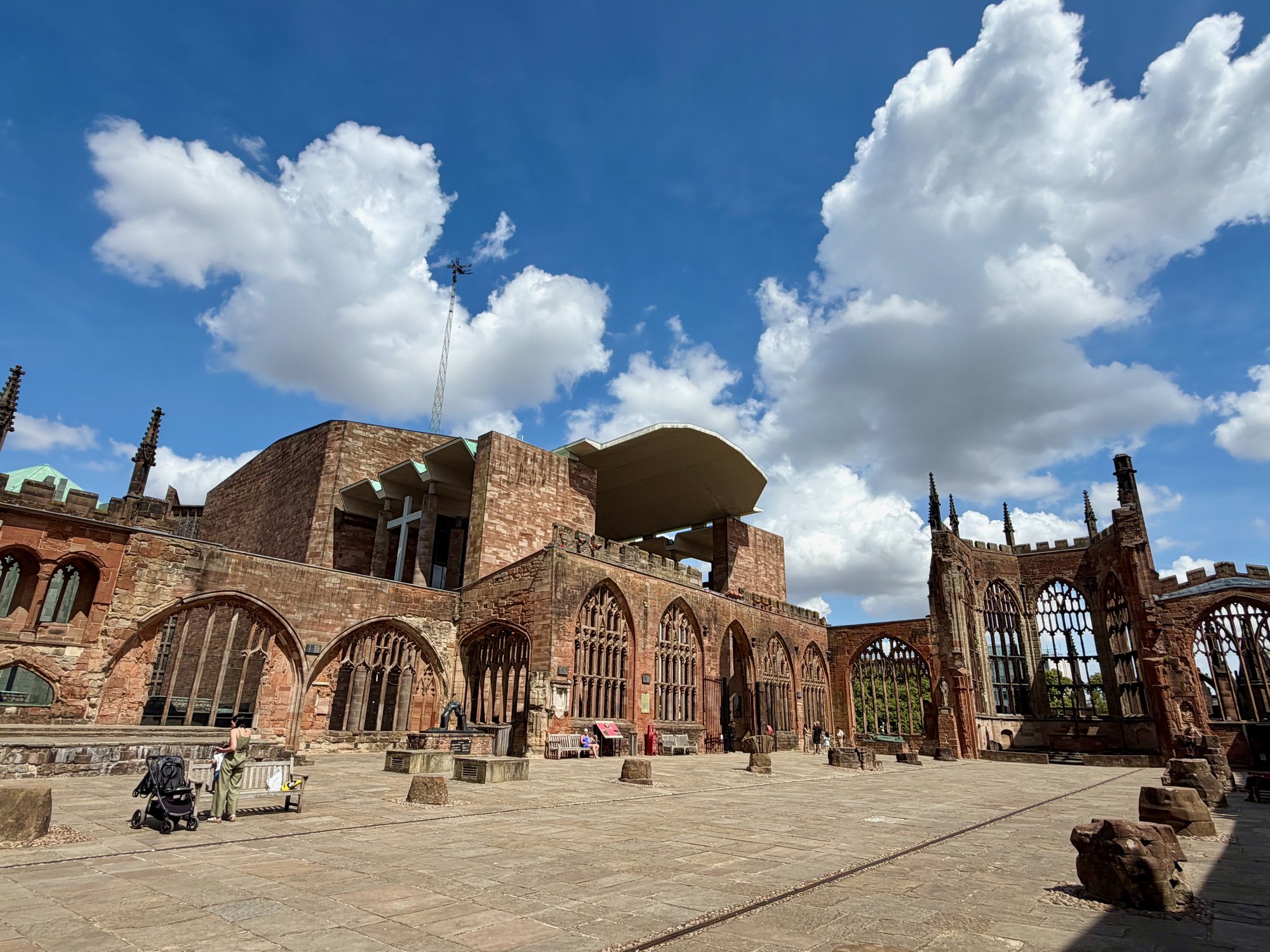
A design competition was launched in 1950, and in 1951 the Scottish architect Basil Spence’s design was chosen from more than two hundred entries. What he proposed was not to rebuild. Leave the ruin standing as a garden of remembrance, put the new cathedral beside it at right angles, and join the two with a wall of glass so that the ruin is never out of sight from inside the new church. The Queen laid the foundation stone in March 1956 and the cathedral was consecrated on 25 May 1962. Benjamin Britten’s War Requiem, written for the occasion, was premiered here five days later.
Spence was knighted for it, and if you go to visit the cathedral, you can see why.
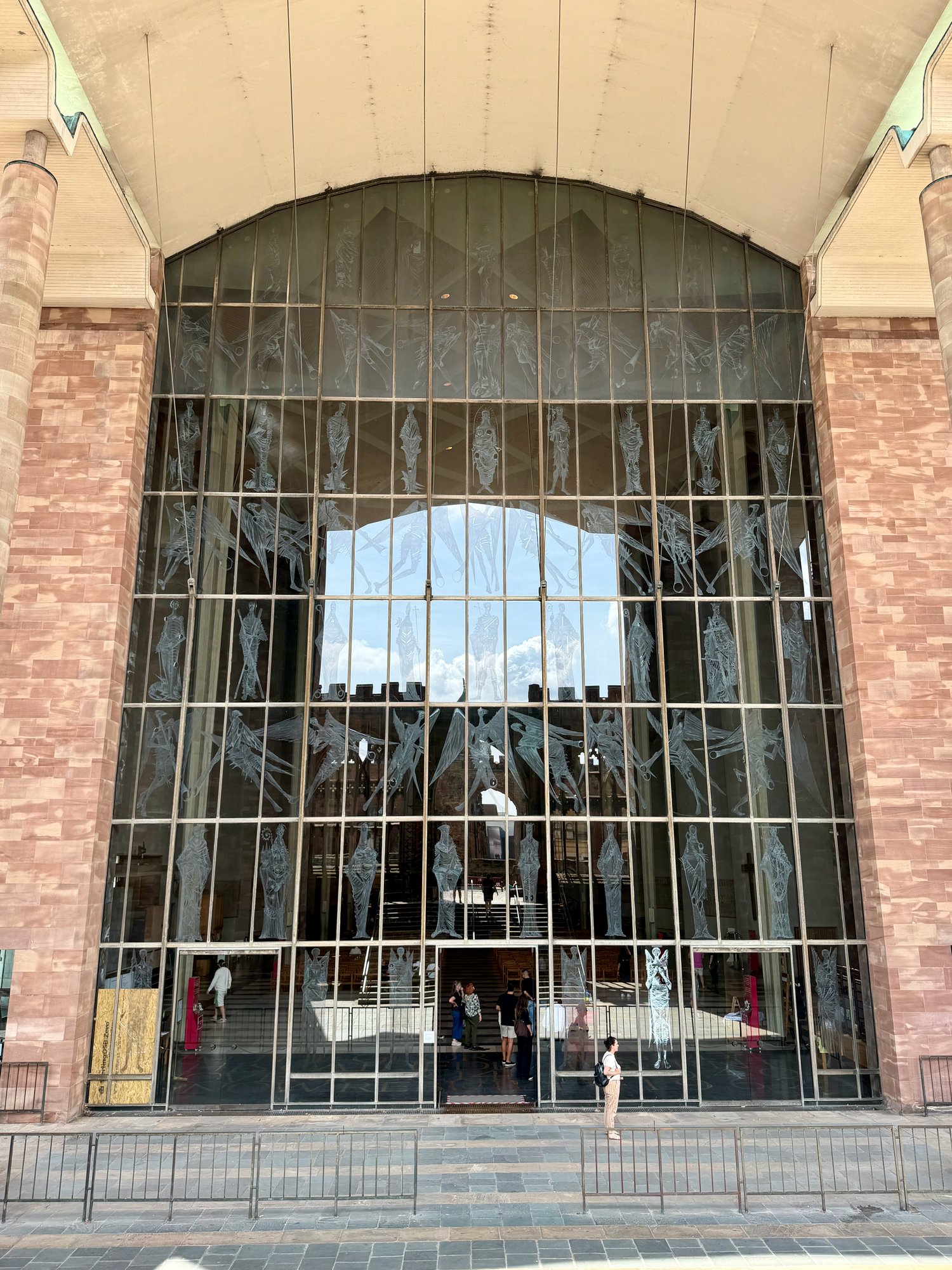
The glass wall is John Hutton’s West Screen, and it is extraordinary. Sixty-six saints and angels, engraved directly into the panes. From outside, the saints stand against the dark of the interior. From inside, I turned round and found myself looking through angels at a bombed-out church.
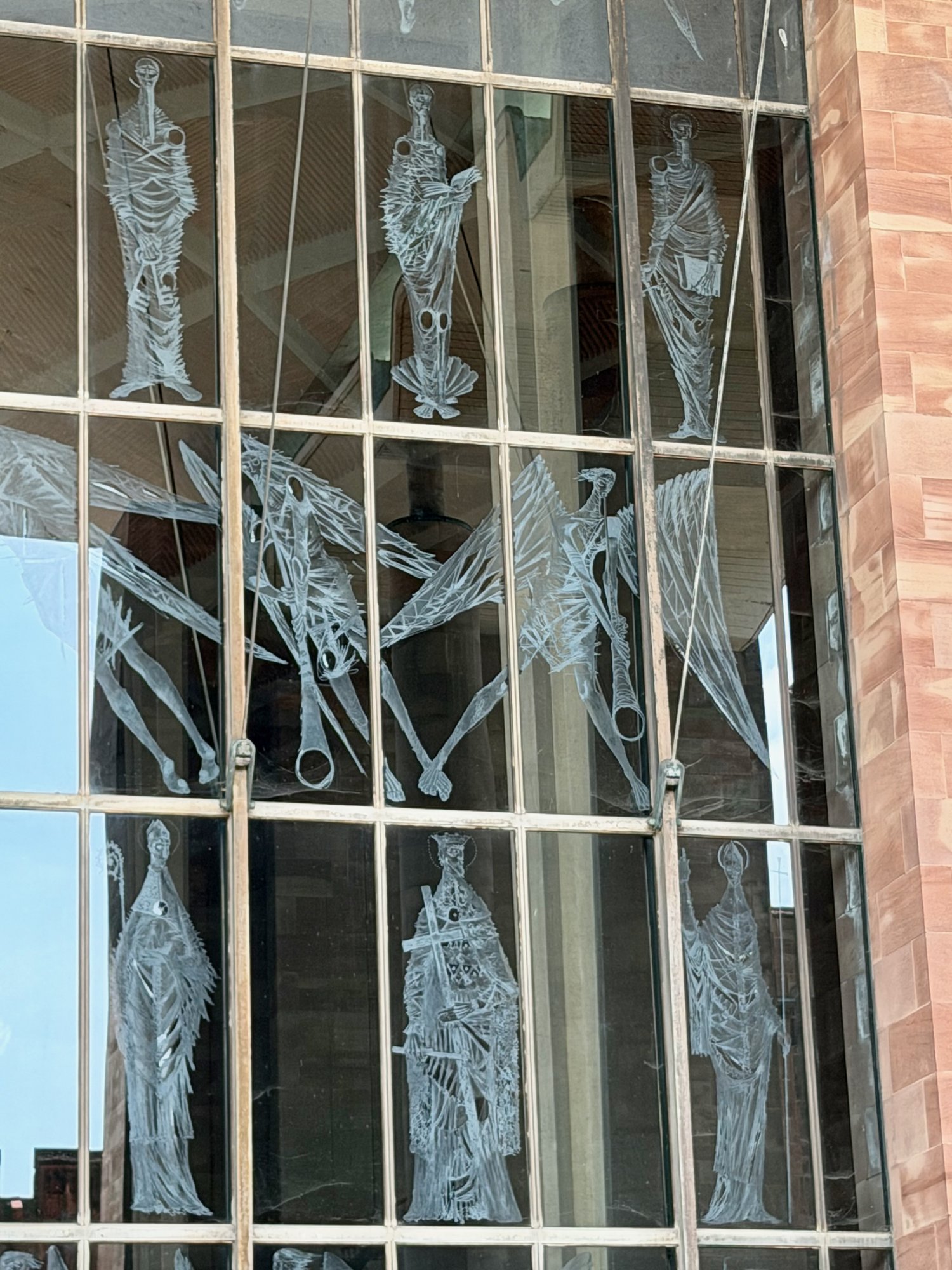
Up close, the angels are all diagonal and mid-flight, elongated, scratched into the glass at what looks like enormous speed. Some of the figures are skeletal and quite disturbing in some places. It’s a challenging piece, which I think modern art should be.
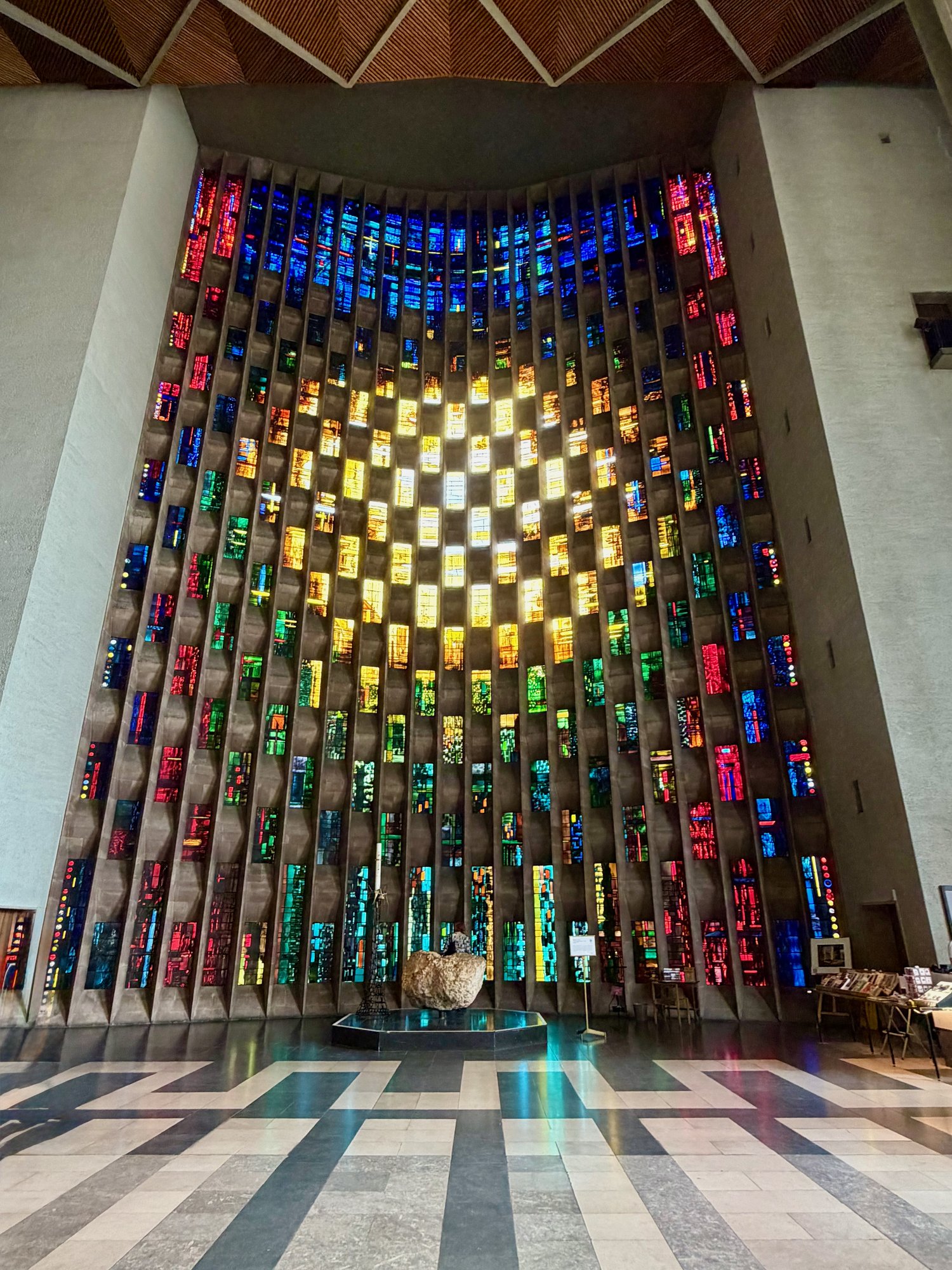
Inside, this is the first thing on the right.
John Piper designed the Baptistry window and Patrick Reyntiens made it between 1958 and 1961. It’s 198 individual panes of stained glass set into an enormous concrete grid that curves outwards towards you. The colours run dark at the edges into a burst of gold and white at the centre.
My photos don’t do it justice. In person it doesn’t read as a window at all, more like a wall of light.
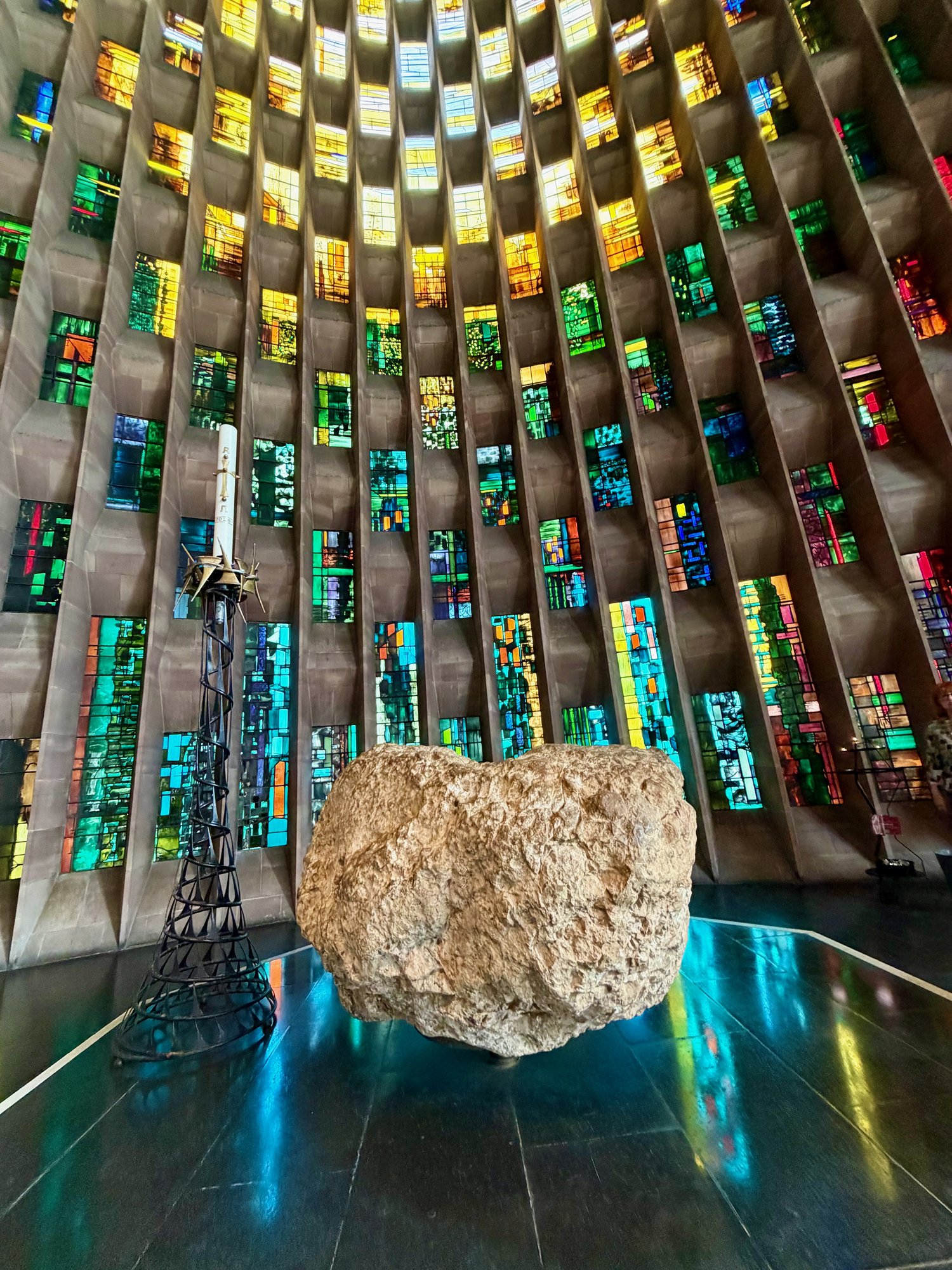
The font sits in front of it, and it’s simply a boulder, brought from a hillside near Bethlehem and hollowed out. Rough and unworked against all that engineered colour. I loved it.
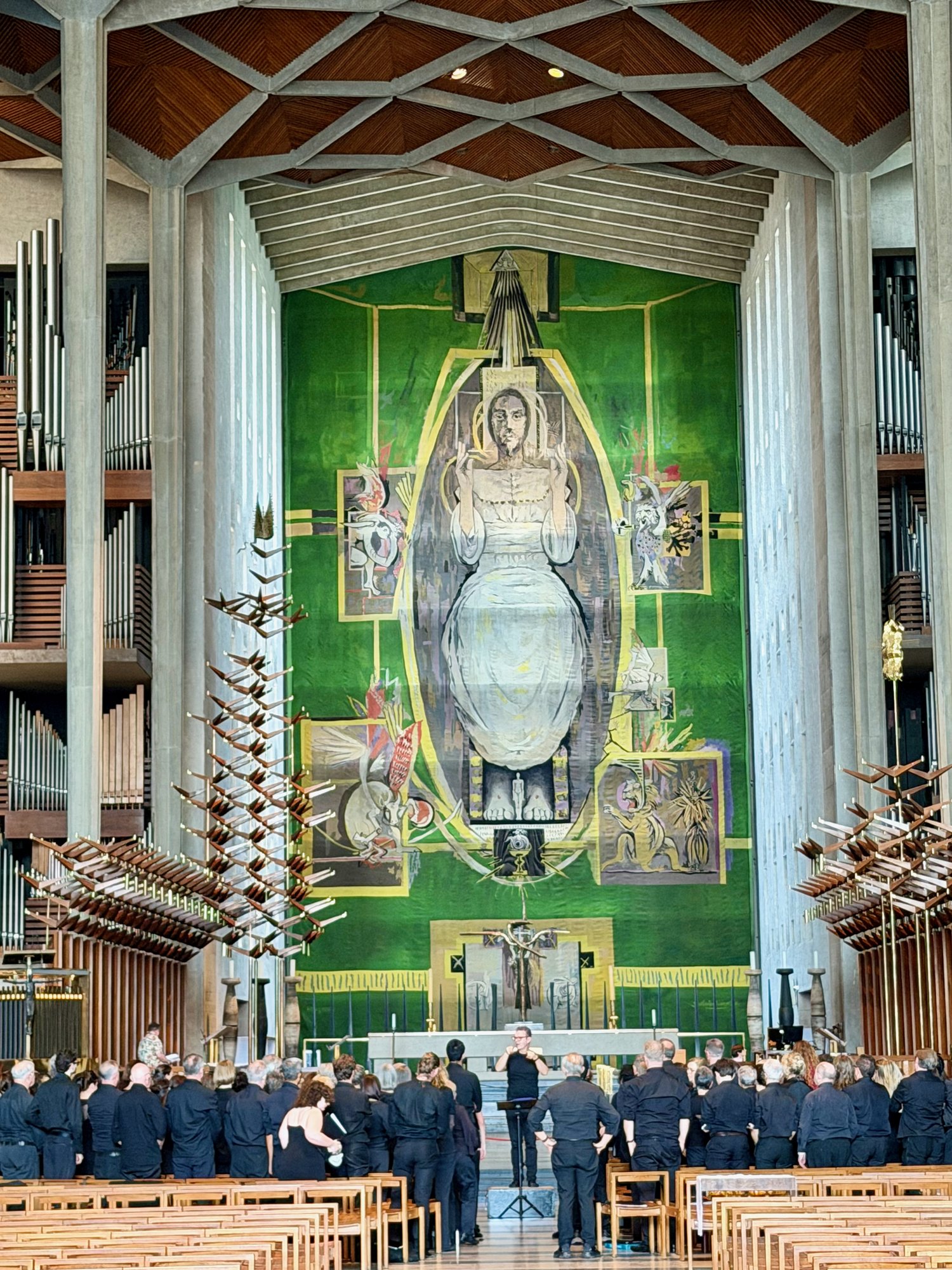
Graham Sutherland’s tapestry, Christ in Glory in the Tetramorph, hangs the full height of the east end. It’s 23 metres by 12 and weighs about a ton. Sutherland worked on the design for the best part of a decade, and it was then woven by hand in one continuous piece on a 500-year-old loom made from two tree trunks, in a workshop near Aubusson in France. Christ sits enthroned in an almond-shaped mandorla, surrounded by the symbols of the four Evangelists, with a tiny human figure standing between his feet for scale.
When I walked in there was a choir rehearsing in front of it, all in black, the conductor mid-beat. They sang the entire time I explored the cathedral which was a wonderful way to experience it. The acoustics are magnificent, and I would love to return for a concert or another event another time.
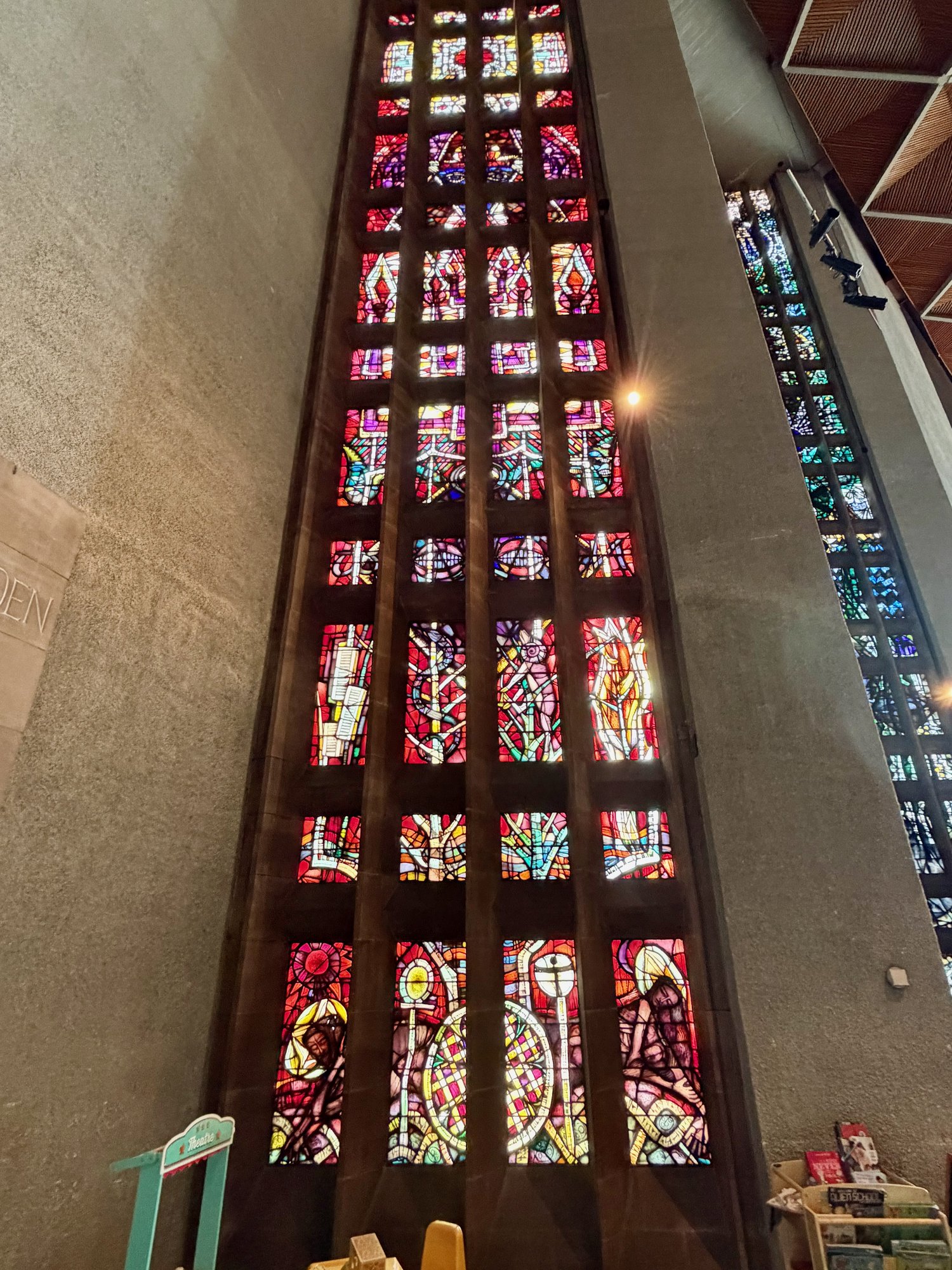
The nave windows are one of Spence’s cleverest tricks. There are ten of them, by Lawrence Lee, Geoffrey Clarke and Keith New, and they are set at an angle in deep concrete recesses so that walking up towards the altar you can’t see them at all. You have to turn round. They run in pairs from birth through to old age and heavenly glory, one side representing the human and the other the divine, so you only get the whole sequence on the way out.
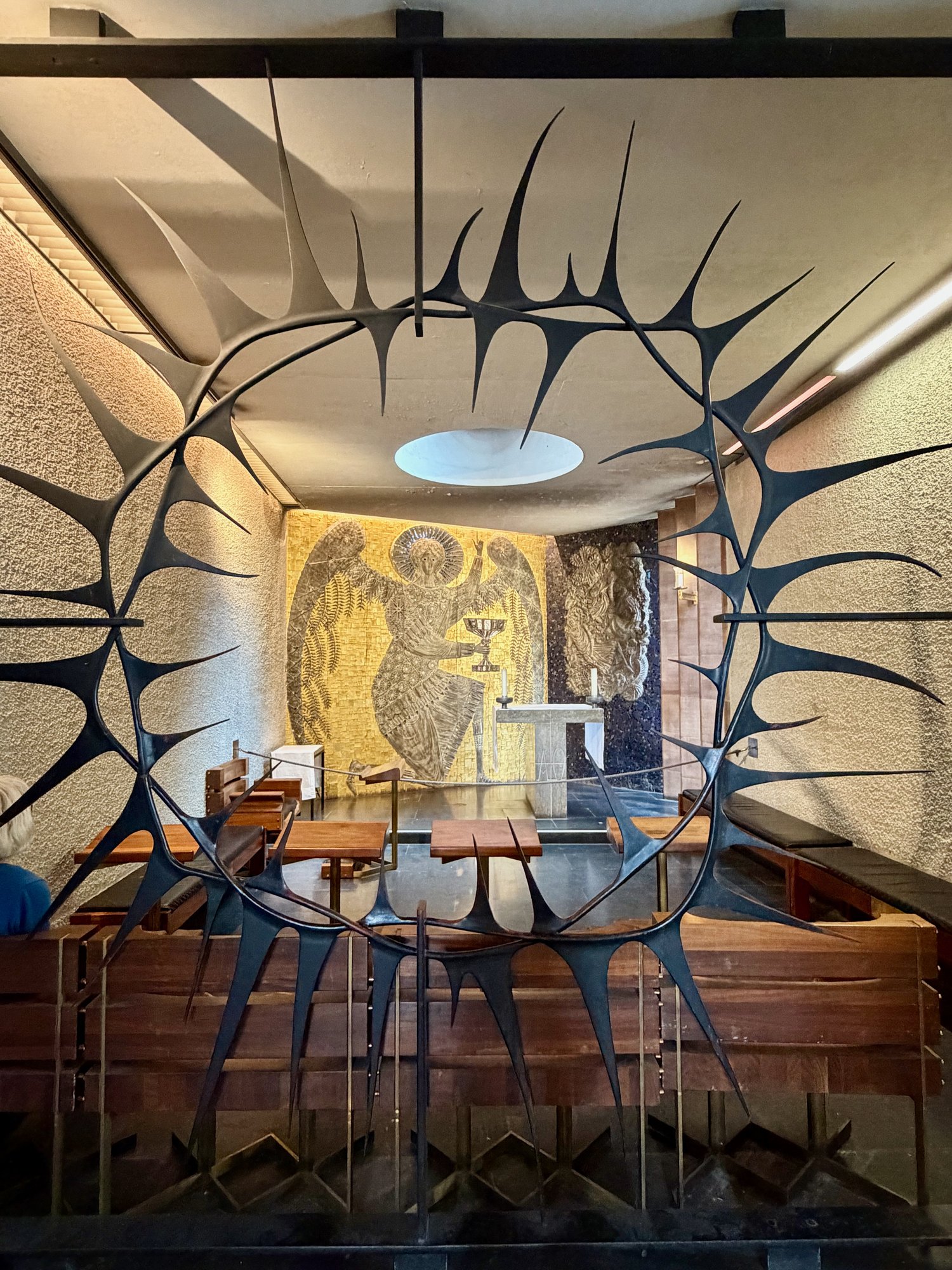
The Chapel of Christ in Gethsemane is a wonderful little chapel.
You look into it through a wrought-iron crown of thorns designed by Spence himself, and beyond it is Steven Sykes’s mosaic of the Angel of the Agony, holding out the cup of suffering against a wall of gold leaf. There’s a circle of plain daylight cut into the ceiling above.
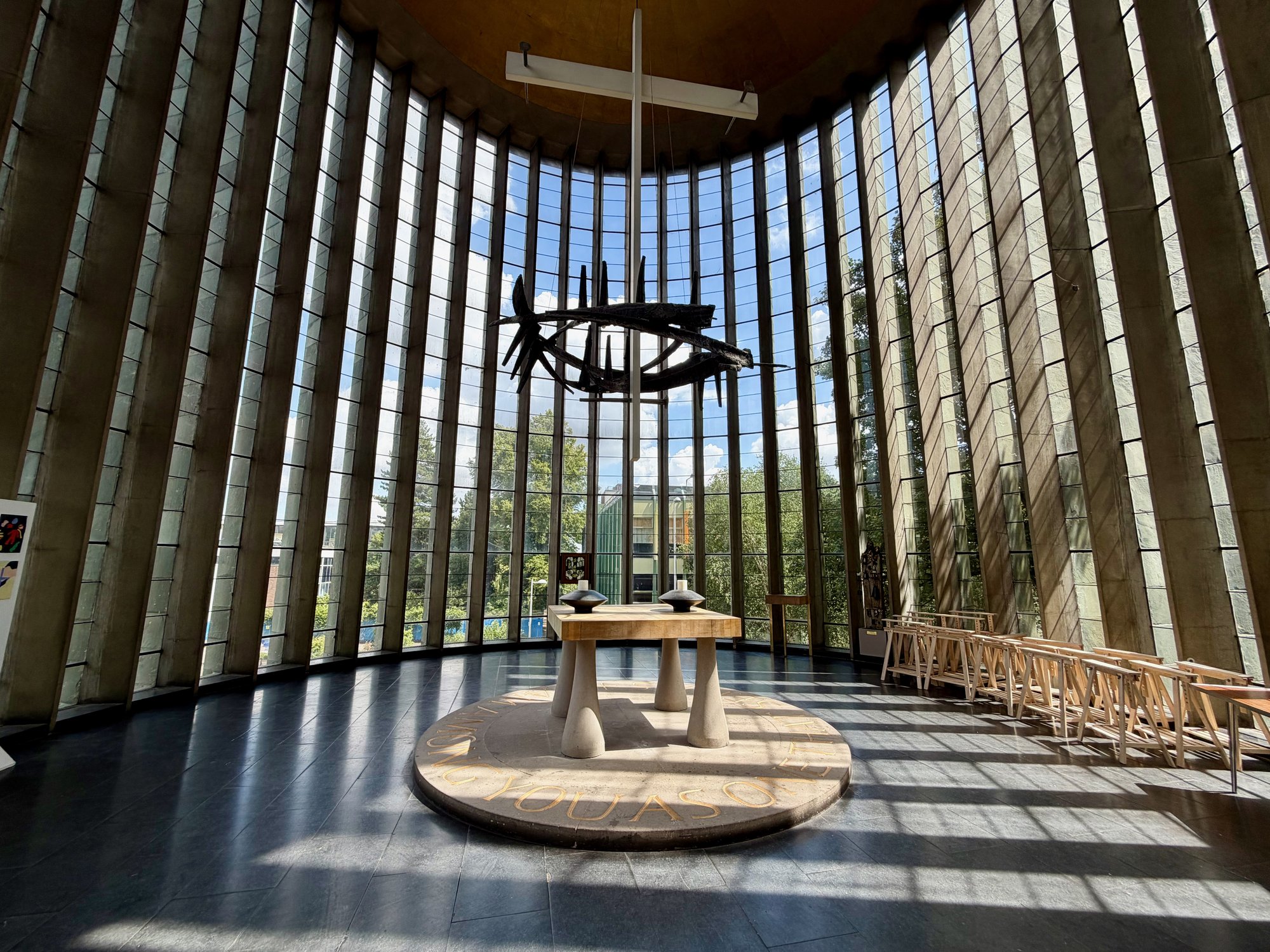
The Chapel of Christ the Servant is the opposite in every way. It’s circular and walled almost entirely in clear glass, so the city is right there while you’re inside. I loved the cross-hatching on the floor from the light and the glass dividers.
It’s also known as the Chapel of Industry, because the works and factories that surrounded the cathedral were what the bombers were aiming at. Around the base of the altar is engraved, “I am among you as one that serves.”
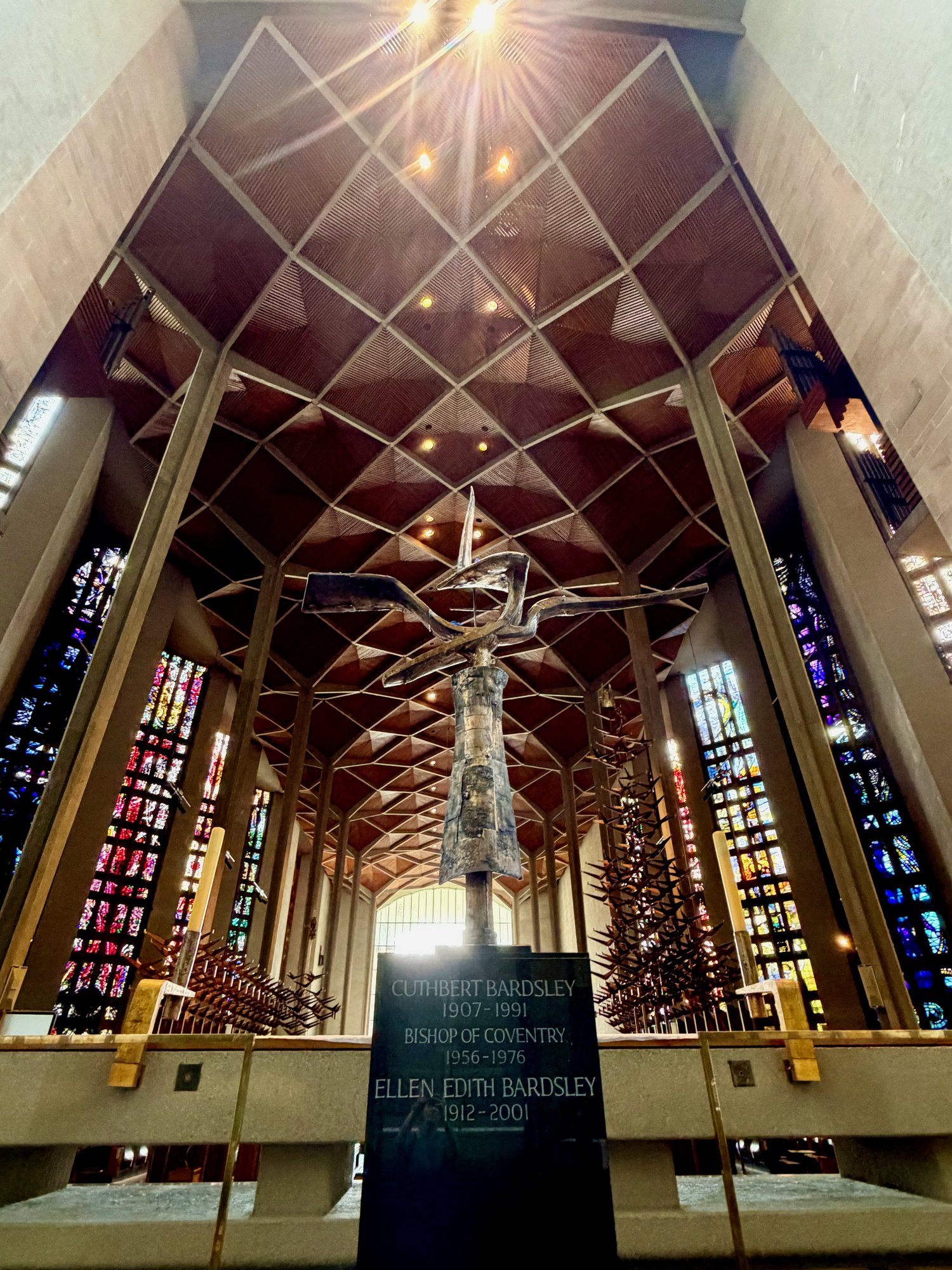
As with any cathedral, always look up!
Spence’s ceiling is a canopy of concrete ribs in a lattice of diamonds and stars, floating on slender columns that barely seem to touch it. It does the same job as a Gothic vault in a completely different language.
In the foreground is the memorial to Cuthbert Bardsley, Bishop of Coventry from 1956 to 1976, so the bishop who saw the new cathedral built and consecrated, and his wife Ellen.
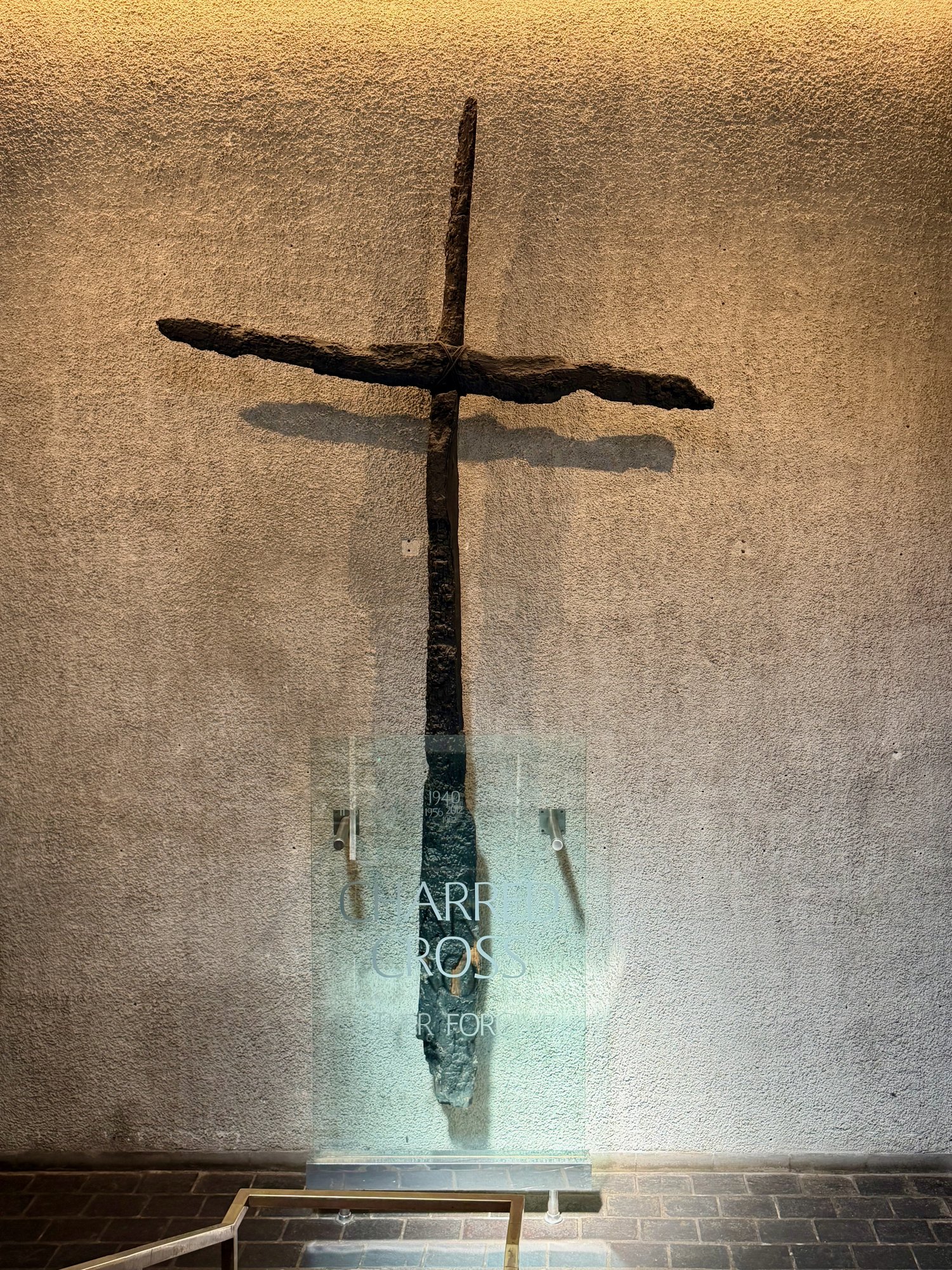
And then, in the new cathedral, behind the altar, the Charred Cross.
The cross standing in the ruins is a replica, made in 1964. This is the original: the two burnt roof timbers bound together after the raid, now lit against a bare concrete wall. The wood is scorched black and eaten away along its length, and moved inside to save it from the elements.
I always look for memento mori in cathedrals, the reminders that everything ends. Usually it’s a cadaver tomb or a skull on a plaque, but here, these burned spars served the same purpose.
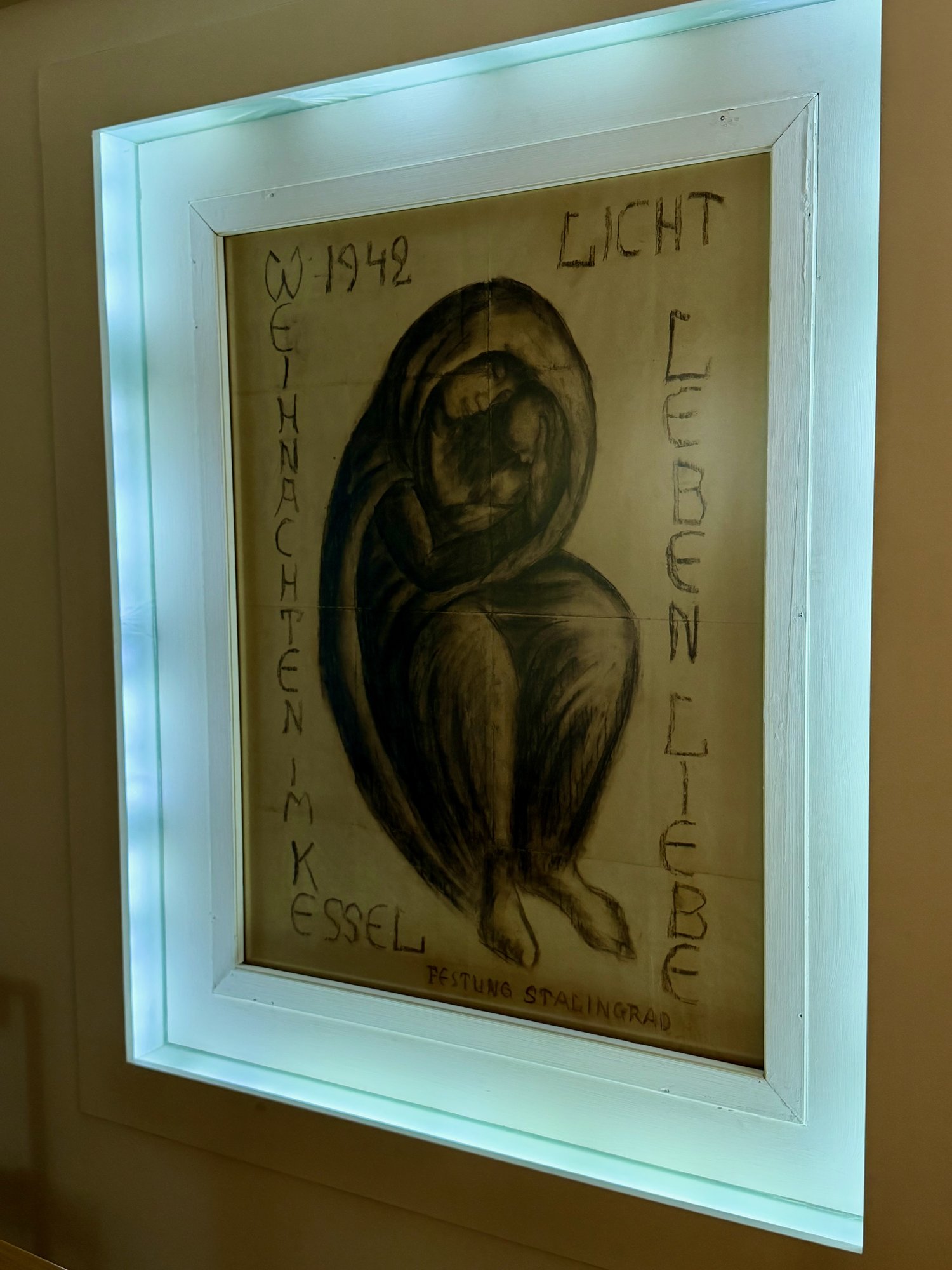
This is Coventry’s copy of the Stalingrad Madonna, and it’s downstairs in a private chapel.
Kurt Reuber was a German army doctor and pastor, trapped with the Sixth Army in the encirclement at Stalingrad. In December 1942 he drew this on the back of a map, in charcoal, by candlelight in a bunker. Down the left he wrote Weihnachten im Kessel, Christmas in the cauldron, and Festung Stalingrad. Down the right, Licht, Leben, Liebe. Light, life, love. It was flown out on one of the last transport flights out of the encirclement. He died in Soviet captivity in 1944.
The original hangs in Berlin. This copy was given to Coventry as a symbol of reconciliation, and there is a third in Volgograd, so the same drawing now hangs in the churches of all three nations that were fighting each other.
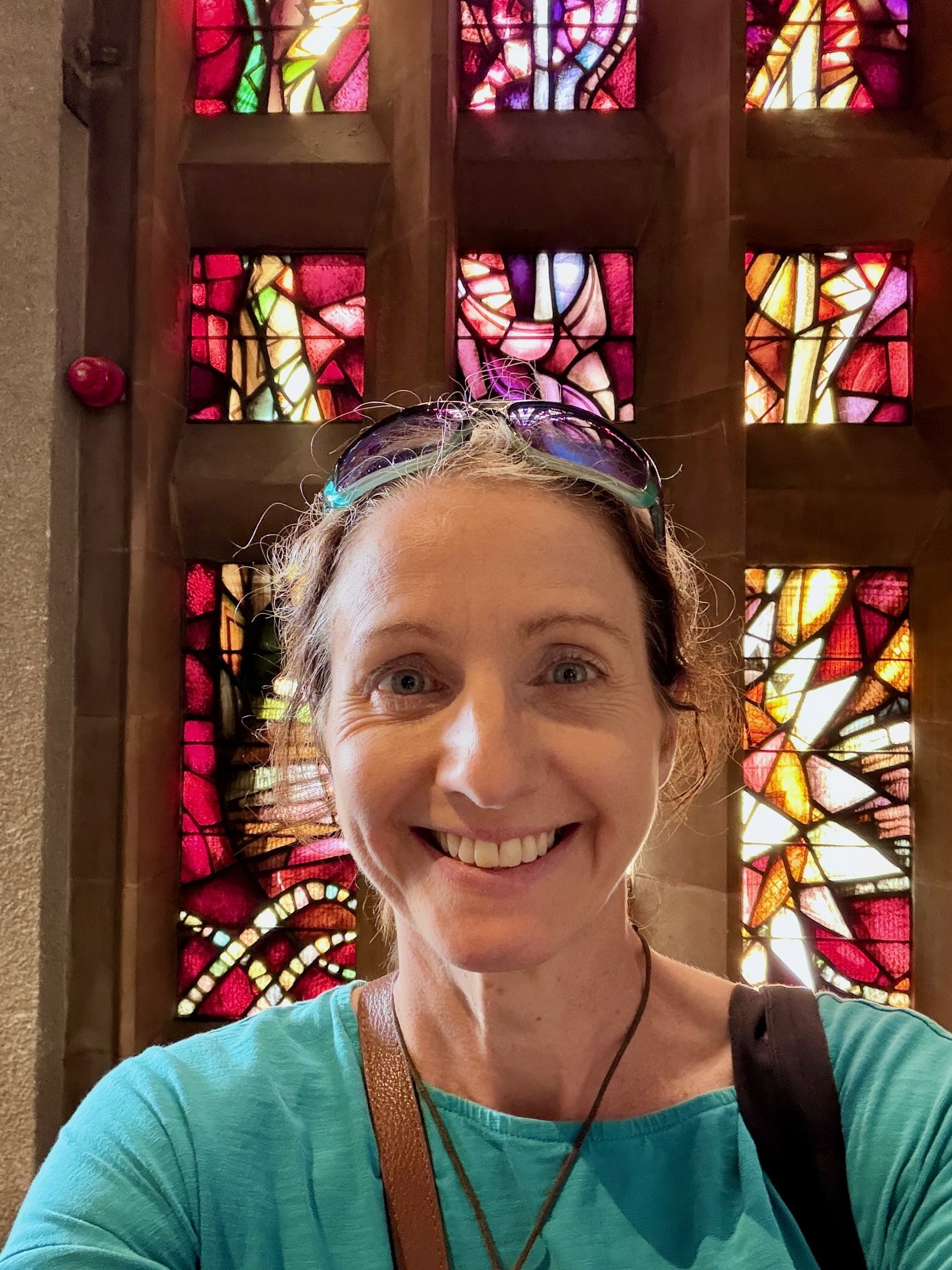
Here I am, enjoying the visit, standing in front of one of the nave windows.
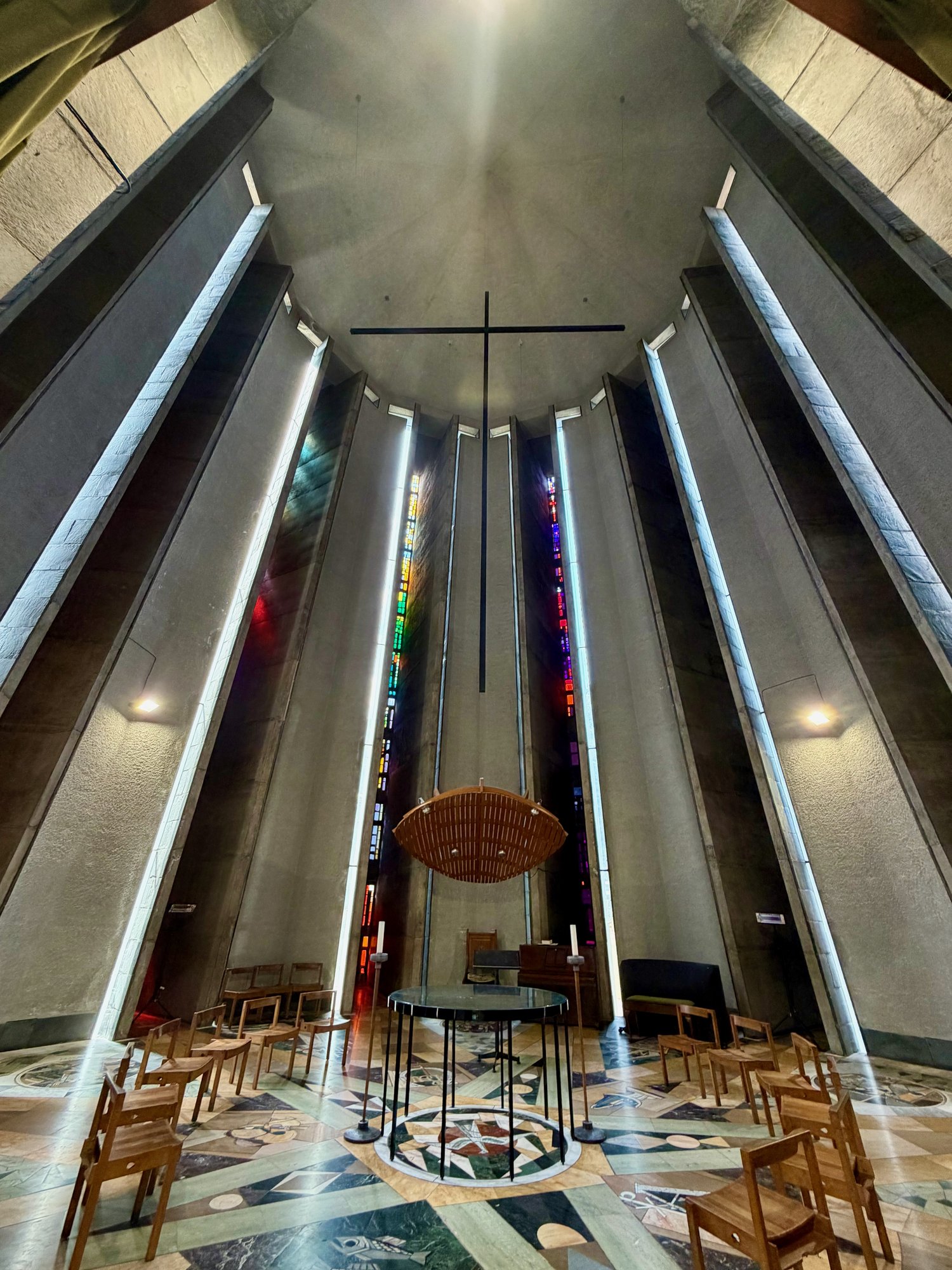
The Chapel of Unity is shaped like a tent. Spence intended it as “the temporary home of a people always ready to move onwards”, which is a lovely idea for a chapel about Christian unity. Inside, it’s a star of tall concrete fins with narrow slots of dalle-de-verre glass between them by Margaret Traherne.
The floor mosaic was designed by Einar Forseth and given by the people of Sweden. It was executed by Tatra Maria Drescha, and it shows the nations of the world, the five continents gathered into a single floor.
There is a lot of that here. The cathedral gave crosses made from its own medieval roof nails to the Kaiser Wilhelm Memorial Church in Berlin, and the Frauenkirche in Dresden joined the Community of the Cross of Nails in 2005, the year it finally reopened after being rebuilt. Two ruined churches, on opposite sides of the same war, tied together by three nails. There are now around three hundred partner organisations across forty-five countries. One Cross of Nails went to sea aboard HMS Coventry and sank with her off the Falklands in 1982. It was recovered from the wreck, passed to the next ship of the name, and since 2011 it has served aboard HMS Diamond.
The Litany of Reconciliation is prayed here at noon every weekday, and on Fridays traditionally out in the open air of the ruins. It was written in 1958 by Canon Joseph Poole and built on the seven deadly sins. Part of it runs:
“The hatred which divides nation from nation, race from race, class from class, Father, forgive. The covetous desires of people and nations to possess what is not their own, Father, forgive. The greed which exploits the work of human hands and lays waste the earth, Father, forgive. Our indifference to the plight of the imprisoned, the homeless, the refugee, Father, forgive.”
Two stories get repeated about Coventry that are worth clearing up.
The first is that Churchill knew the raid was coming, through Enigma decrypts, and let the city burn rather than reveal that Britain had broken the German codes. The intelligence was fragmentary and contradictory. It showed that a major operation was coming, and Coventry was among the possible targets, but the city wasn’t confirmed until the German navigation beams were found to intersect over it at about three in the afternoon on the day itself.
The second is that Dresden was payback for Coventry. The Dresden raids were part of an Allied effort to wreck German transport and reinforcements as Soviet forces advanced from the east. The precise chain of requests and authorisation is still argued over by historians, but it was not a retaliatory answer to Coventry. Both stories survive because they’re tidier than what actually happened, which is the confusion of war.
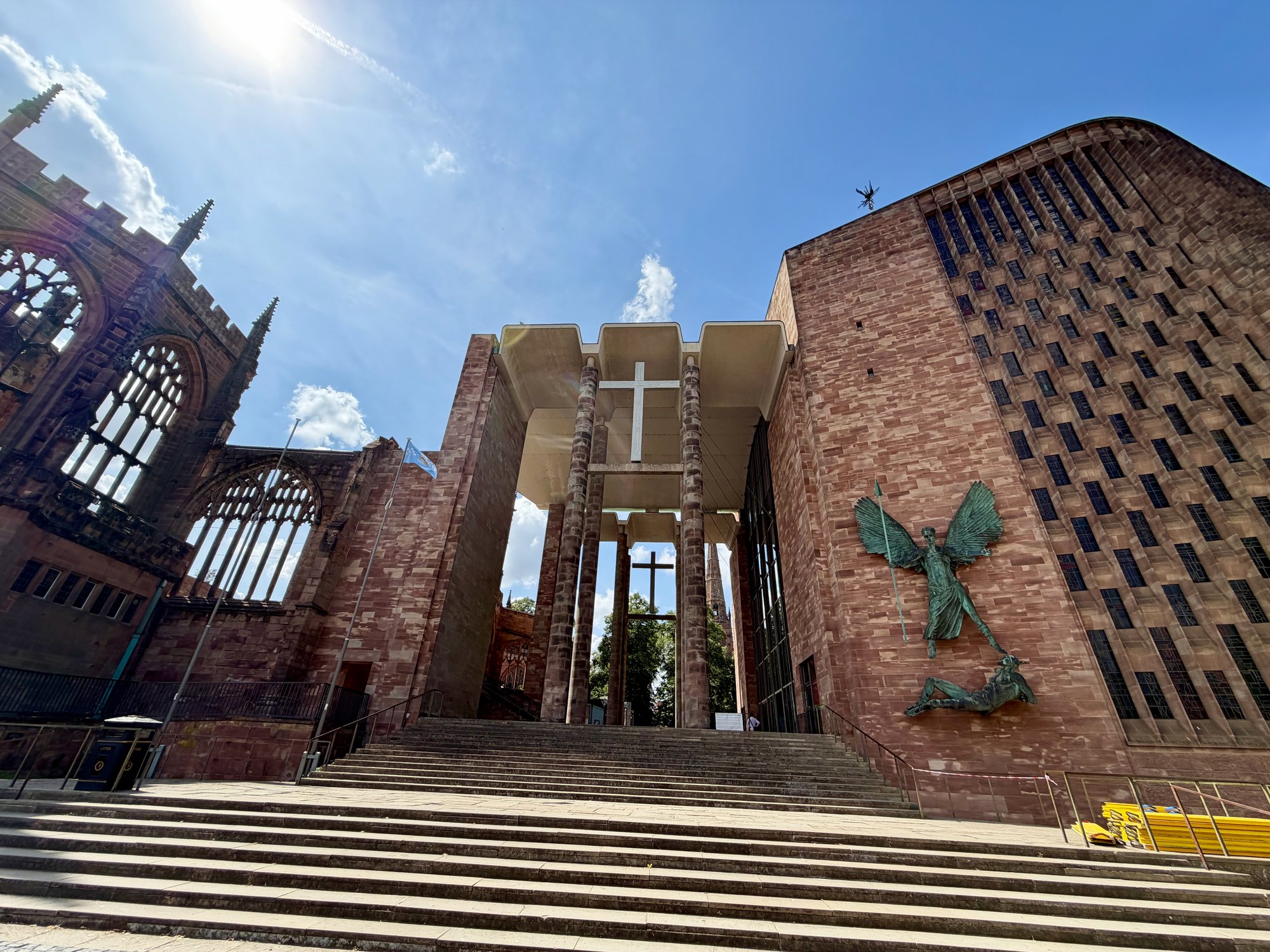
On the way out, back down the steps between the two buildings, turn around to see Jacob Epstein’s St Michael’s Victory over the Devil. Bronze, over seven metres high with a wingspan to match, the archangel standing with his spear over a bound and fallen devil. Michael holds his spear upright rather than levelled at the devil, which the cathedral reads as victory without vengeance. Epstein died in 1959 and never saw it in place; his widow unveiled it in 1960.
Look through the porch and you can see the ruined spire framed by the new cathedral’s columns, with a cross hanging between them.
I loved Coventry Cathedral and if you think modern churches can’t move you, this is the one to visit.
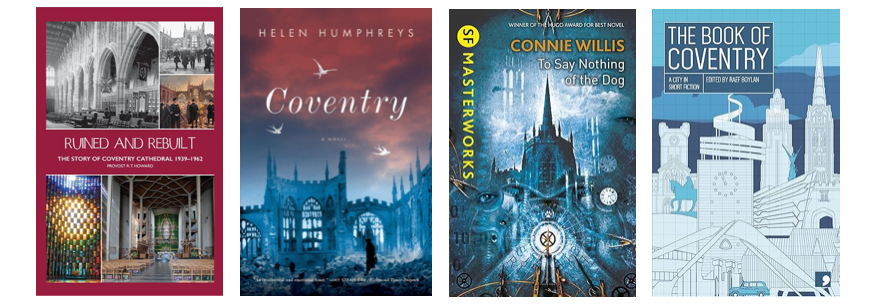
Books set in and around Coventry
Ruined and Rebuilt — Richard Howard. On the night of 14 November 1940, Reverend Richard Howard, Provost of Coventry Cathedral, was one of four firefighters who climbed onto the roof to smother with sand the incendiary bombs that were landing not just on the Cathedral but starting a firestorm across the city centre. In this moving and detailed account of the years that followed, Howard describes how the building of the new Cathedral was planned; how the architects and designers were chosen; with what materials they worked, and what their designs mean. It closes with the sight of the new Cathedral finished and ready for Consecration.
Coventry — Helen Humphreys. A historical novel set across the night of 14 November 1940. Harriet Marsh is fire-watching on the cathedral roof when the raid begins, and the hours that follow reshape her life and the lives of a young fire watcher and his artist mother.
To Say Nothing of the Dog — Connie Willis. Ned Henry is a time-travelling historian who specialises in the mid-20th century – currently engaged in researching the bombed-out Coventry Cathedral. He’s also made so many drops into the past that he’s suffering from a dangerously advanced case of ‘time-lag’. Unfortunately for Ned, an emergency dash to Victorian England is required and he’s the only available historian. But Ned’s time-lag is so bad that he’s not sure what the errand is – which is bad news since, if he fails, history could unravel around him…
The Book of Coventry— edited by Raef Boylan. A short story anthology. Often overshadowed by its higher-profile Midlands neighbours, Coventry’s quiet demeanour conceals a steadfast spirit of resilience and resourcefulness. From rebuilding itself after the devastation of WWII, to overcoming huge social-economic decline during the 1970s and 80s, Coventry has long been a city of resolve and rebirth, a place used to picking itself up and dusting itself down. The stories gathered here attest to this fortitude, following a host of characters who see their own myriad struggles reflected in the city’s sometimes precarious development.
Joanna Penn’s writing is everything you would want good writing to be. It’s engaging, relatable and always informative. I loved this piece on the new Coventry Cathedral – both the writing and the enticing images taken by the author.
In the development of my own career as an independent author Joanna’s guidance books have been immensely helpful. She gives generously of her exceptional expertise for which I have been, and will always be, very thankful.
Thanks, Jacqueline, and glad you enjoyed the virtual tour 🙂
Wow! I knew the story about the Coventry Cross, but what a treat to virtually visit it. I love listening to your regular podcast where you mention trips you’ve made so it was so nice to see this glimpse into this one. Makes me want to go back to England for a visit. I too love cathedrals and churches. Our western Canadian history hasn’t given us anything like the architecture in Europe so I always appreciate going to cathedrals and churches when I’m there. Thanks again for sharing this trip and the incredible pictures.
Thanks, Carolyne, and I am getting back into sharing my photos here again, so you can expect more!
Canada has a lot of wonderful nature, of course 🙂
I’m not religious, but this moved me to tears.
Beautifully presented .
Thank you, Jo.
I’m so glad you enjoyed it 🙂