
I love ancient Gothic cathedrals, but I’m finding some interesting things in modern cathedrals too. Coventry showed me how beautiful new cathedrals can be, and in September 2026 I visited another surprising place, the Cathedral of Our Lady of the Angels in downtown Los Angeles.
I arrived in a Waymo, my first ride in an autonomous vehicle, so the whole morning was modern meets ancient from the moment I stepped out of the car. I hope you enjoy this virtual tour.
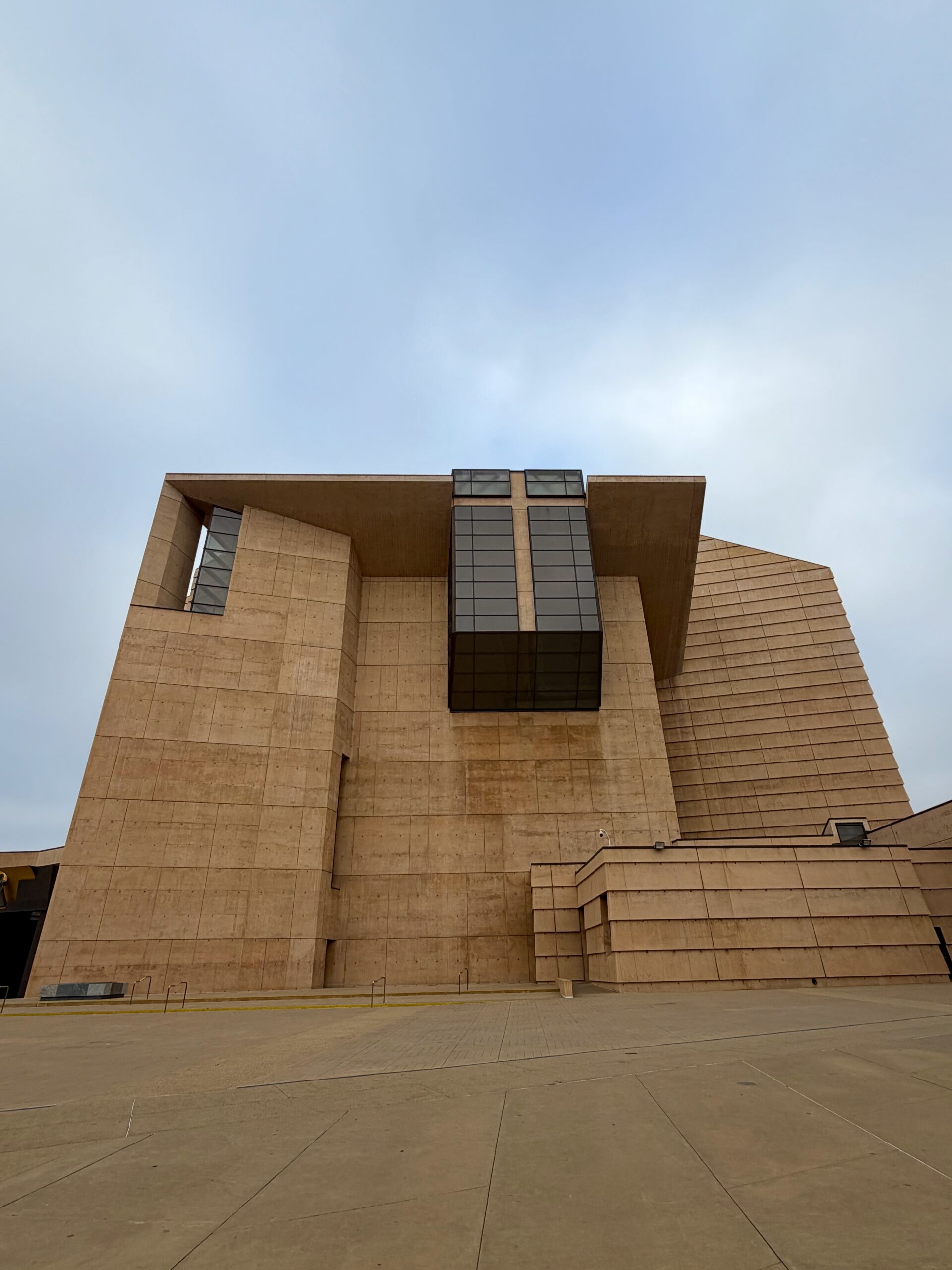
The cathedral sits on the old Bunker Hill above the Hollywood Freeway, in a part of town that is all traffic and concrete. The building is concrete too, poured in a colour that the cathedral says recalls the sun-baked adobe of the California Missions, and although it felt quite brutalist and gritty, especially given its location, I started to find beauty there immediately.
Watch a short video tour of the cathedral, with my photos (4 minutes):
The architect was the Spaniard José Rafael Moneo, who treated the freeway as the city’s river, the way so many European cathedrals stand beside water. Building began in 1999 and it was dedicated on 2 September 2002. The glass-clad box on the front is a fifty-foot cross lantern, lined with alabaster and lit from inside at night.
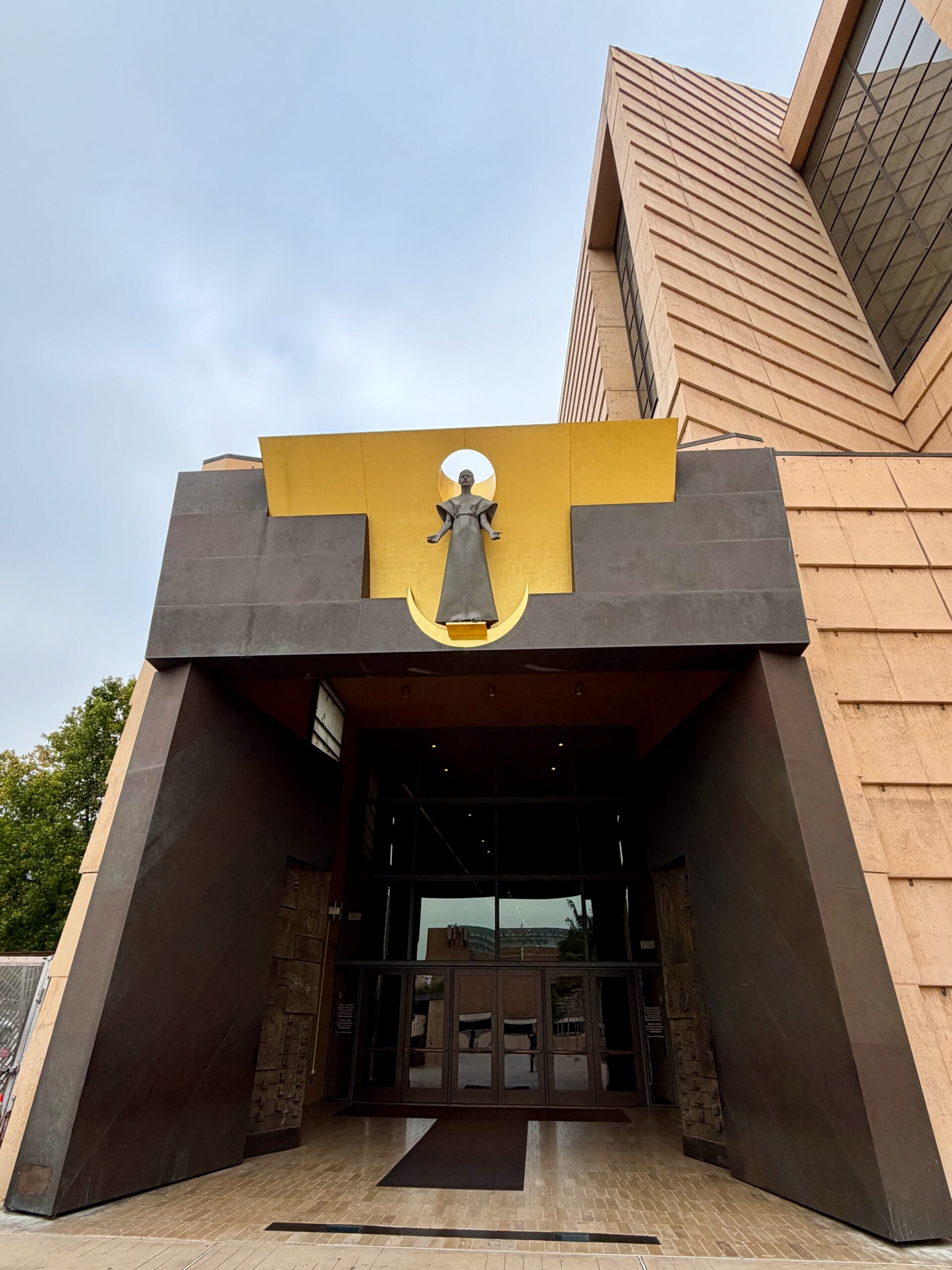
You don’t go in through a west door at the end of the nave like an ancient cathedral. The entrance is on the side, through the Great Bronze Doors by the Mexican-born Los Angeles sculptor Robert Graham, which took nearly five years and some 150 artists to make. They are a door within a door, thirty feet square, and the doors weigh twenty-five tons between them.
Above them stands an eight-foot Our Lady of the Angels, also by Graham, with no veil, bare arms held out and a thick braid down her back. The cathedral describes her hands as “the hands of a working woman”.
Two angels were planned either side of her and then dropped. The city was founded in 1781 as El Pueblo de Nuestra Señora, Reina de los Angeles, so the people of Los Angeles are her angels.
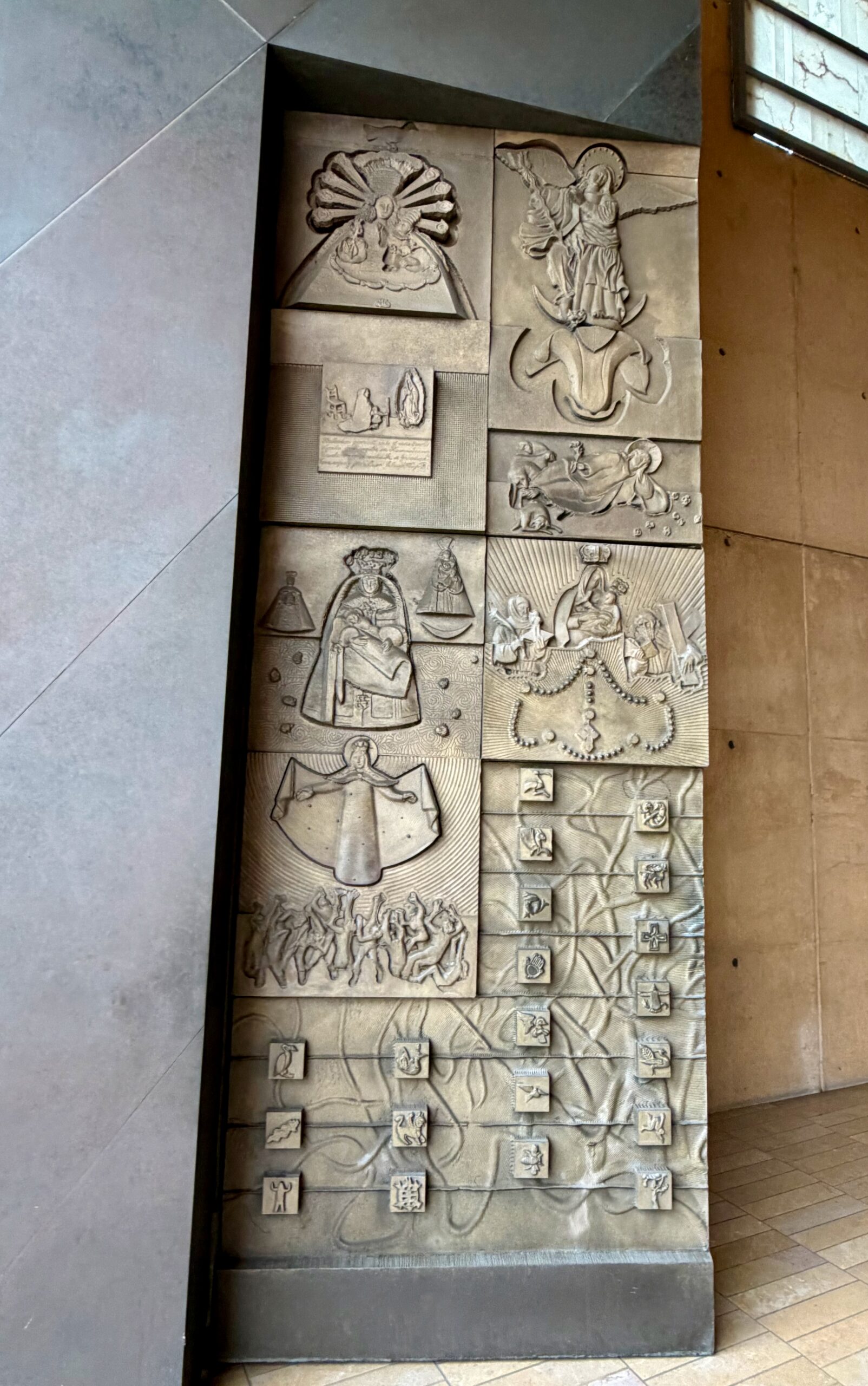
I love an interesting door! Instead of the usual Bible stories you see on so many cathedral facades, Graham filled the inner doors with images of the Virgin from across the Spanish-speaking Americas. On this panel there is the Virgin of Pomata in a feathered Inca headdress, an Immaculate Conception crushing the serpent, and at the bottom the Virgin of Mercy sheltering the souls in purgatory under her cloak.
Graham used his own mother’s rosary for the Virgin of the Rosary of Chiquinquirá.
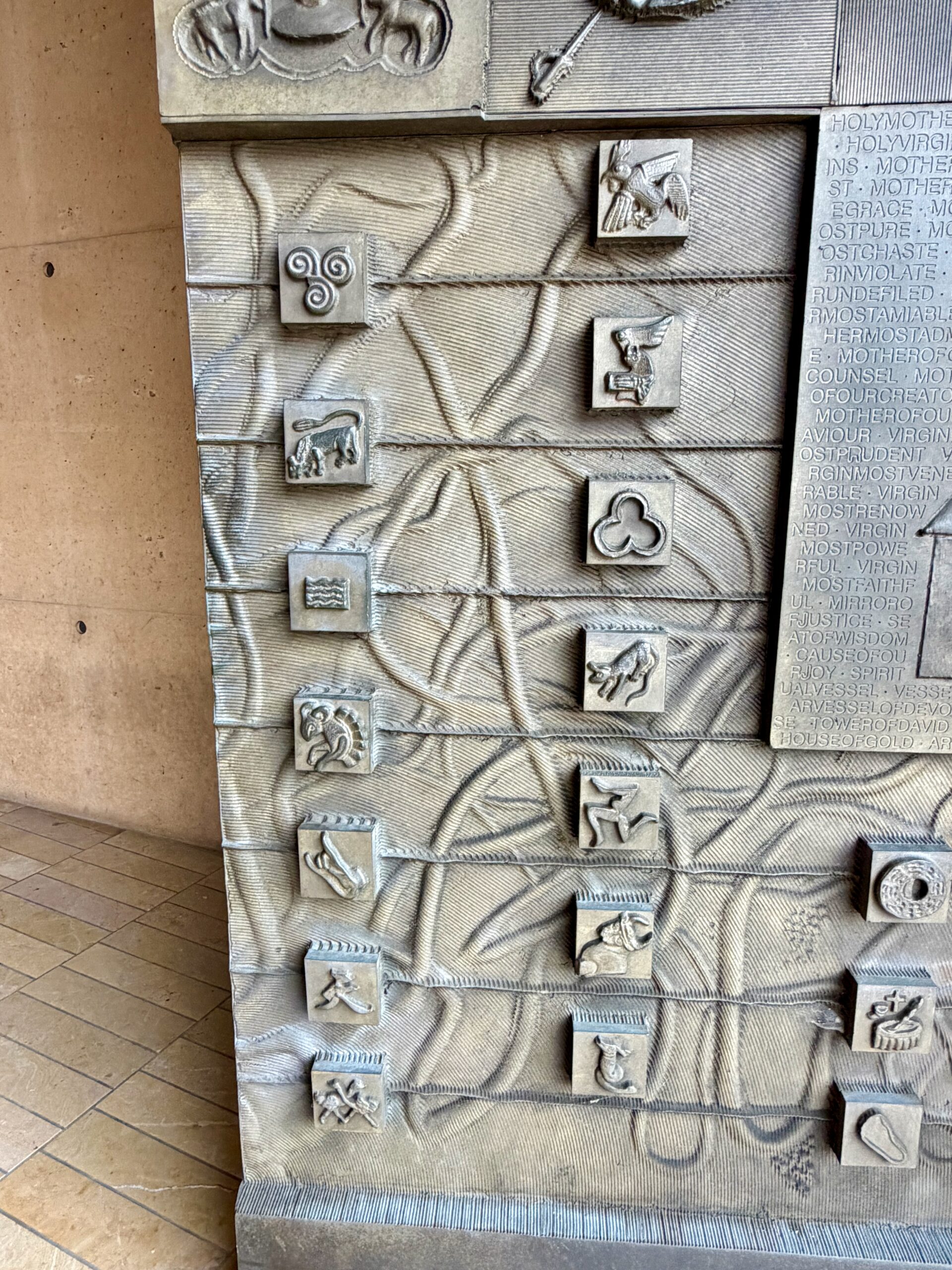
Below the Virgins, folded into a grapevine, are forty pre-Christian symbols from Europe, Asia, Africa and the Americas: a griffin, a bee, a hand, a Chinese turtle, a Samoan kava bowl.
Graham thought the old cathedral doors were “history books and storytelling books” for people who couldn’t read, and that the job now was to make images that are “culturally recognizable”. I loved how unusual these were, with some of the symbols giving even an occult vibe in places.
To the right on the door is part of a long panel of Mary’s titles, run together without spaces: Mother most pure, Tower of David, House of Gold.
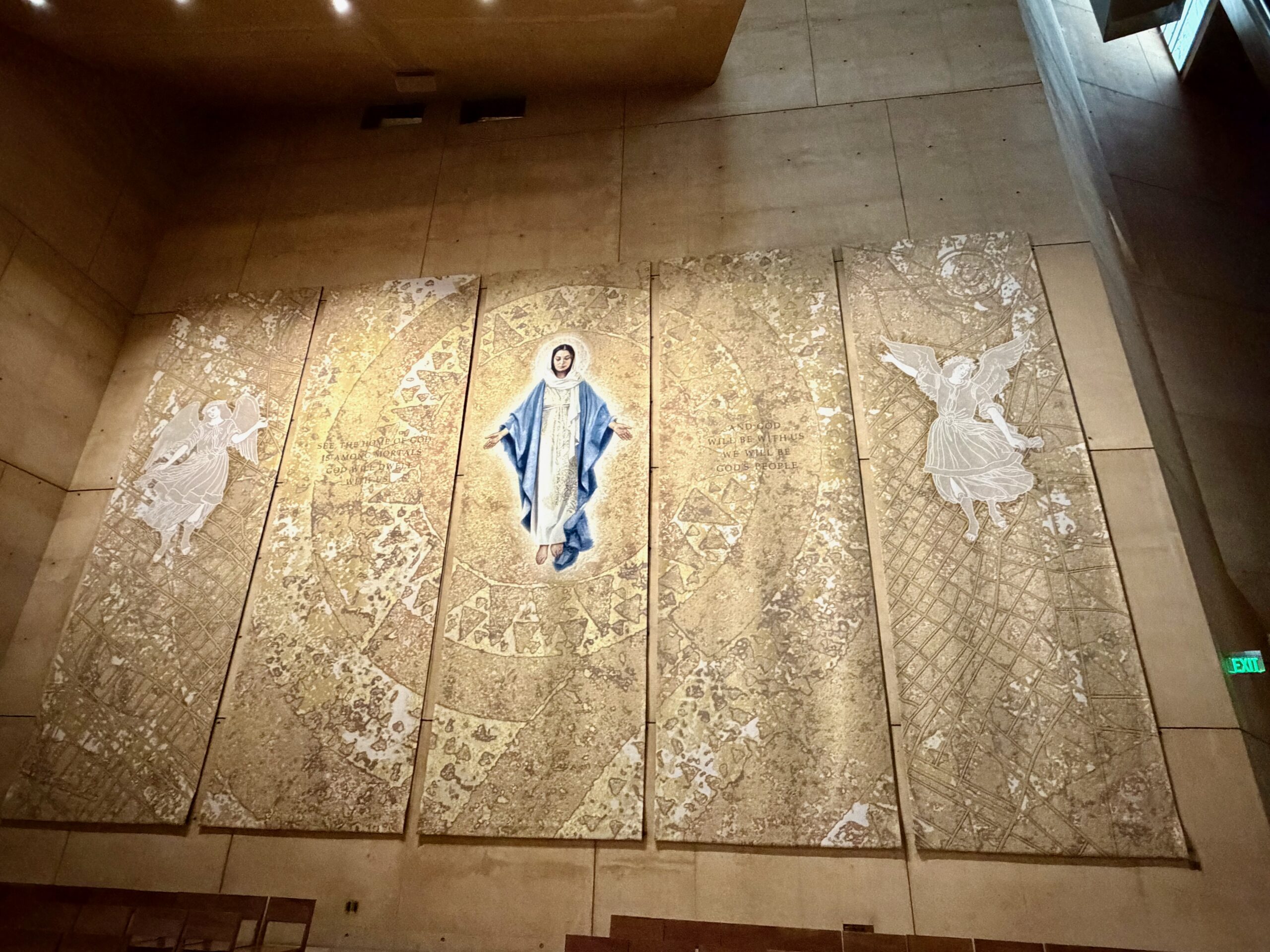
Inside, the doors open not onto the nave but onto an ambulatory, a wide walkway that circles the whole interior on a slight incline, with the chapels opening off it. It feels underwhelming to enter, and as it was almost empty inside I didn’t know where to go first. I turned right past a sound area and emerged near the altar, looking out down the nave next to the huge tapestry altar (above).
This five-panel tapestry, with Mary fourteen feet high in a blue cloak over a robe patterned from the Virgin of Guadalupe, was unveiled on 1 January 2021.
The outer panels carry a street map of downtown Los Angeles and a line from Revelation: “See, the home of God is among mortals. God will dwell with us.”
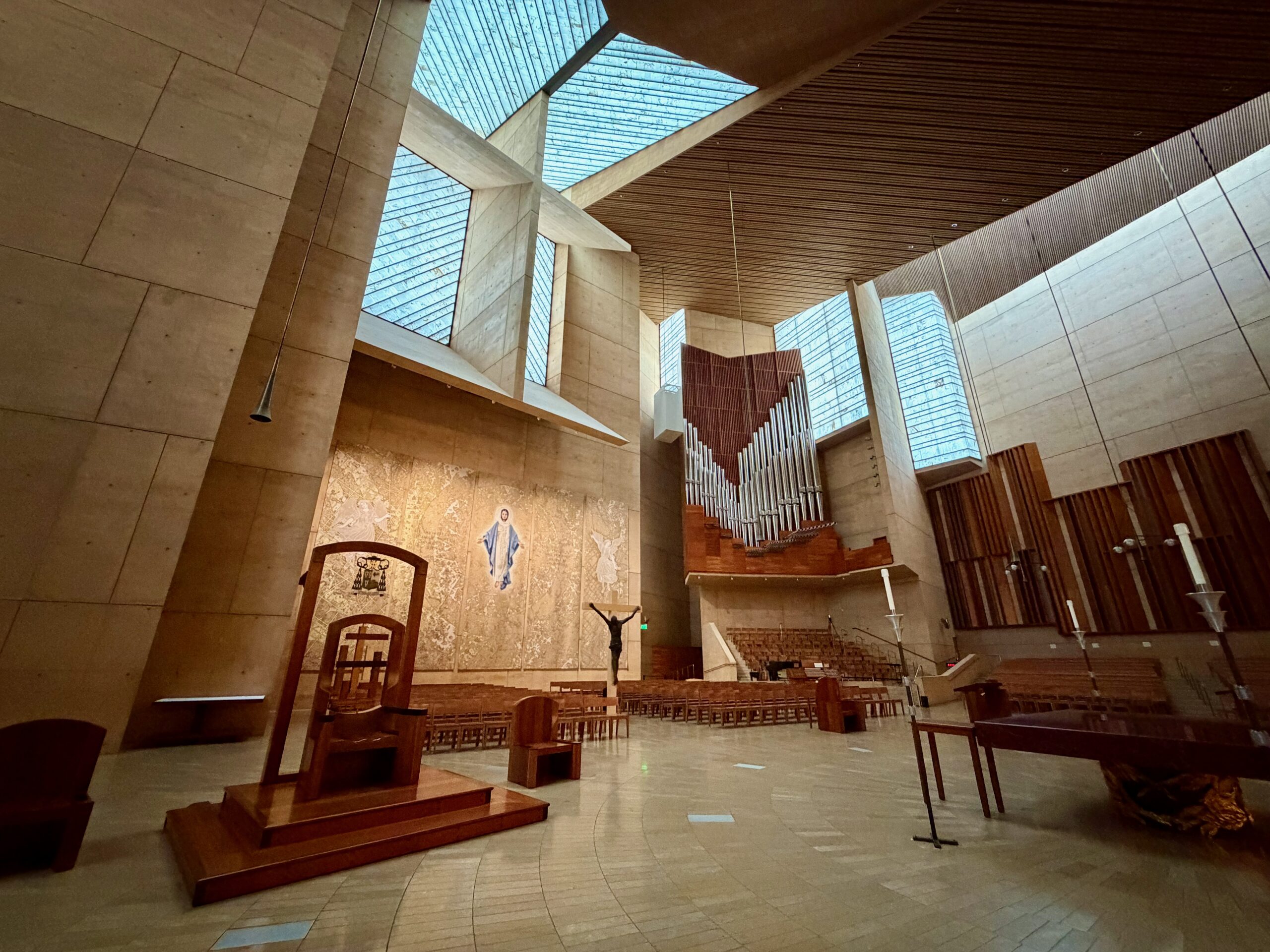
And then the light. After the concrete outside, the inside is so light, and the stone is lovely, warm and pale. Moneo built the cathedral around two ideas, light and journey, and the ambulatory is the journey.
The great windows are thin panels of Spanish alabaster behind protective glass, set in a grid, so the light comes through milky and even, with the veins of the stone showing. The cathedral says it’s the largest installation of alabaster windows in the United States.
High on the left wall is an alabaster cross, with light pouring down the slanted crossbeam. Below it is the cathedra, the bishop’s chair that makes a cathedral a cathedral, built by Jefferson Tortorelli from linked crosses in woods from around the world for the different communities of the city.
The crucifix is a life-size bronze by Simon Toparovsky, cast with burlap pressed into the surface so the skin seems flayed.
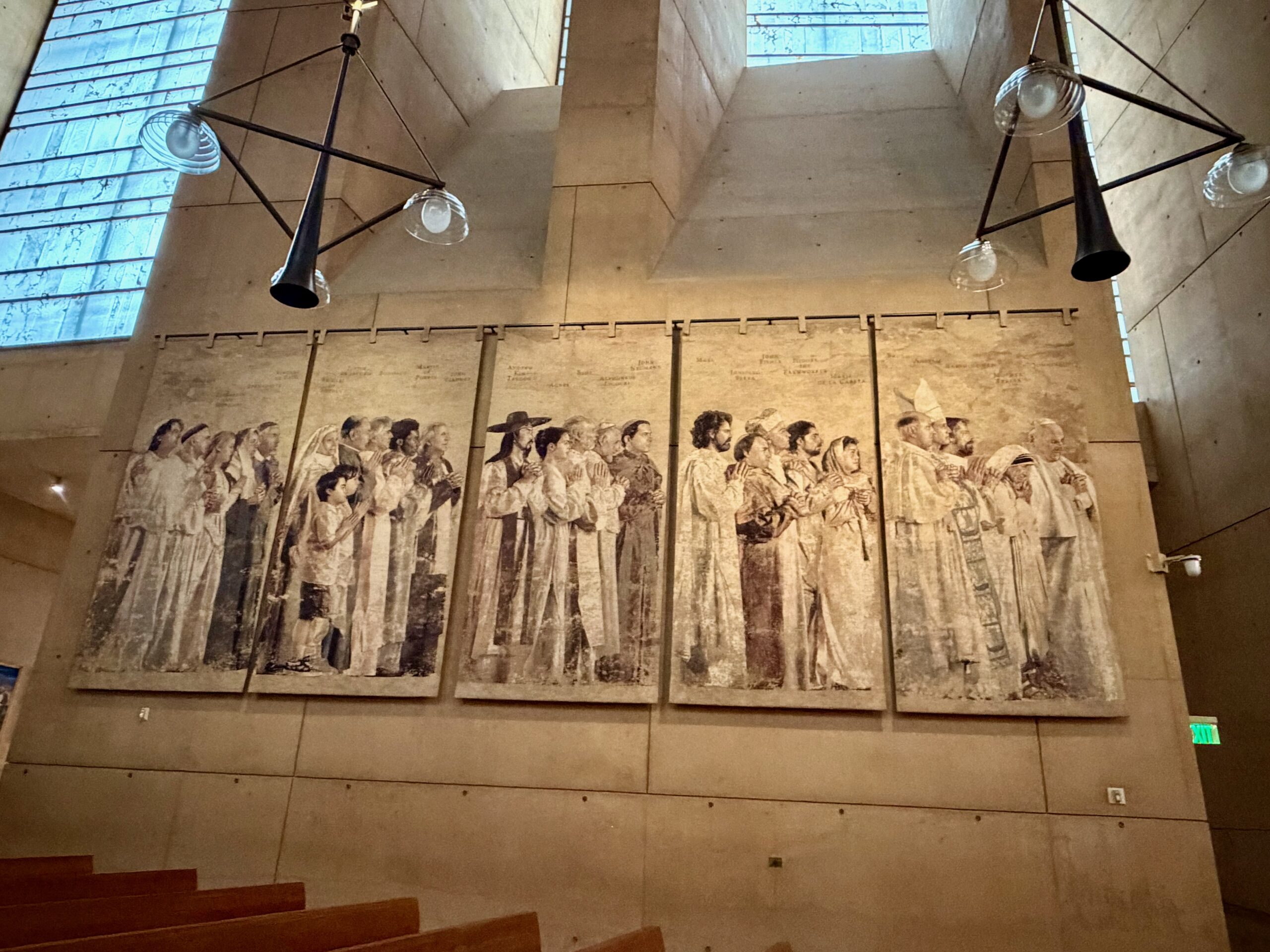
Down both sides of the nave hang the Communion of Saints, twenty-five tapestries by John Nava with 135 saints and blessed figures from around the world, all facing the altar. Alongside them stand twelve unnamed figures, including children of all ages, for the holy people nobody ever canonised.
I loved these as they give a real multi-cultural vibe which is true for Los Angeles, as well as the Catholic church in general. Nava used real people as models, because he wanted everyone to be able to think “a saint could look like me”. All kinds of people, standing in a queue together. Pope John XXIII and Mother Teresa are in there, and on this panel a boy in shorts stands in the line with the rest.
The files were emailed from Nava’s studio in Ojai, California, to a mill near Bruges in Belgium: twenty months of designing and two months of weaving.
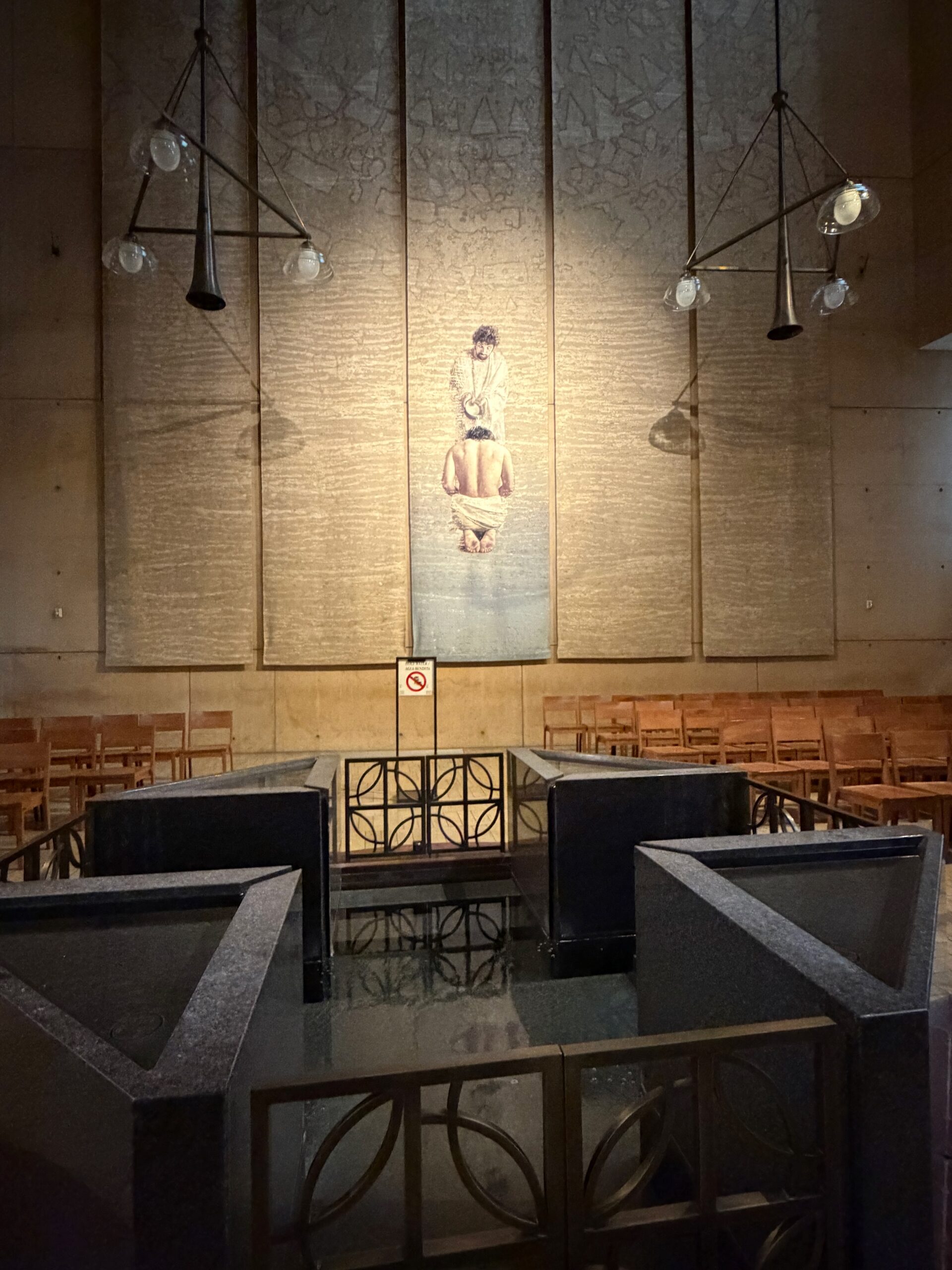
The ambulatory delivers you to the baptistry at the back of the nave. The font is cruciform, with three steps down into the immersion pool for the three days in the tomb, an octagonal surround for the eighth day, and fish worked into the iron gates. Water moves through it the whole time.
Behind it, five tapestries, each nearly fifty feet high, with the baptism of Jesus in the Jordan at the centre.
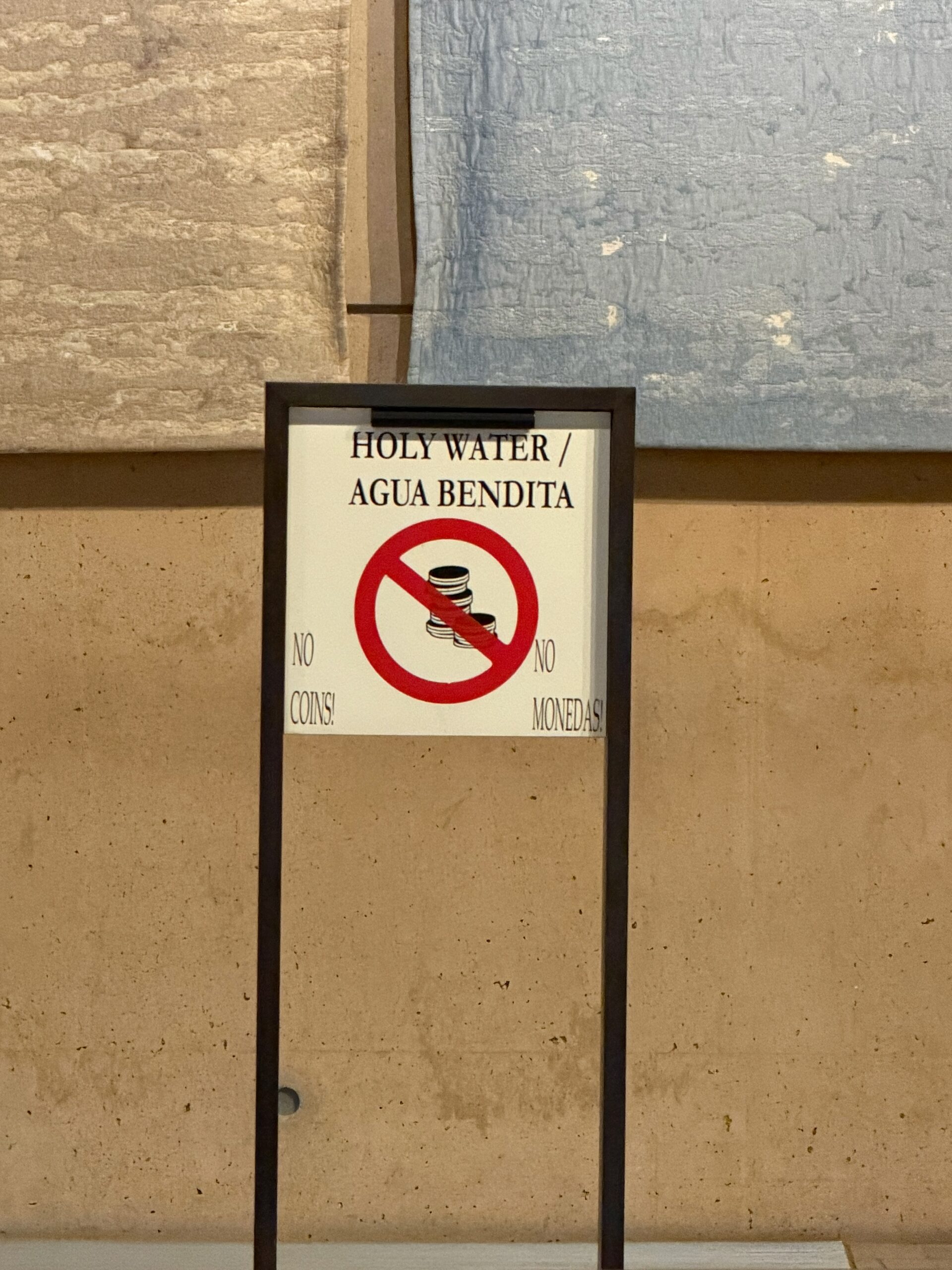
I loved this sign: “Holy water. No coins!” Clearly people have been throwing coins in for good luck!
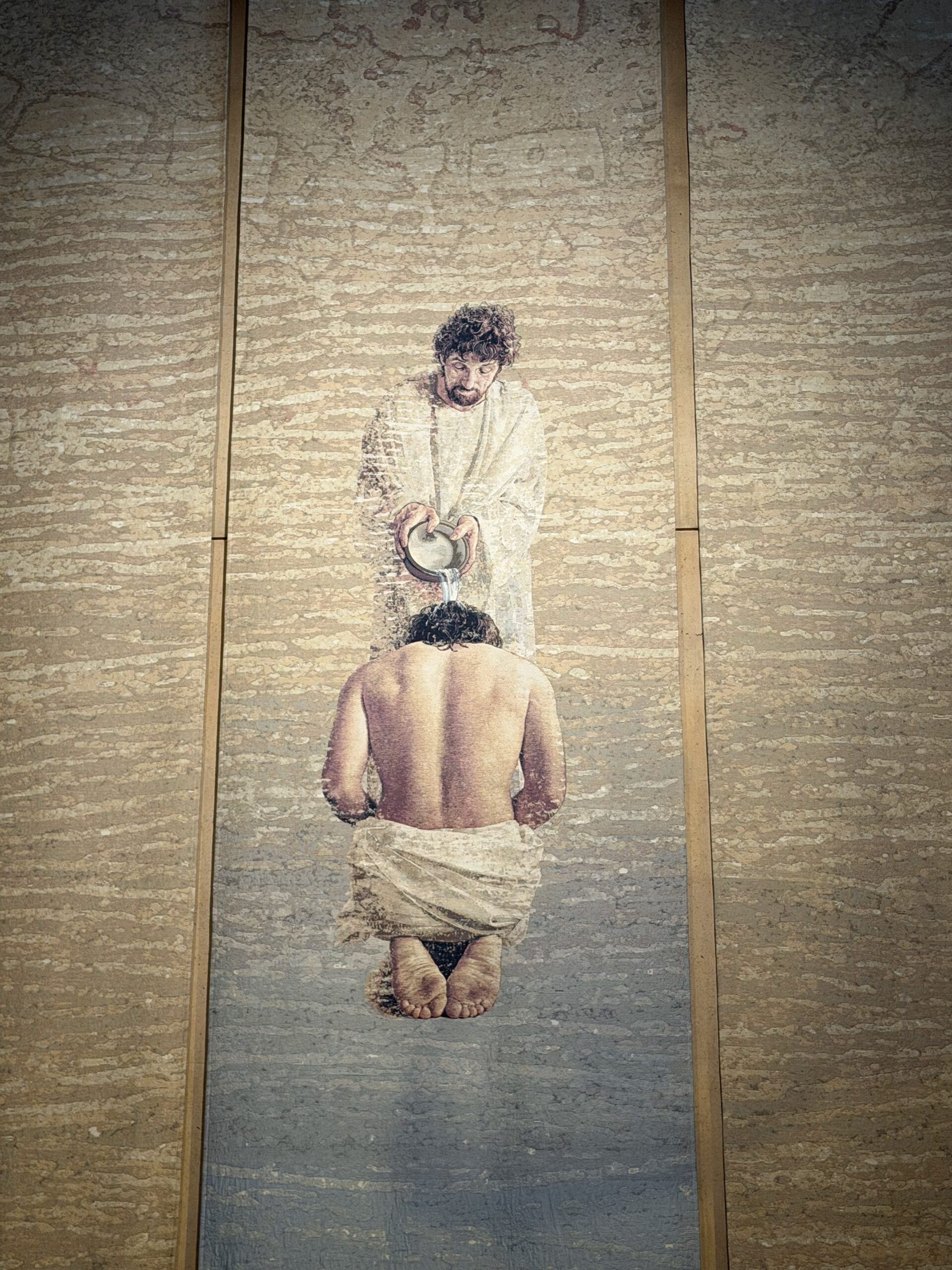
Here’s the central panel up close. The water patterns come from Byzantine mosaics at Ravenna, and the circle above is based on eleventh-century Cosmati floors in St Mark’s, Venice. I loved its simplicity.
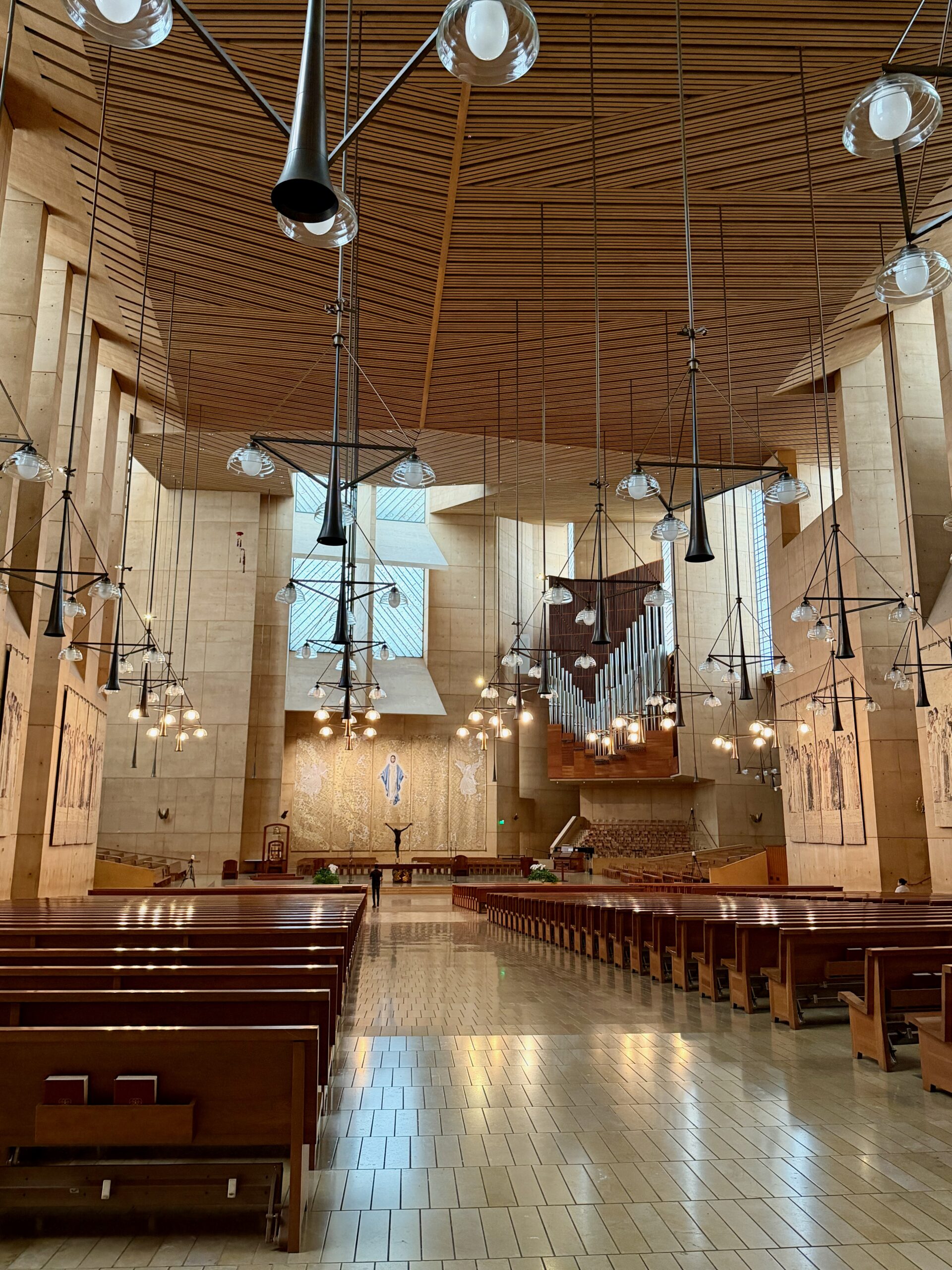
I stood at the back looking towards the altar. There are no pillars here at all, whereas in an older cathedral, they are often a feature. Nine steel trusses and the chapel walls carry the cedar ceiling, so nothing blocks the view, and the whole space tilts and angles away from you.
The cathedral faces east, towards Jerusalem and the rising sun, so the morning light comes in through the alabaster walls. There is room for three thousand people here, and the nave was almost empty.
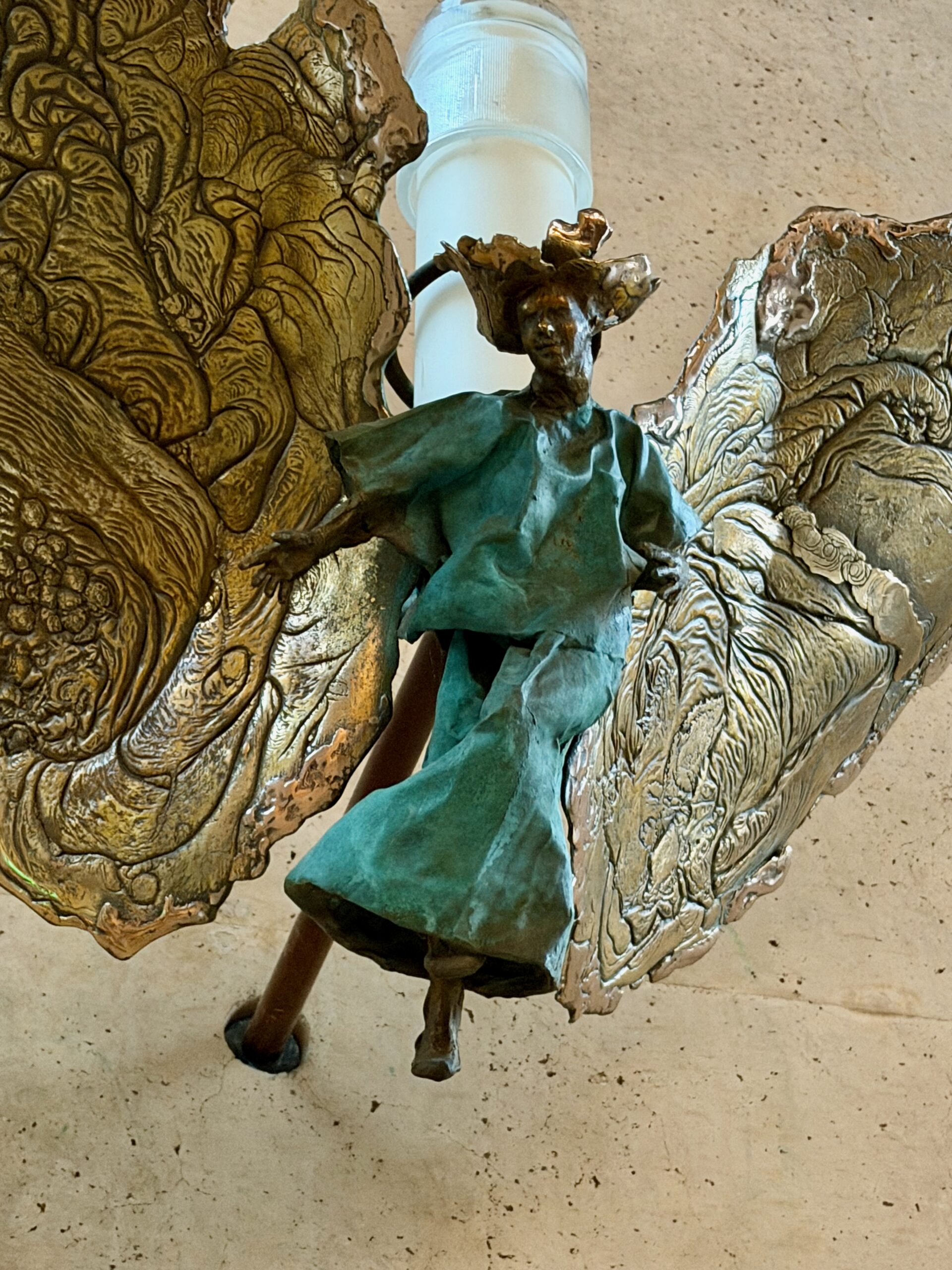
My favourite things in the whole building were the little angels. Twelve of them hold the dedication candles along the walls of the nave, bronze and silver, and they look like nature fairies with wild hair, bare feet pointing down as if in flight, green robes, and arms reaching out. They are wonderful, and very folklore-y rather than Christian.
The sculptor is Max DeMoss, who sat down with twelve people from his own life, family, friends and neighbours, and talked to each of them about angels for an hour, watching how they moved as they spoke. Each angel carries the gestures and personality of one of those people.
His four grandsons, aged four to eight, were consulted too. The pointed toes, the flowing hair and the outstretched arms are their ideas.
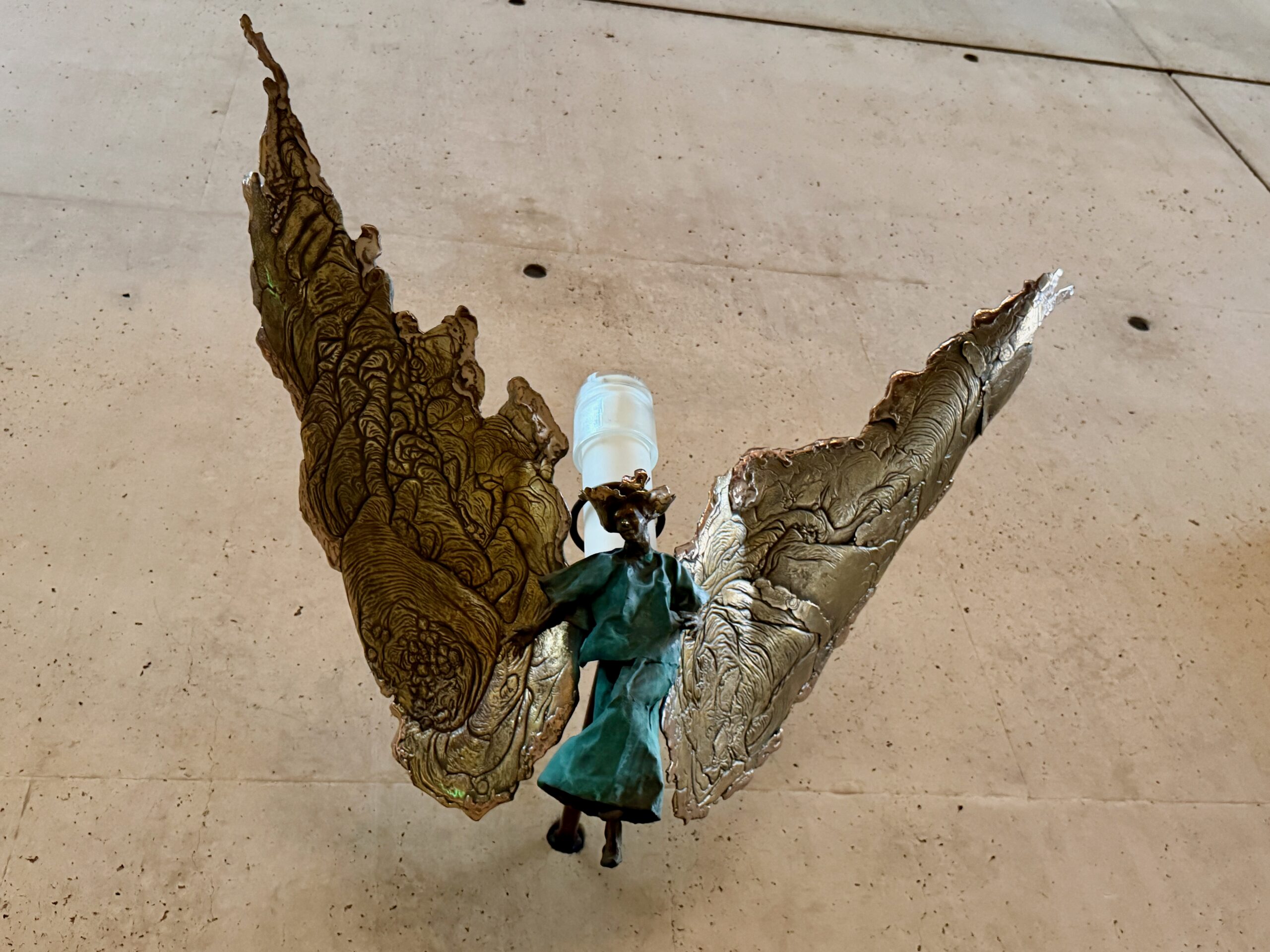
Always look up! From below you see the great ragged wings of beaten metal against the concrete. DeMoss doesn’t think angels would need wings to fly. He gave them wings to catch the light. You can buy other limited edition angels in the gift shop of the cathedral and I gave it some serious thought as I really loved them!
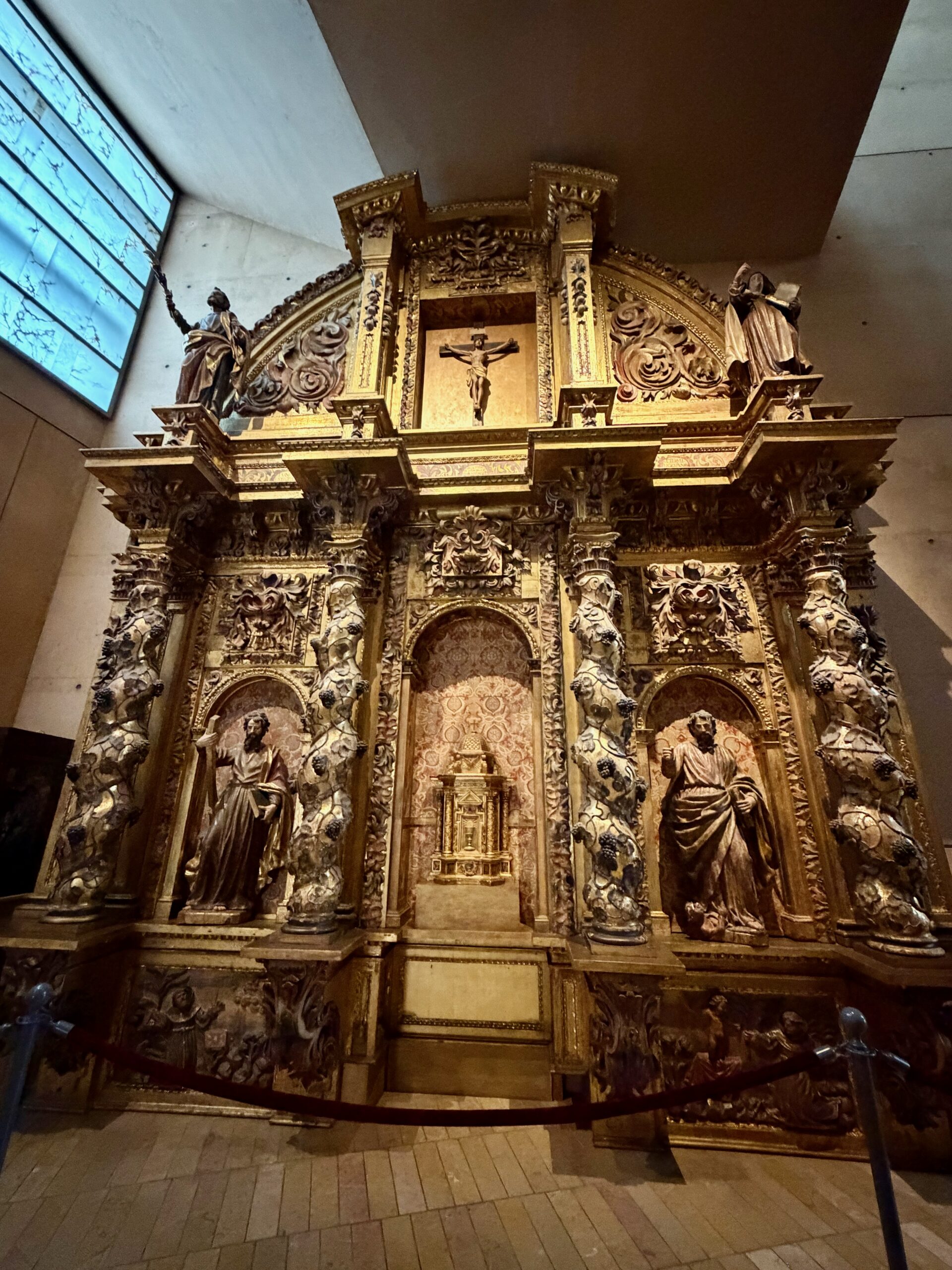
But not everything in the cathedral is new. At the end of the south ambulatory lies this seventeenth-century gilded black-walnut retablo from a chapel in Ezcaray, in northern Spain, where it was installed in 1687.
The village sold it to a New York dealer in 1925 to raise money, a Pasadena collector bought it, and it spent decades at Mission San Fernando and a seminary chapel before coming here.
The four twisted columns were each carved from one walnut trunk, wrapped in clusters of grapes. It stands twenty feet high beneath a window of alabaster.
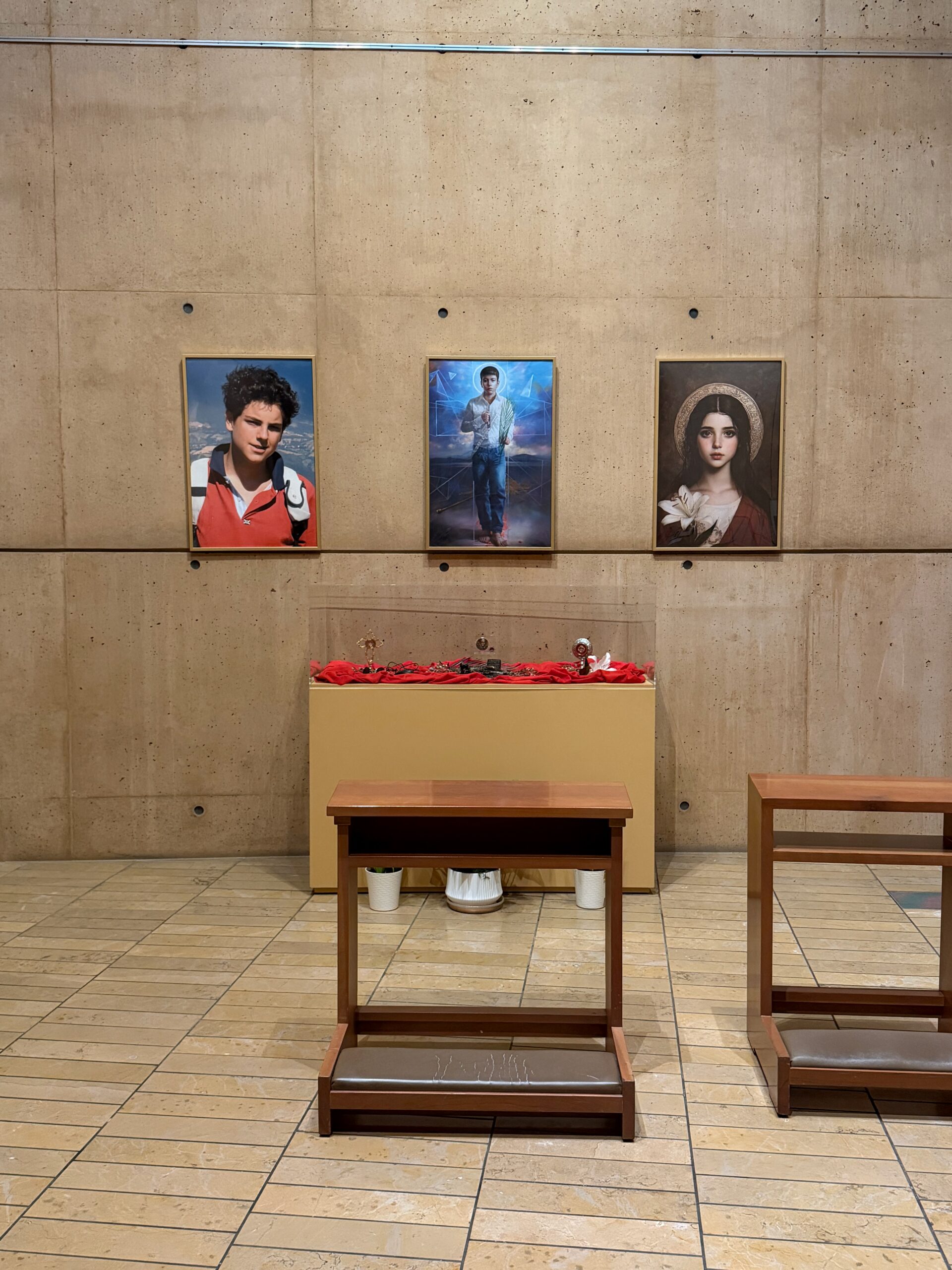
There are lots of chapels around the edge of the nave. This is the Chapel of Young Witnesses, blessed in September 2025, which holds relics of three young people. Carlo Acutis, the Italian teenager in the red polo shirt, died of leukaemia in 2006 aged fifteen. José Sánchez del Río was killed in Mexico in 1928 aged fourteen, and Maria Goretti was murdered in 1902 aged eleven.
Their reliquaries sit on red cloth in a glass case beneath the portraits, with two kneelers in front.
The sign at the door calls it “a chapel dedicated to young hearts seeking truth, beauty, and the joy of walking with Jesus”.
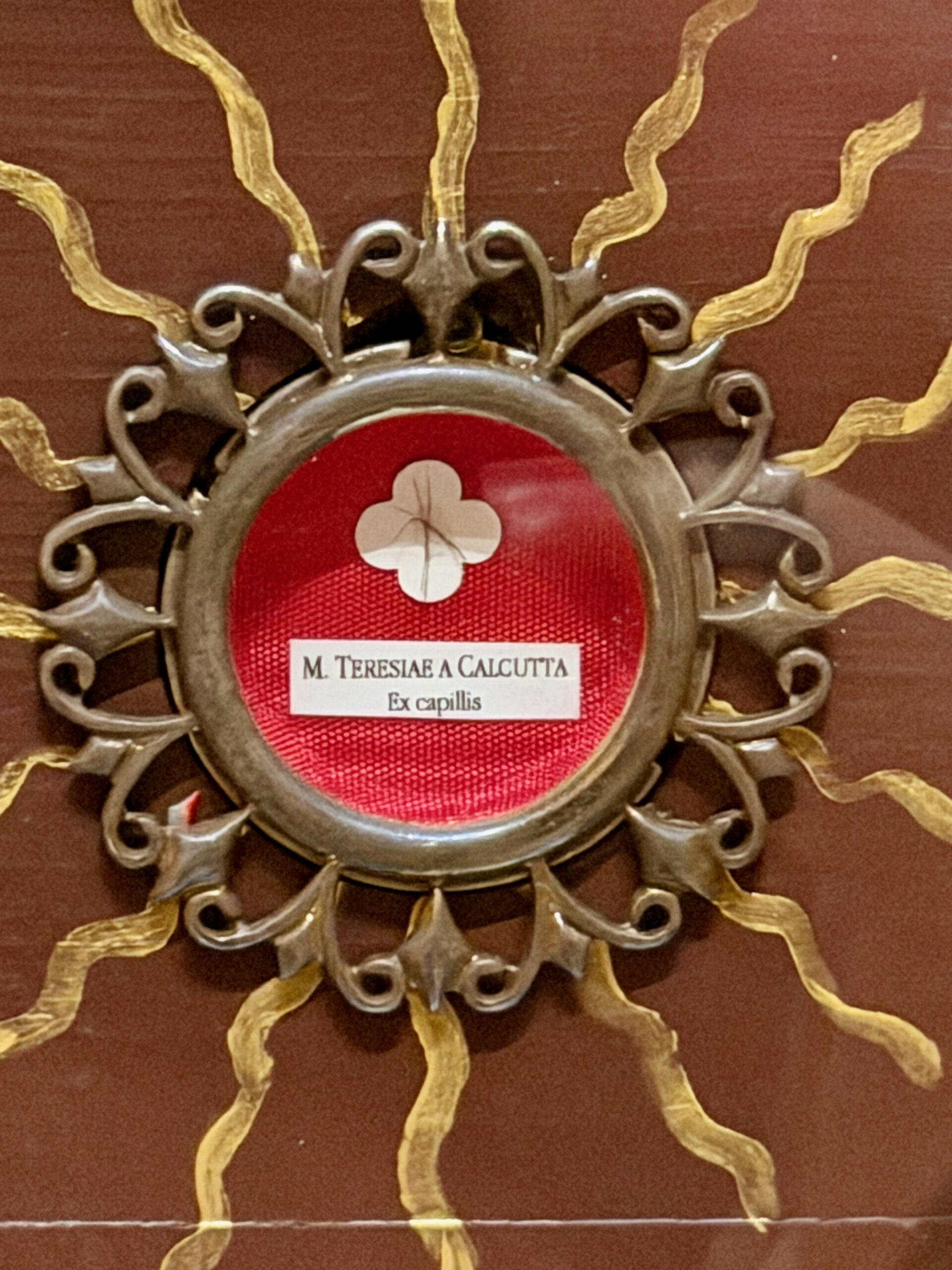
Another relic close by, a few strands of Mother Teresa’s hair, labelled in Latin, “ex capillis”, on a panel of gold rays. She died in 1997.
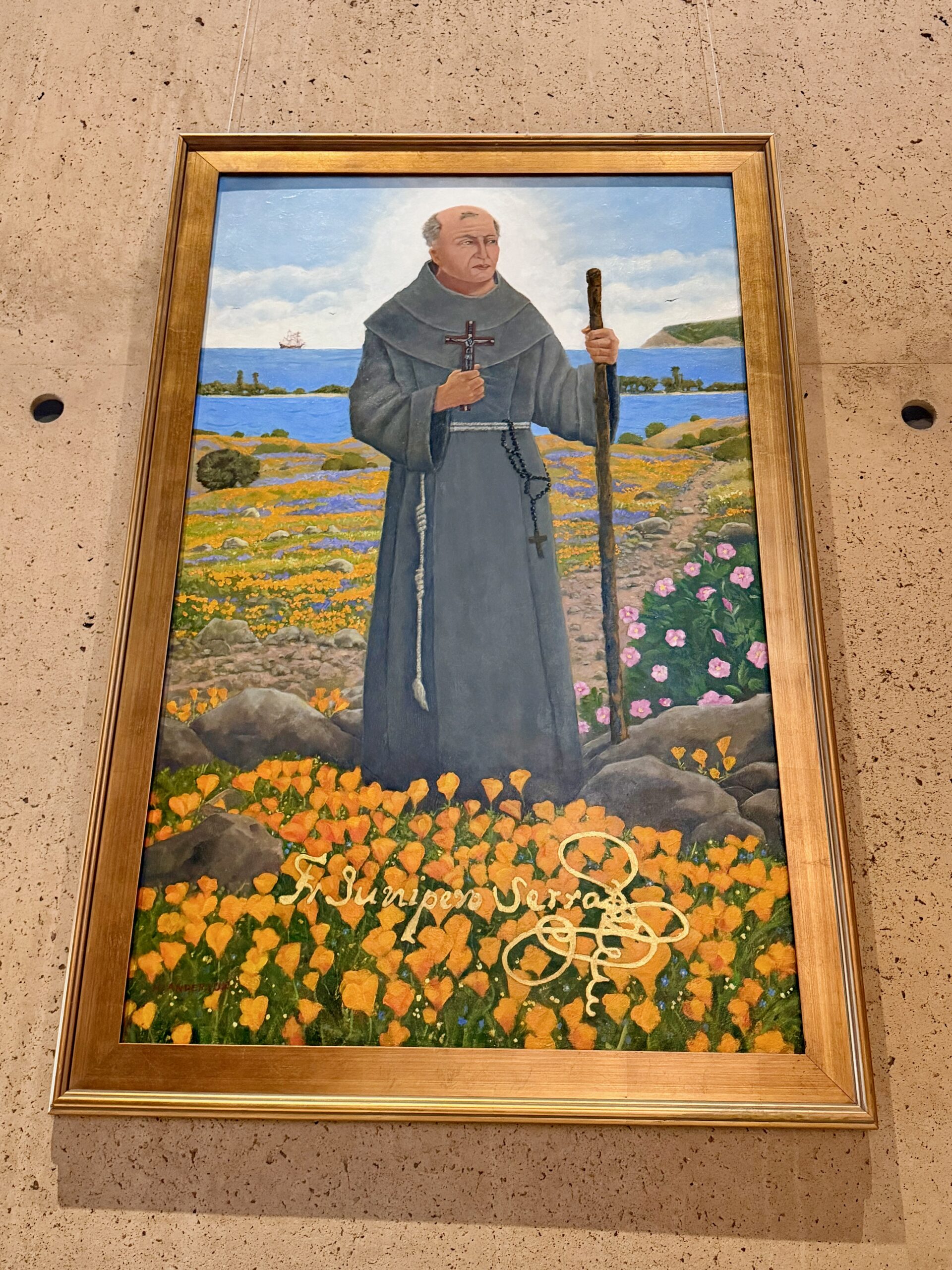
There were also several artworks featuring Junípero Serra, the Franciscan who founded the first nine of California’s Spanish missions, painted by Lalo Garcia among orange poppies with a halo of 24-carat gold leaf. It was hung in September 2015, days before Pope Francis made Serra a saint.
However, he is a contested saint. The mission system took a heavy toll on the Indigenous people of California, and a statue of Serra in downtown Los Angeles was pulled down by protesters in June 2020.
Serra found his way into my ARKANE thriller Valley of Dry Bones after I saw his relic beside the altar at Mission Dolores in San Francisco, one of the chain of missions he founded up the coast. In the book, Morgan Sierra follows that relic on the hunt for the Hand of Ezekiel, and she stands in the same chapel weighing the same history.
There’s other artwork in the cathedral too.
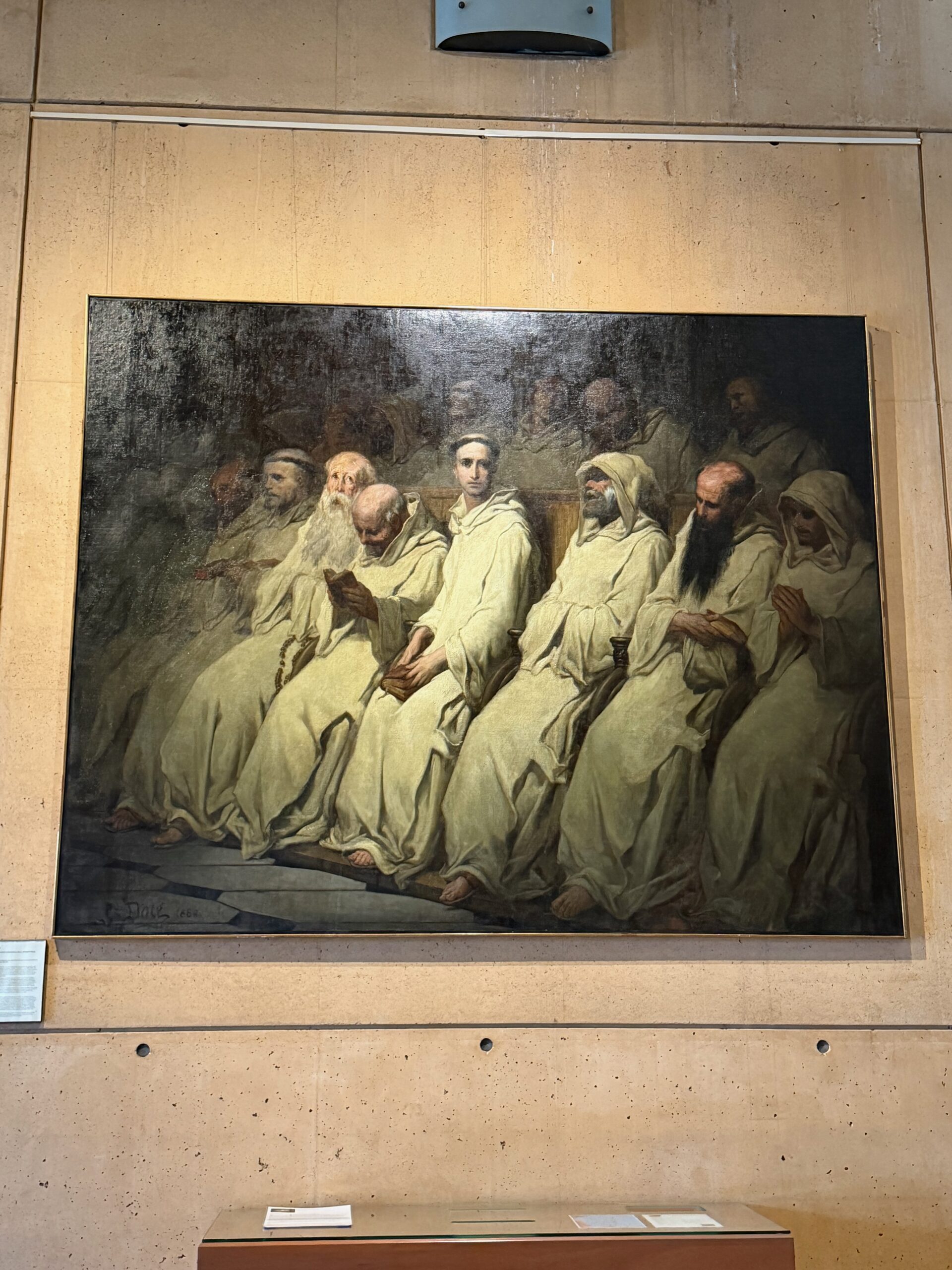
The Neophyte by Gustave Doré, signed on the canvas at lower left, lies at the back of the cathedral. A young novice sits in a row of old monks, the only one looking out at us, and he does not look happy about his vows. Doré took the subject from George Sand’s novel Spiridion and painted it more than once, and it made me wonder why the cathedral chose to feature this painting as it seems to be questioning a life of faith.
Doré is better known for his book illustrations than his paintings. His drawings for the Bible, Dante’s Divine Comedy and Don Quixote were cut into wood blocks by engravers and printed everywhere in the nineteenth century, and late in life he sculpted too, including the Alexandre Dumas monument in Paris. This, though, is oil on canvas.
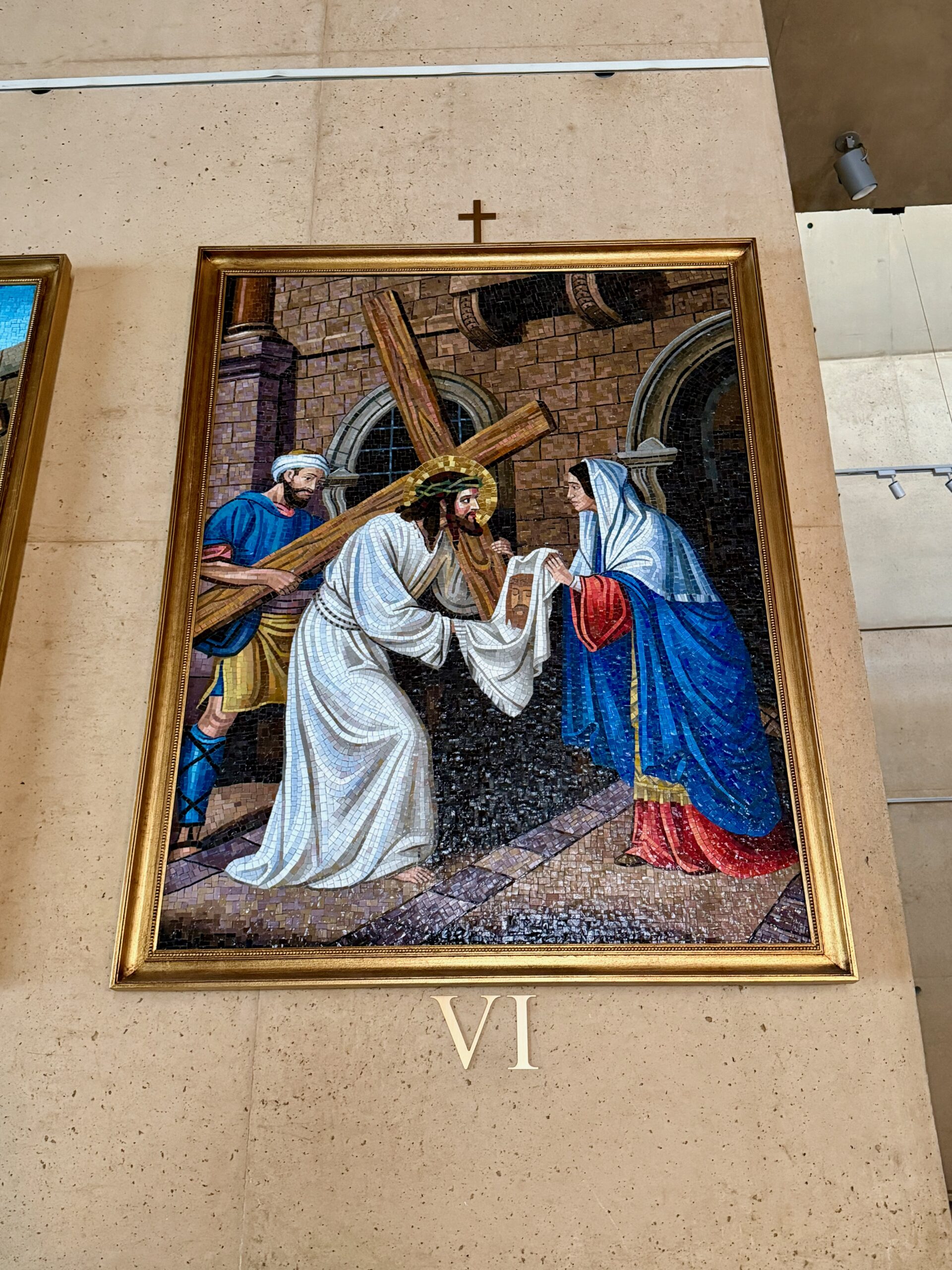
The Stations of the Cross along the ambulatory are glass mosaics in gold frames, bright against the bare concrete. This is the sixth, Veronica wiping the face of Jesus.
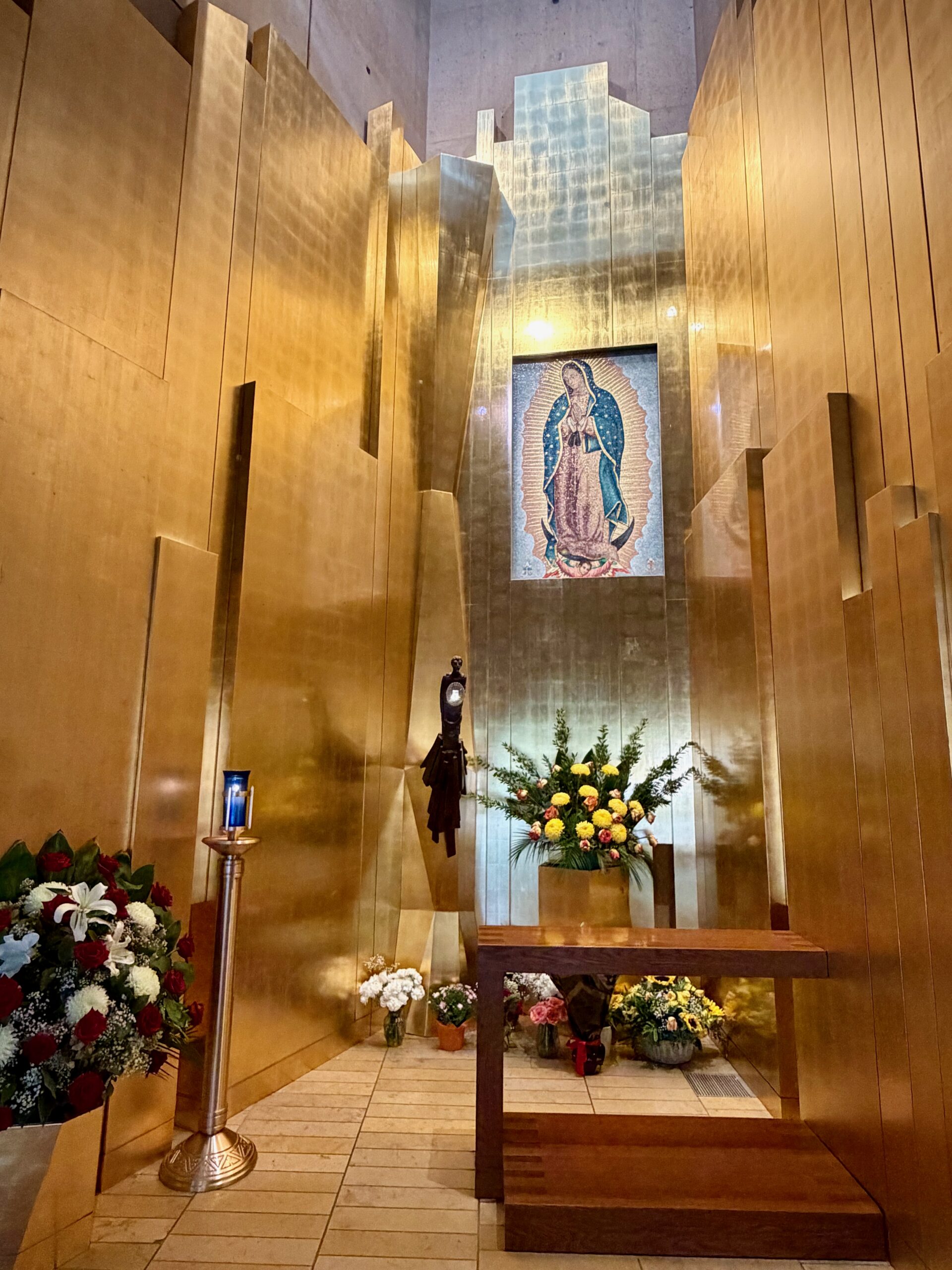
The chapels open off the ambulatory rather than the nave, which keeps them quiet. This one, walled in gold, was consecrated in 2012 for the cathedral’s tenth anniversary.
It holds the only known fragment in the United States of the tilma, the agave-fibre cloak of Juan Diego on which the image of Our Lady of Guadalupe is said to have appeared in 1531.
The piece is a centimetre square. It was sent to the Archbishop of Los Angeles in 1941 as a thank-you after a pilgrimage to Mexico City, then sat in the archdiocesan archive for decades.
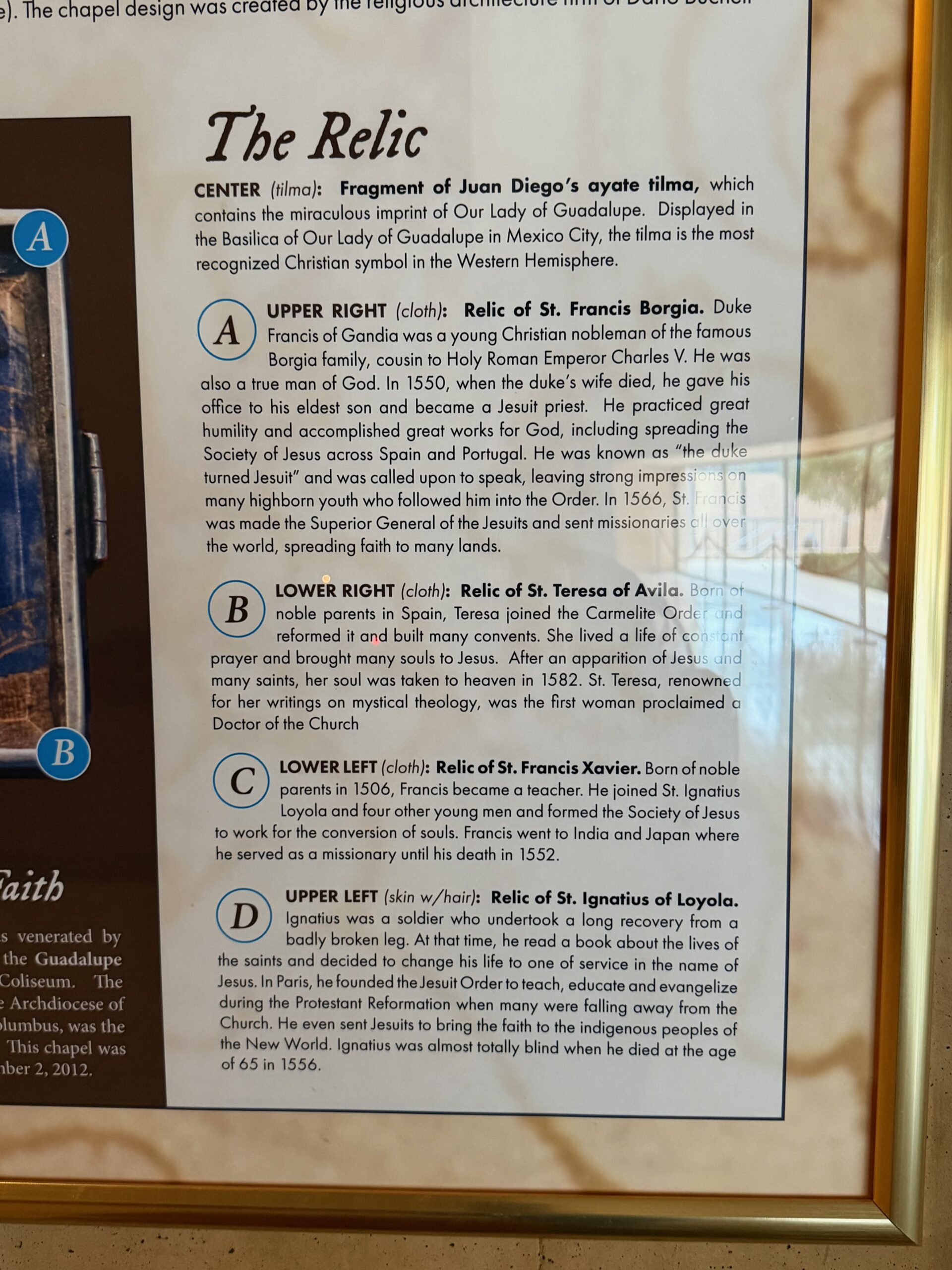
The panel by the door lists what else the eighteenth-century gold-plated silver reliquary holds around the tilma: cloth relics of St Francis Borgia, St Teresa of Avila and St Francis Xavier, and skin with hair of St Ignatius of Loyola. So Mother Teresa is not the only Teresa in the building.
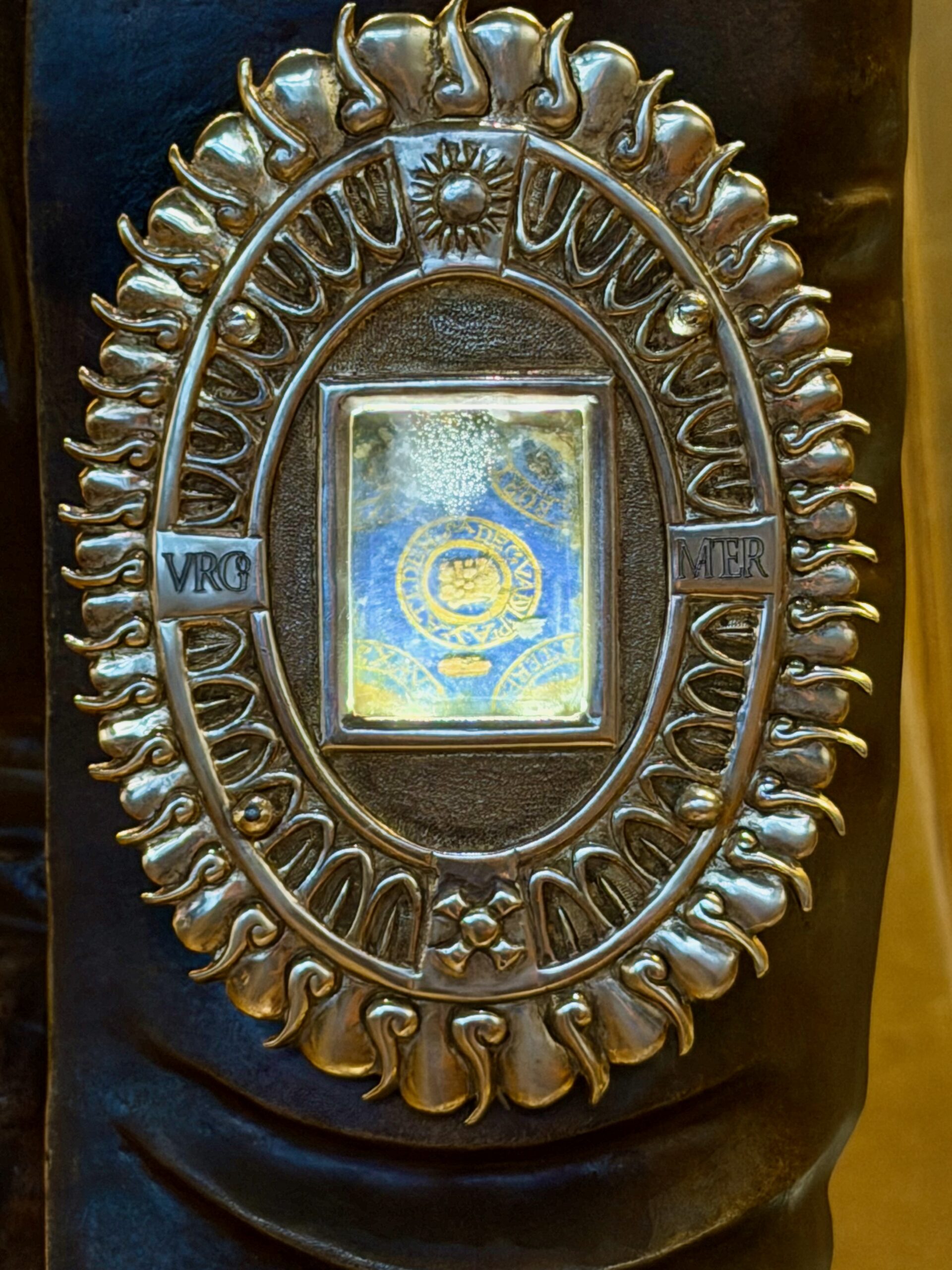
The reliquary, with the fragment of cloth under glass at its centre.
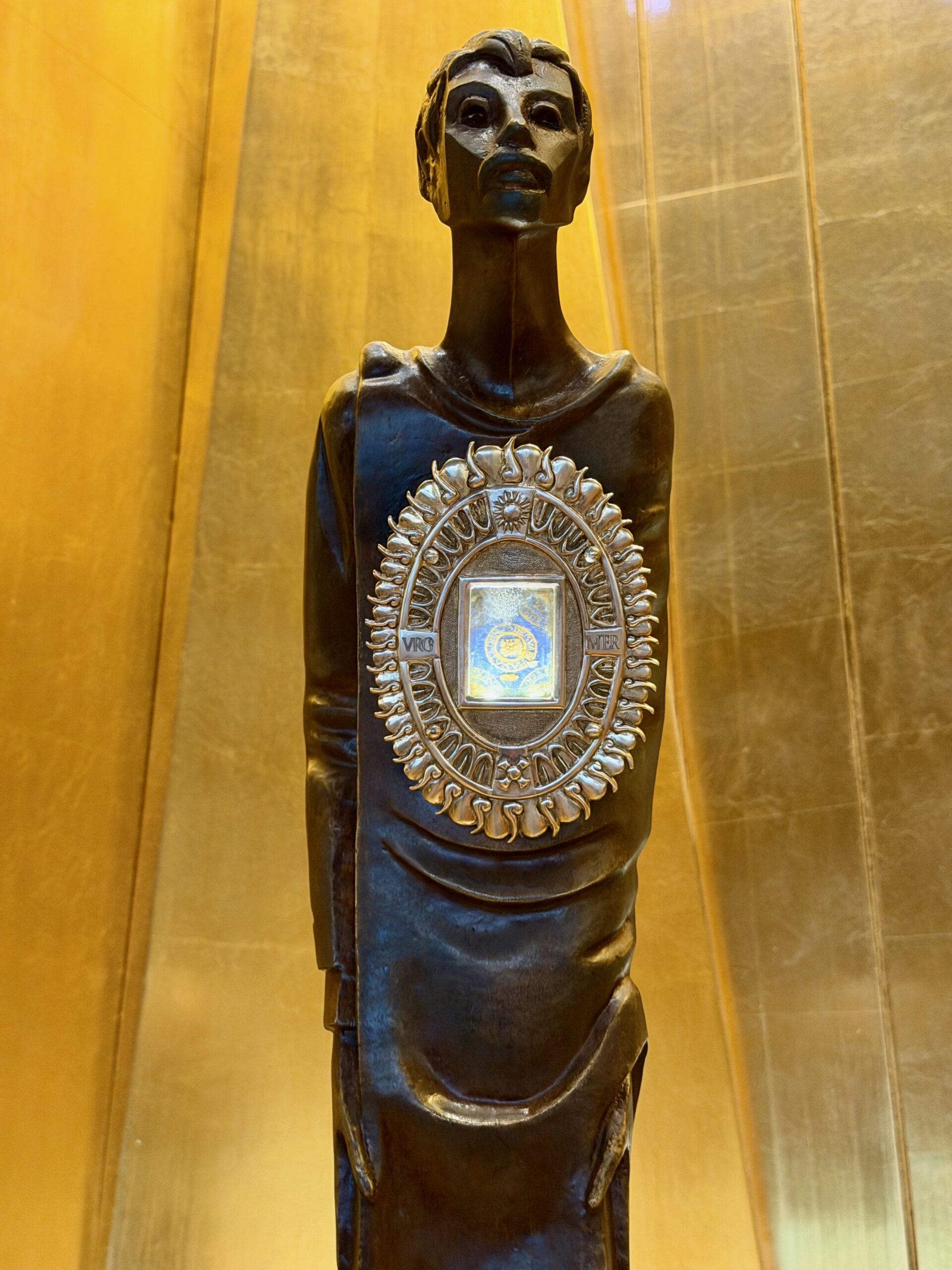
It sits in the chest of a bronze St Juan Diego, so you venerate the relic through the man who carried the cloak.
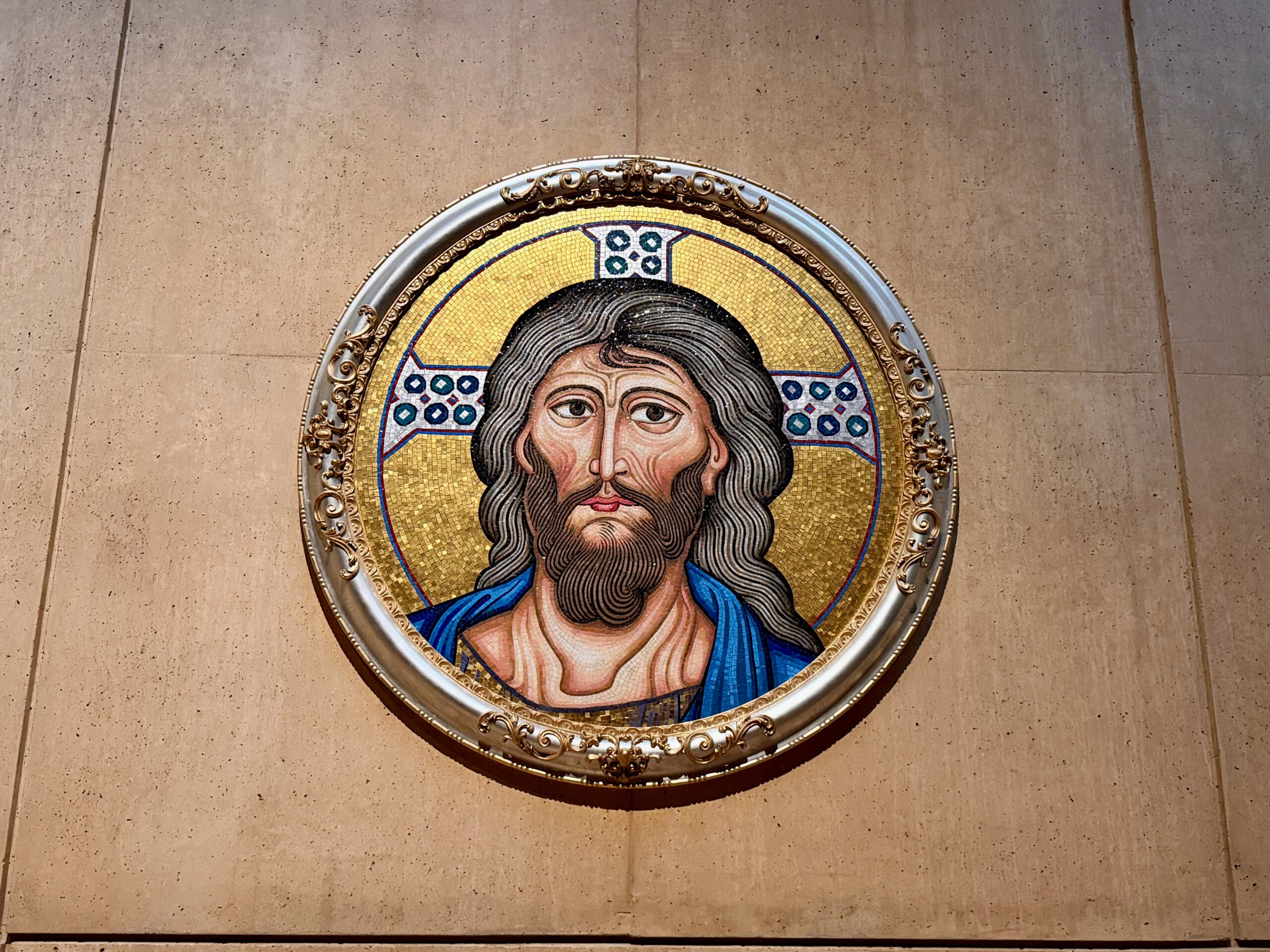
I love finding smaller things amid the grand. This mosaic roundel of Christ, Byzantine in style on a gold ground, hangs alone on a wall of plain concrete panels.
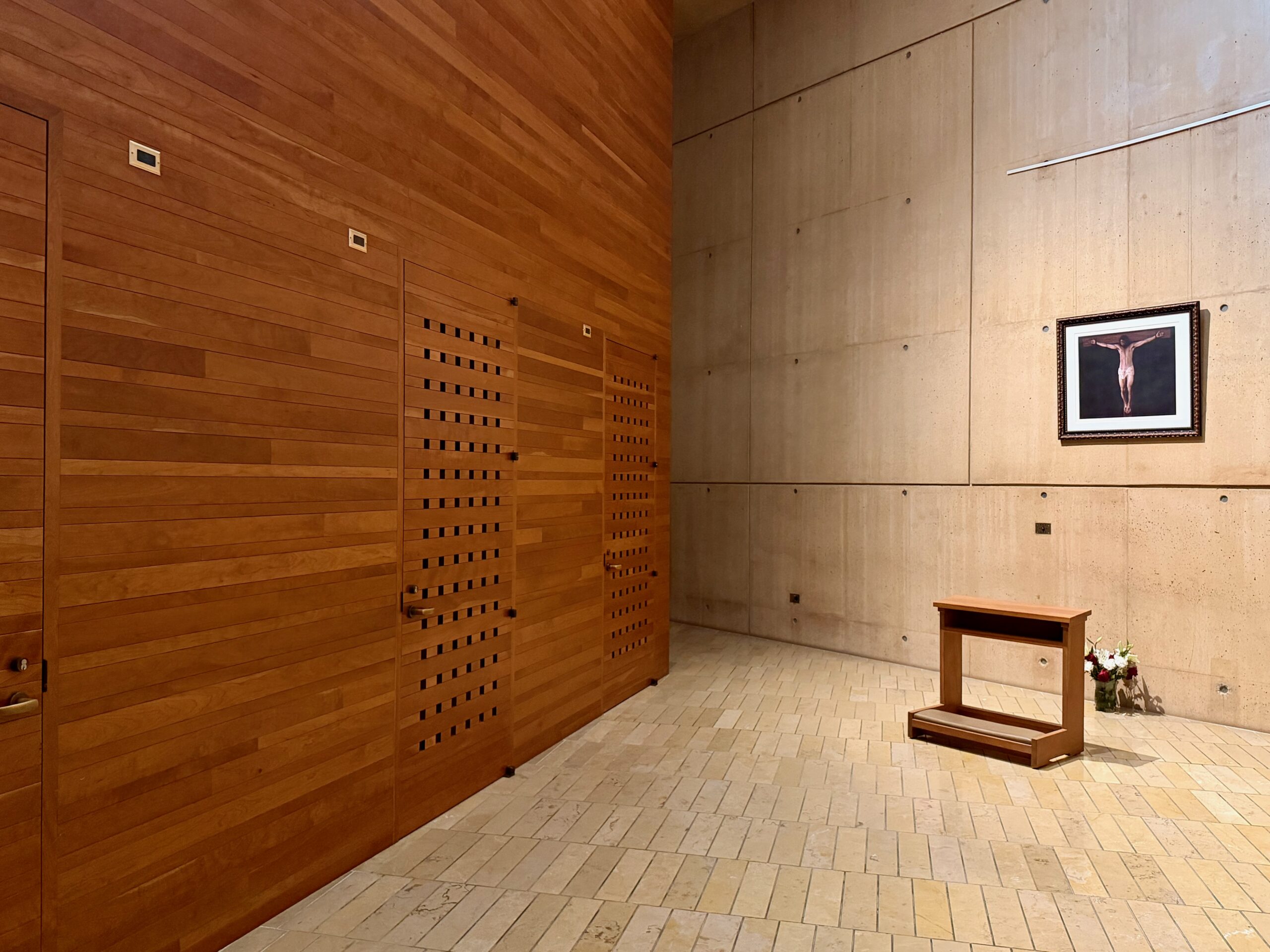
The Reconciliation Chapel looks so modern. Instead of confessionals along the sides of the nave, there is a separate chapel with private confession rooms behind slatted cherry-wood doors, where you can choose a screen or face to face. One wall is wood, the other is bare concrete with a single kneeler and a small framed crucifixion.
The slatted wood and doors reminded me of an upmarket spa, a strange resonance for a confessional!
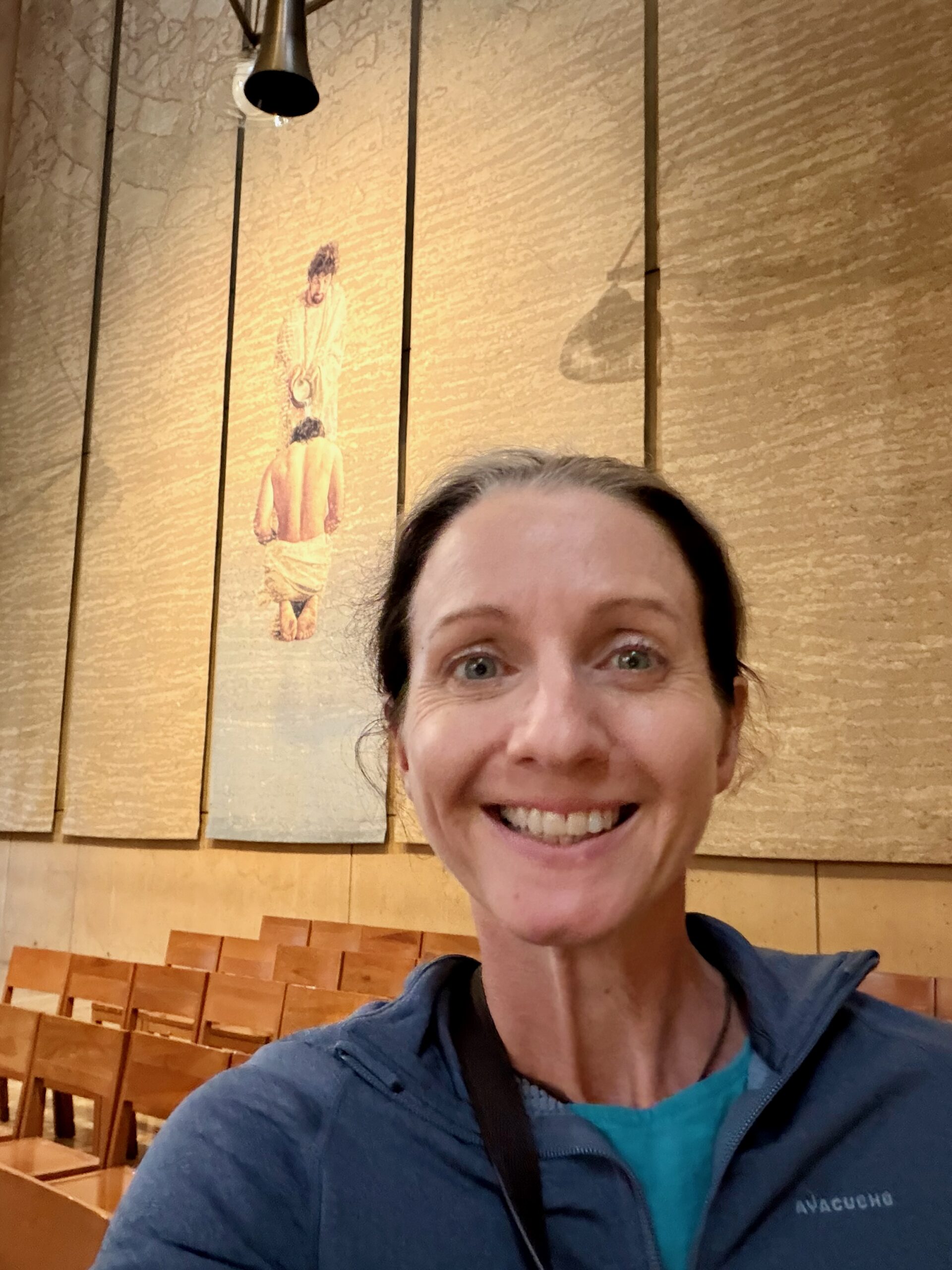
Here I am by the baptism tapestry, enjoying the quiet, before I headed downstairs to the crypt.
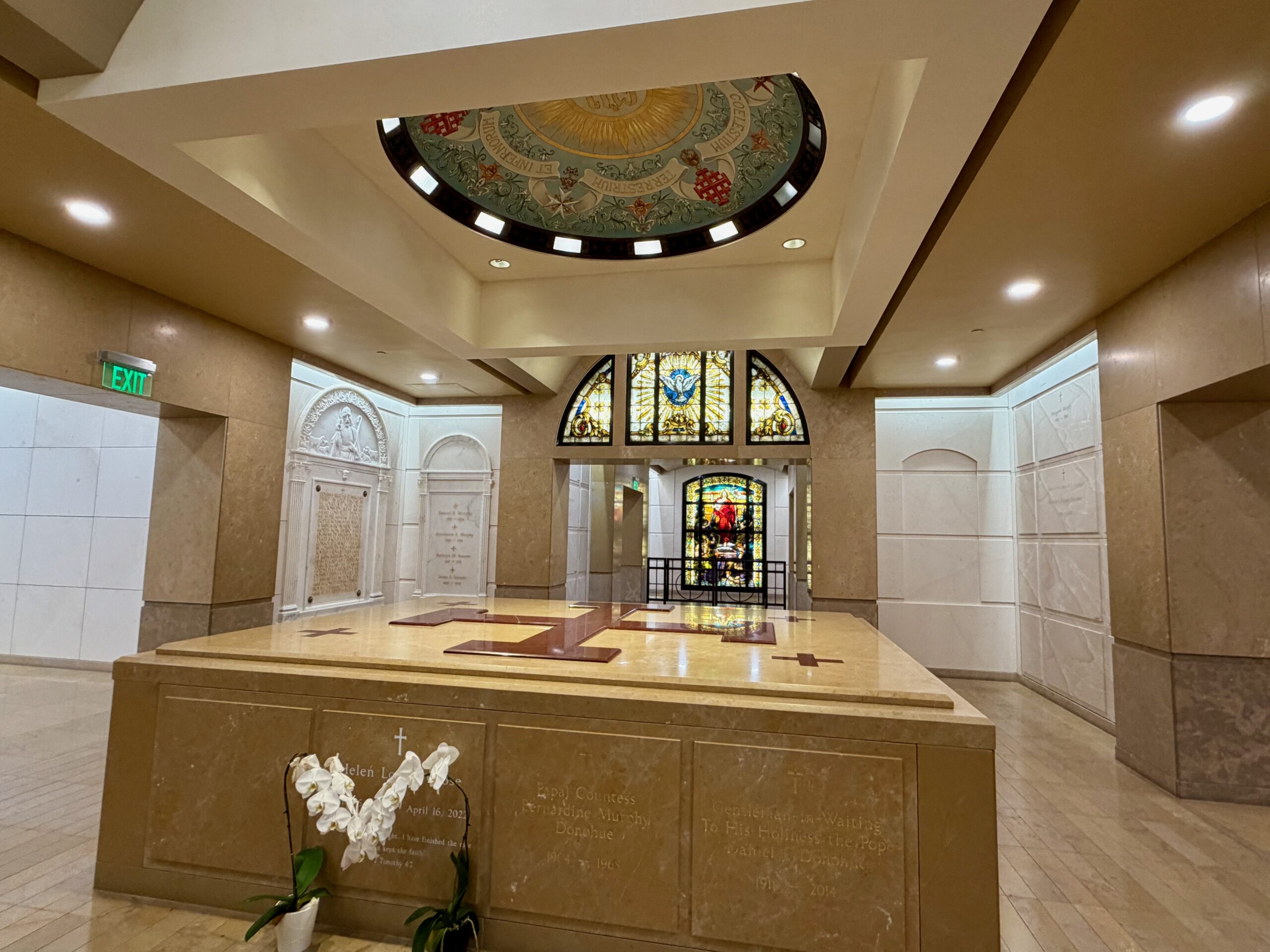
Stairs at the back of the cathedral lead down to the crypt mausoleum, and this was the strangest part of the visit. It is a whole floor of polished limestone under the church, with 1,275 crypt spaces and nearly 4,800 niches for urns, and most of the slabs I passed were empty or marked reserved.
The cathedral sells them, and the price depends on location, level and row.
It was so quiet down there, hardly anyone around in such a busy part of town. I met a stone carver engraving a tomb but otherwise the corridors were almost empty.
The sixteen stained-glass windows along the walls came from the old St Vibiana’s Cathedral, made in Munich in the 1920s, and because you are underground they are lit from behind. The painted dome at the end was moved here in one piece from a private chapel at Calvary mortuary. Apparently, Gregory Peck is buried somewhere along these corridors.
Across from the mausoleum is the shrine of St Vibiana, and the strange story of how an ancient Roman saint ended up in a basement in Los Angeles.
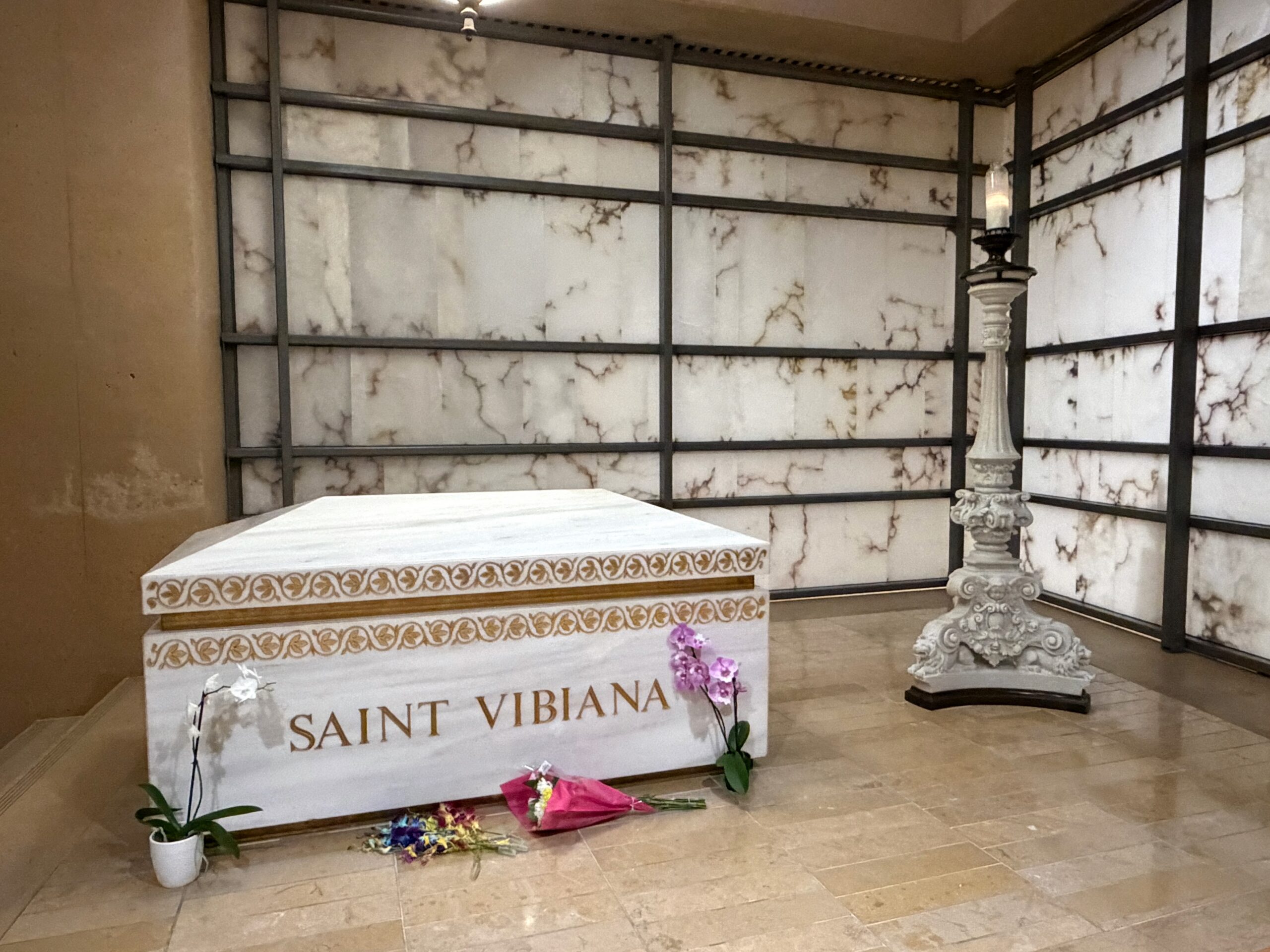
In 1853 her tomb was opened in a catacomb near the Appian Way in Rome. The marble tablet that sealed it was inscribed “To the soul of the innocent and pure Vibiana”, with a laurel wreath, which the cathedral says the early Christians used as a code for martyrdom.
She is venerated as a third-century virgin martyr, though the cathedral admits little is known about her. Pope Pius IX gave her remains to Thaddeus Amat, the new Bishop of Monterey, who brought her to California.
She became the patron of the first cathedral in Los Angeles, St Vibiana’s, dedicated in 1876, where she lay above the altar. When that building was badly damaged by the Northridge earthquake in 1994 and the archdiocese built this one, she came too.
She is the patron saint of the archdiocese, and her marble sarcophagus sits in a small room lined with veined stone, with fresh orchids in front of it.
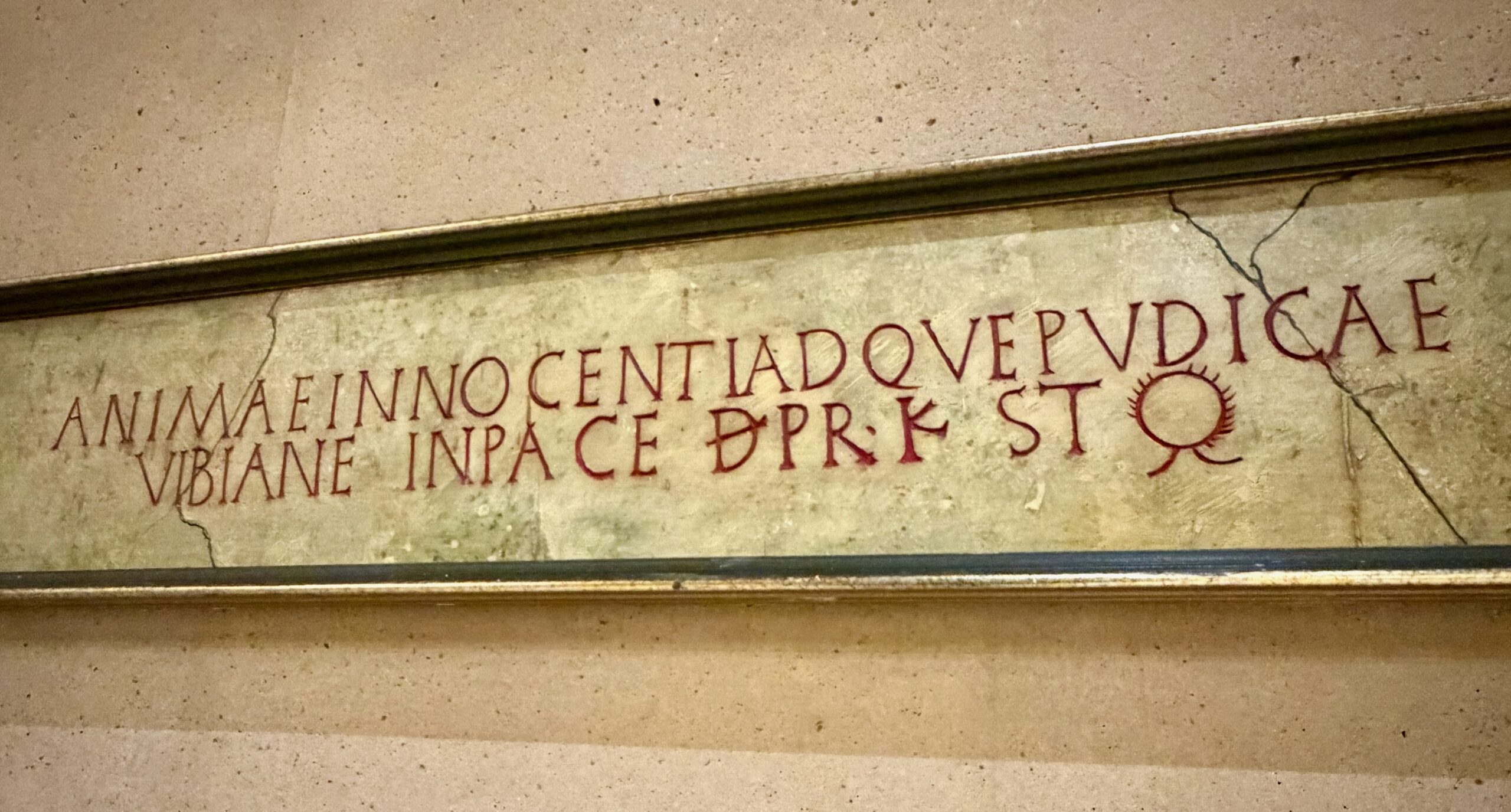
The tablet from her tomb hangs on the wall beside her, with the laurel wreath at the end of the line. A young woman believed to have lived in third-century Rome, in a concrete cathedral above a freeway, next to rows of empty graves waiting for the people of Los Angeles.
It is a fascinating place with all kinds of interesting art and architectural aspects, even if you are not a believer, and it’s a haven of quiet contemplation in the heart of the busy city.
I loved my visit to the Cathedral of Our Lady of the Angels. If you think you only like the ancient places, this and Coventry might just change your mind.

Books about the cathedral, Los Angeles and Junípero Serra
- Sacred Material: The Art of the Tapestries of the Cathedral of Our Lady of the Angels by John Nava. The artist’s own book on the Communion of Saints, the baptistry and altar tapestries: how real Los Angeles people were chosen to stand in for the saints, how the designs became digital weaving files, and how they were woven at the mill near Bruges. If you stood in the nave wondering why these saints look like people you might pass in the street, this is where Nava explains it.
- Rafael Moneo: Remarks on 21 Works by Rafael Moneo. The architect walks through twenty-one of his buildings in his own words, including the Cathedral of Our Lady of the Angels, with Michael Moran’s photographs, plans and construction images. Each project is presented from first idea to finished building, and the cathedral sits alongside his Museum of Roman Art in Mérida, so you can see the ancient and the modern side by side in one architect’s mind.
- Ask the Dust by John Fante. The Los Angeles novel, published in 1939 and set on Bunker Hill, the hill the cathedral now stands on, when it was still a neighbourhood of cheap hotels and dusty rooms. Arturo Bandini, a young Italian-American writer with one published story and no money, falls for Camilla, a Mexican waitress, and the city of the 1930s, with its sunshine, earthquakes and desperate hope, is the real subject. Charles Bukowski wrote the preface to the 1980 reissue that brought it back into print.
- Angels Flight by Michael Connelly. A Harry Bosch thriller named for the little funicular railway on Bunker Hill, a few blocks from the cathedral. A prominent Black lawyer who made his name suing the LAPD is found shot dead in one of the Angels Flight cars, and Bosch is handed a case in which any officer in the LAPD could be the killer. Downtown Los Angeles, its hills, courts and freeways, is on every page.
- Valley of Dry Bones by J.F. Penn. My own ARKANE thriller, the tenth in the series which can be read as a stand-alone, inspired partly by Junípero Serra. ARKANE agents Jake Timber and Morgan Sierra hunt the Hand of Ezekiel, a relic tied to the prophet’s vision of dry bones rising, from the voodoo cemeteries of New Orleans to a relic room in Madrid, the Basilica of San Francesc in Palma where Serra preached before he sailed for the New World, a drowned town in the Philippines, and Mission Dolores, the Columbarium and Alcatraz in San Francisco. The Author’s Note at the back explains which parts are real, and it is far more than you might think.



Leave a Reply